

Evan Armstrong was a lead writer at Every who explored profit and power in technology in Napkin Math.

How Startups Can Survive the Creator Economy Winter
The Race for Revenue Share
May 19, 2022 · 14 min readUpdated Aug 4, 2026

Sponsored By: Flatfile
Today's newsletter is brought to you by Flatfile, the customer data onboarding platform.
Clients can’t use your application without being able to populate their data, causing the CSV import problem to present itself at the most inopportune time—during onboarding.
Slash time-to-value, onboard customers faster, and cut product churn with a 1-click data import experience from Flatfile:
- Cut hours off data cleaning and focus on growing your company.
- Import customer data in less than 60 seconds.
- Migrate data using stringent compliance standards
Since launching in 2018, Flatfile has onboarded data for over 1.5 million customers spanning 400+ of the best companies around the world. In just a few clicks, Flatfile intelligently imports, transforms, and validates your customers’ data, solving the most critical part of onboarding, in seconds.
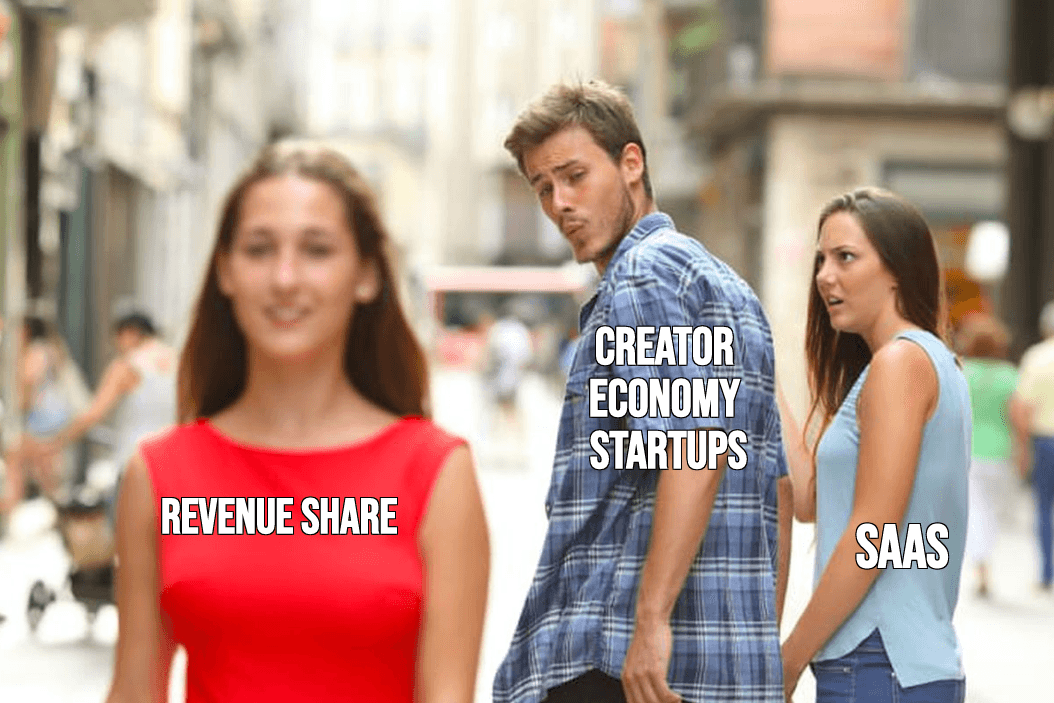
TL;DR Because 99% of creator revenue accumulates at the top .01% of creators, creator economy startups have to find a way to justify taking a % of revenue. This is not an easy task and only a select few will succeed in the coming bear market.
From 2020-2022, it was relatively easy to raise a seed round for your startup. All you had to do was cryptically tweet out the password, “I’m building something new in the creator economy,” and $5M would magically appear in your bank account. Even the A round would generally be that easy with crossover funds vomiting capital everywhere.
That was then, this is now. Interest rates are up! Digital monkeys now only sell for 100K instead of the millions they are worth! Founders are looking at 20x revenue multiples and shaking, crying, throwing up. Venture capitalists are learning what the phrase “cash flow” means. It’s terrible out there! I’m being more than a smidge facetious, but in all seriousness: private market capital is going to be in short supply for sometime.
My friends, a creator economy winter is coming. The result will be a thinning of the creator economy herd. In the short run, many of the buzzier startups will fold. In the long-term, the gritty teams will pull through this period with superlative companies serving this emerging class of digital entrepreneurs. The difference between the two will come down to how well these startups are able to answer one question: what are you doing to earn revenue share?
In researching this piece, I’ve talked with dozens of management teams, over a hundred creators, and the most prominent investors in the creator space. Thanks to all those who were so generous with their time..
Now, to business: to understand why revenue share is so important, we must go in depth of what creators are like as customers.
Small customers, smaller wallets
The good news for the creator economy is that there is a strong positive tailwind. More and more individuals are pursuing a life of creativity online. A report from Linktree pegs the total number of creators at ~200M. Another report by Kajabi puts it at 50M+. (Much of the difference is determined by how you determine the split between social media user and “creator”). Regardless, this is a huge number! And on an emotional level, there is something deeply satisfying about helping individuals build their own businesses and pursue their passions.
Thanks to our Sponsor: Flatfile
Thanks again to our sponsor Flatfile for today's newsletter. Click below to view the data onboarding platform that the world’s best companies use to onboard their customers.
 Create a free account to continue reading
The Only Subscription
You Need to
Stay at the
Edge of AI
The essential toolkit for those shaping the future

"This might be the best value you
can get from an AI subscription."
- Jay S.
 Every Content
 AI&I Podcast
 Monologue
 Every Agent
Join 100,000+ leaders, builders, and innovators

Already have an account? Sign in.
What is included in a subscription?
Daily insights from AI pioneers + early access to powerful AI tools



 Front-row access to the future of AI
 In-depth reviews of new models on release dayPlaybooks and guides for putting AI to workPrompts and use cases for buildersIn-depth reviews of new models on release dayPlaybooks and guides for putting AI to workPrompts and use cases for builders
 Bundle of AI software






 Katie Parrott
 Every Staff
 Kieran Klaassen
Comments