


Evan Armstrong was a lead writer at Every who explored profit and power in technology in Napkin Math.

The One-person Billion-dollar Company
Can AI agents make you a billionaire?
Feb 8, 2024 · 11 min readUpdated Aug 15, 2026

Sponsored By: Deel
You found global talent. Deel’s here to help you onboard them.
Deel has simplified a whole planet’s worth of information. It’s time you got your hands on our international compliance handbook, where you’ll learn about:
- Attracting global talent
- Labor laws to consider when hiring
- Processing international payroll on time
- Staying compliant with employment & tax laws abroad
With 150+ countries right at your fingertips, growing your team with Deel is easier than ever.
In a recent interview, OpenAI cofounder Sam Altman said:
“We’re going to see 10-person companies with billion-dollar valuations pretty soon…in my little group chat with my tech CEO friends there’s this betting pool for the first year there is a one-person billion-dollar company, which would’ve been unimaginable without AI. And now [it] will happen.”
Altman’s idea is that AI tools will soon reach the point where they can replicate the entire output of human employees. Instead of needing to hire a designer, you can use GPT-6 to design for you. There will be far less need for software engineers (meh), sales staff (no one will miss them), and newsletter writers (a tragedy of Greek proportions, leaving our society barren and empty).
An ambitious founder could outsource the work they would use employees for to an army of artificial intelligence agents. Theoretically, this would allow entrepreneurs to focus on only tackling their most important competitive advantage.
This is a claim worth examining, not just because I would like to be the first person to build that billion-dollar company. The one-person billion-dollar company matters because it is a handy way to understand how AI will disrupt knowledge work. In a good world, Altman’s prediction would come true because AI would allow people to build something whatever they can dream up. In a bad world, it would become true because AI will make most people’s jobs irrelevant, concentrating power in the hands of the elites.
Writing is perhaps the most obvious use case of AI. All of these AI companies have my life’s work squarely in their crosshairs. It makes me wonder if the consumers of the future will even want writers in their life. This is a deeply important question for me personally, because, you know, student loans. Is there a way I can use these same tools to build a billion-dollar company of my own? Can I use the instrument of my career’s destruction as my financial savior?
But let’s start with a more basic question: Is anybody close to achieving this today?
Closest proxies
First off, we need to lay some ground rules. Altman is talking about a billion-dollar valuation for a company—which is not a rigorous enough metric. As I wrote two weeks ago, valuations for startups are made up anyway. I’m pretty sure that if Sam Altman tweeted, “I have an idea for an AI company,” he could raise a round that valued his company at $1 billion.
Navigating the global talent pool has never been easier, thanks to Deel. Our handbook demystifies labor laws, international payroll processing, and compliance with employment and tax laws across borders. Whether you're attracting new talent or expanding your team in 150+ countries, Deel's resources are designed to make growth seamless and compliant. Ensure your business thrives in the global market by leveraging our expertise.
What I want is a real business, one that has healthy profit margins and judicious revenue growth. To keep things simple, let’s say that our one-person billion-dollar company has to have at least $100 million in annual recurring revenue (ARR). Then, if the company is hot enough to attract investment, it could probably get a 10x revenue multiple, valuing it at $1 billion.
There is no company that even comes close to qualifying.
In technology, the most recent example is Midjourney, a generative AI imaging startup. It’s never raised outside capital, has fewer than 100 employees, and is reportedly at over a $200 million annual revenue rate. Not bad! But it is still disqualified on an employee volume basis. In 2012 there was Instagram, which Facebook acquired for$1 billion, but it had 13 employees and no revenue, so that’s out. Alternatively, I have a few friends who run $1–10 million ARR SaaS companies with no full-time employees—but that’s because they contract with part-time, low-cost developers (which feels like it violates the spirit of the exercise). Plus, those companies are a tenth of the size we need to get to the billion-dollar mark. So no dice in the private tech sector.
In the public markets, investment and energy firms come closest to meeting the bar. This data set from 2020 provides a sense of what they look like.
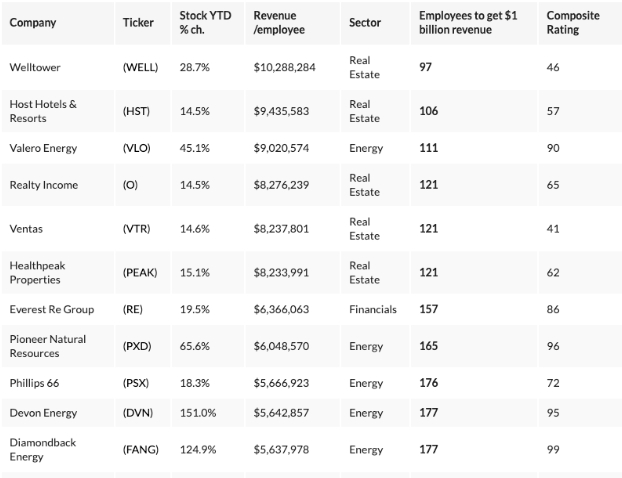
These firms don’t pass muster because they are a tenth of the size needed on a revenue-per-employee-basis, have too many employees, and are more like Russian nesting dolls than real, meaty businesses. Subcontractors outside of the publicly listed corporations are doing a large chunk of the labor, again violating the spirit of the rule. Plus, I’m skeptical that ChatGPT will be able to work on an oil rig.
So, fortunately or unfortunately, his prediction isn’t close to coming true (yet).
Creation goes to zero
The reason why is fairly obvious: The AI technology isn’t good enough. Autonomous AI agents are far from being sufficiently powerful to fully replace employees. Altman’s CEO betting pool isn’t a bet on the rugged individualism of entrepreneurship—it's a bet on technology improvement curves.
But let’s wave a magic wand and say that, starting right now, AI is good enough to swap with humans. What happens?
Thanks to our sponsor: Deel
Thanks again to our sponsor Deel, your partner in global talent acquisition. With our international compliance handbook, you're equipped to attract, hire, and onboard talent from around the world, worry-free. Simplify your access to a world of information and stay ahead in compliance and payroll processing. Expand your team with confidence and ease with Deel.
 Create a free account to continue reading
The Only Subscription
You Need to
Stay at the
Edge of AI
The essential toolkit for those shaping the future

"This might be the best value you
can get from an AI subscription."
- Jay S.
 Every Content
 AI&I Podcast
 Katie Parrott
 Every Staff










 Kieran Klaassen
Comments