



Sometimes You Have to Delete Everything
Plus: Our Claude Opus 5 Vibe Check, what makes an AI workflow stick, and the expertise trap that a prompt can’t shortcut
Jul 26, 2026 · 7 min readUpdated Sep 13, 2026

Hello, and happy Sunday! Vibe Checks are always a journey filled with unexpected twists and turns. As we worked with the Anthropic team to test what was Opus 5, deadlines shifted, release candidates changed, and the model kept fighting the setups we’d built for earlier versions of Claude. It’s exhausting and exhilarating. So when some of the Every New York team caught The Odyssey the morning before the model launch, the parallel wasn’t lost on us. Scroll down for the full Vibe Check and everything else we published this week.—Kate Lee
Was this newsletter forwarded to you? Sign up to get it in your inbox.
Knowledge base
“Claude Opus 5 Is Brilliant in Flashes, Frustrating in Practice” by Dan Shipper and Katie Parrott/Vibe Check: Claude Opus 5 is brilliant in flashes and frustrating in practice—it builds strong software and grinds through bugs for hours, but its best work often requires tearing down the systems you already rely on. It doesn’t reach Fable’s ceiling or match GPT-5.6 Sol’s day-to-day ease. Read this to decide whether Opus 5 is worth making room for—and what you’d have to change to use it well.
“How Every’s Team Used AI to Ship Its Biggest Launch Ever” by Laura Entis/Context Window: Our All Access launch drove the biggest revenue gain in company history—roughly $9,000 in two days. Every COO Brandon Gell hands the mic to three of our colleagues the builders behind the record-setting All Access launch—growth engineer Yash Poojary, head of growth Austin Tedesco, and head of marketing Douglas Brundage—to walk through the tools they build with and their advice for anyone starting out. Watch or listen to learn how an AI-native team turns ideas into shipped products. 🎧 🖥 Listen on Spotify or Apple Podcasts, watch on YouTube, or follow the discussion on X. Also inside: OpenAI’s Romain Huet and Dominik Kundel share a playbook for getting started with Codex, Marcus Moretti cuts Fable’s token spend by delegating to a cheaper sub-agent, and “the daily driver,” a running list of the models the team is using this week, debuts.
“Why Some AI Workflows Stick—And Others Don’t” by Katie Parrott/Working Overtime: After abandoning an “Attention Desk” clone of Dan’s Tend, Katie stopped treating it as a personal failing and ran a post-mortem on why some AI workflows stick and others don’t. She found that a workflow survives or dies on what it asks of your time, energy, and sanity versus what it gives back. Read this to get the four questions she uses to decide which workflows to keep, redesign, revisit, or retire.
“Drowning in Demos? Here’s a Better Way to Prototype” by Hilary Gridley: AI let Hilary’s product team at Whoop build prototypes in an afternoon—so they built too many, with no way to sort the keepers from the noise. Her argument is that once building is cheap, a prototype’s job is to test whether the problem is worth solving, and the only honest verdict comes from people using it, not stakeholders reacting to a demo. Read this to see how Whoop put that to work with a 12,000-member beta group. 🧑🏫Sign up for Hilary’s self-paced Maven course, How to Become a Supermanager With AI, and receive a 15 percent discount. (This piece was produced in partnership with Maven.)
Steal this workflow
How Notion builds Notion with AI
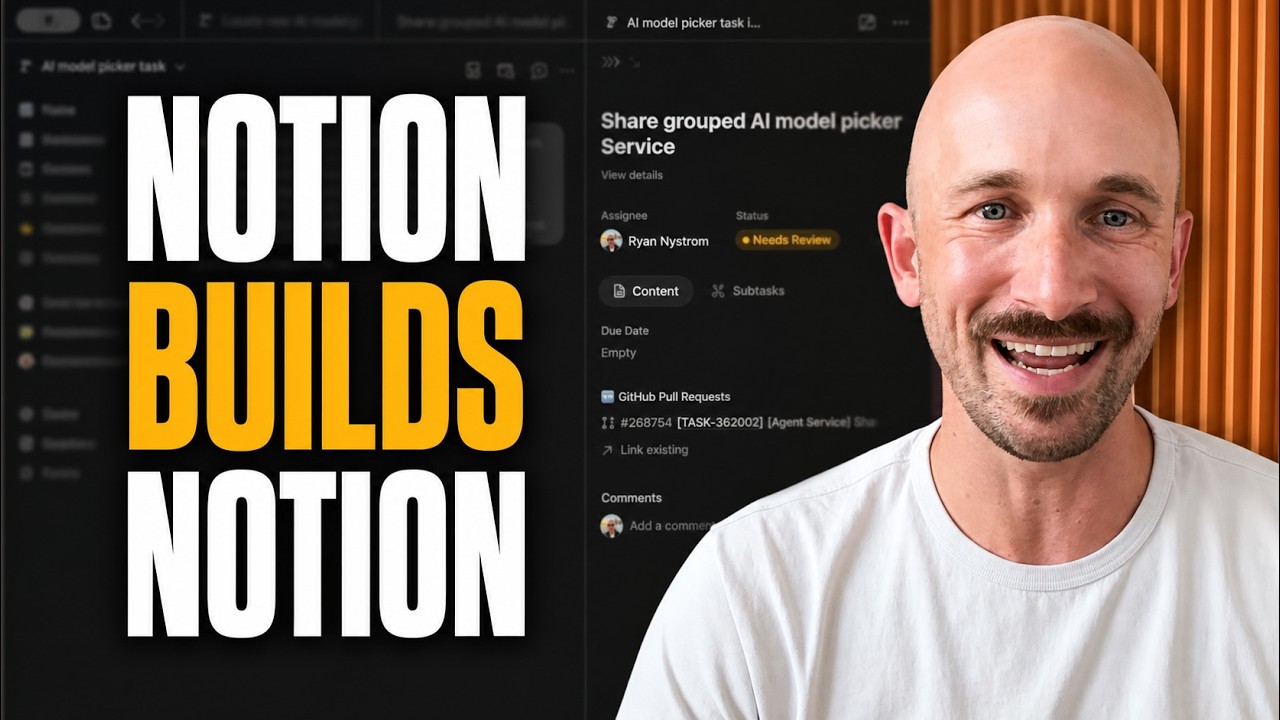
Ryan Nystrom, a software engineer on Notion AI, starts coding tasks by talking through them. Speaking lets him add the nuance, corrections, and context that tend to disappear when he compresses an idea into a short written prompt.
In this video, Ryan shows Dan how that spoken brief becomes a sourced Notion task, a working pull request, and a review loop that catches bugs and maintainability problems before a person reviews the code.
- Ryan talks through a model-picker migration. Notion AI explores the codebase and turns his explanation into a task with code pointers, requirements, constraints, and verification steps.
- He hands that task to an agent, then runs a custom review swarm across the front end and back end. The agent opens a pull request, watches the tests, fixes failures, and returns with passing code while Ryan is in meetings.

Here’s how you can get started:
- Talk through the work before you write the brief. Explain the goal, relevant context, constraints, and what a finished result should look like.
- Ask an agent to research the relevant sources and turn your explanation into a structured task with requirements and verification steps.
- Review the plan, then hand the task to an agent that can work in the target environment.
- Save recurring review standards as a reusable skill. Ryan built his review swarm by asking Codex to study existing skills and turn his preferences into a new one.
Ready to try Ryan’s workflow? Upgrade to Every All Access and get six months of Notion Business through the Builder Pack for eligible workspaces. All Access members can redeem more than $7,000 in partner offers.
From Every Studio
A new Cora brief experience is coming soon
Kieran Klaassen, general manager of Cora, rebuilt Briefed—its digest of everything that isn’t urgent—into a two-pane reader: the Brief on the left, emails opening on the right, as in the inbox. You can now set how much you want per category (either a full summary or a short snippet), give old promotions and newsletters an auto-clear window so they tidy themselves up, and bulk unsubscribe without leaving the brief. Kieran Klaassen has set the open beta for August 4, when active users get an email and an onboarding link. Take a look at cora.computer.
Every Agent browses the web for you and onboards itself
Every Agent, the AI coworker Every is building inside Slack, can now act on public websites for you: It logs in, fills out forms, and stops for your confirmation before it does anything one-way—like making a purchase. It also onboards itself now. Reply “yes” to it, and it reads your channels and identifies three tasks it could take off your plate—and any teammate can start that, not just whoever installed it. Every Agent is in private alpha while the team hardens connections before an external beta. Watch this space.
Alignment
The expertise trap. How does arguably the most brilliant mathematician of this century use AI?
Quite simply.
I opened Terence Tao’s conversation with ChatGPT about Fable’s counterexample to the notorious Jacobian conjecture, an 87-year-old problem that has long stumped the mathematical community. I half-expected beautiful, elaborate prompts I could steal for my own AI use. Instead, Tao asks short, precise questions, dense with mathematical jargon, and pushes the frontier AI model on reasoning that doesn’t make sense. It was like watching a 10-year-old genius being schooled by a much older, wiser genius.
I quickly learned that I could copy every prompt Tao used and still never, not in a million years, reproduce what he did. This sort of mathematical sorcery can only happen when someone has deep knowledge of their craft, because Tao can do the one thing a non-expert cannot: Evaluate the response. Without that expertise, you don’t know whether the answer coming back to you is correct or confidently delivered gibberish.
What irritates me is that I fell for the most charlatan-like advice about “learning AI” from LinkedIn AI influencers who screenshot the latest prompts promising “outputs like a McKinsey consultant” or “growth strategy from a world-class CMO”—as if expertise is just a few sentences you could press the enter key on.
It’s so easy to get a seductive answer from AI that I’m afraid more and more of us will revert to cognitive offloading and skip the hardship and “stuckness” necessary to develop expertise. In Anthropic’s study of 52 mostly junior developers learning a new Python library, the AI-assisted group scored 50 percent on a subsequent quiz, versus 67 percent for those coding by hand. The largest gap between the two groups was in debugging, the skill required to catch the model when it is wrong.
It is a small study, and AI can help people learn. But I now think AI will make expertise more valuable and experts harder to produce.
This has irrevocably changed how I use AI. Before reading its answer, I force myself to clarify what I already understand. Sometimes I ask, “What is a better question here, and why?” before seeking the answer. The machine is always ready to rescue me, but watching Tao, I realized expertise is knowing when it hasn’t.—Ashwin Sharma
That’s all for this week! Follow Every on X at @every and on LinkedIn.
Everyone’s a builder now. Every All Access gets you the full membership plus the Builder Pack—$7,000+ in credits for the tools we build with.
For sponsorships, contact [email protected].
The Only Subscription
You Need to
Stay at the
Edge of AI
The essential toolkit for those shaping the future

"This might be the best value you
can get from an AI subscription."
- Jay S.
 Every Content
 AI&I Podcast
 Monologue
 Every Agent
Join 100,000+ leaders, builders, and innovators

Already have an account? Sign in.
What is included in a subscription?
Daily insights from AI pioneers + early access to powerful AI tools

 Front-row access to the future of AI
 In-depth reviews of new models on release dayPlaybooks and guides for putting AI to workPrompts and use cases for buildersIn-depth reviews of new models on release dayPlaybooks and guides for putting AI to workPrompts and use cases for builders
 Bundle of AI software



 Katie Parrott
 Every Staff
 Kieran Klaassen
Comments