
Vibe Check: GPT-5.6 Sol Is Our Favorite Model to Collaborate With
Sol is fast, resourceful, and unusually easy to steer—but Fable still gets the assignments we want to hand off completely.
We missed GPT-5.6 Sol while it was gone.
For about a month, Sol had been everywhere in our work. It kept Dan Shipper at inbox zero and tracked decisions across meetings and Slack that he might otherwise have missed. It kept up with Austin Tedesco as he moved from campaign idea to email to landing page to experiment without making him repeat himself or lose focus. It retrieved files and context for me (Katie Parrott) so quickly that it completely rewired how I work with models day to day.
Then, at the end of June, we lost access while Sol went through government review. Dan said returning to other models—even with Fable available—felt like going back to the Stone Age. Austin compared using GPT-5.5 to “trying to shoot a basketball that’s twice as heavy as the one I’m used to using.” In our Sonnet 5 Vibe Check, we talked about the revolution of rising expectations. Our time without Sol underscored just how quickly you can get used to a higher standard of living—and how much it hurts when that progress rolls back.
GPT-5.6 Sol is a serious step change in model capability for day-to-day knowledge work. It’s fast enough to keep up with you, resourceful enough to find the context it needs to do good work, persistent when the first approach fails, and responsive when you change direction.
For months now, we’ve been tracking a split in the way we work with AI. Sometimes, you want to delegate—give the model an assignment, send it off, and come back to something you can work with. Other times, like when you’re working on a long complex report or a big writing project, you want to collaborate—stay close to the work, see options quickly, and make decisions that guide the outcome as the work evolves. Sol’s mix of speed, intelligence, and steerability make it a delight for that second kind of work.
Fable still gets the biggest, most ambiguous assignments—the ones where planning and making decisions about the work is a large part of the task. Austin uses it for long-running, go-to-market engineering tasks, like setting up new user journeys, testing them end to end as different audience types, and working in a loop to continue to improve the flow. Dan goes to it for benchmarking projects that involve a lot of synthesis, dataset development, and experimentation. But once we’re done delegating and ready to dig in, GPT-5.6 Sol is where we want to spend our time.
New model releases seldom come unaccompanied these days, and today is no exception. In addition to GPT-5.6, OpenAI is merging the ChatGPT and Codex desktop experiences into one unified app. The move appears to be a bid to build a bigger tent for agentic work—one that pulls in more of ChatGPT’s 800 million-plus users.
Our time with the new app experience has been limited, but so far, like Codex before it, it’s an app we want to spend time in. Which is great news, because GPT-5.6 Sol is a model we want to spend time with. Dan’s analogy is that Sol is a Porsche and Fable is a warp drive. Fable can take you across the galaxy, sure. But most of the time, you’re not going to space—you’re just trying to get around town. Sol is the model that lets you travel in style.
More on our experience driving it below.


What OpenAI is saying
OpenAI calls Sol its “strongest model yet,” but the evidence it released is concentrated in a particular kind of work: difficult assignments that require an agent to plan, use tools, and keep working. The company says Sol sets a new state of the art on Terminal-Bench 2.1, which tests command-line tasks that require planning, iteration, and tool use. It also reports stronger results than GPT-5.5 on a long-running biology benchmark and the company’s best cybersecurity performance.
A new max reasoning setting gives one Sol agent more time to work, while an ultra mode coordinates several agents on the same assignment. OpenAI is also debuting new model tiers below the Sol tier: Terra is the lower-cost model for everyday work, and Luna is the fastest and least expensive. OpenAI says those names will persist as capability tiers even as the models within them advance.
OpenAI is debuting GPT-5.6 alongside another major product update: merging the ChatGPT and Codex desktop experiences into one app. ChatGPT Work is geared to take on the majority of knowledge work tasks, while Codex gets its own dedicated tab for technical work.
On the pricing front, OpenAI’s three tiers map closely onto Anthropic’s trio of models. Sol costs $5 per million input tokens and $30 per million output tokens, matching Opus 4.8 on input but costing $5 more on output. Terra costs $2.50 and $15, compared with Sonnet 5’s introductory $2 and $10 through August 31; Sonnet then rises to $3 and $15. Luna costs $1 and $6, matching Haiku 4.5 on input and costing $1 more on output.
Sol
$5 input / $30 output
per million tokens
Terra
$2.50 input / $15 output
per million tokens
Luna
$1 input / $6 output
per million tokens
The Reach Test

“GPT-5.6 Sol in ChatGPT Codex and Work is obviously the gold standard for knowledge work. I reach for it first as my daily driver for pretty much every task. It’s not Fable-level—I flip back to Fable for my hardest tasks—but for everything else 5.6 is my go-to.”

“Sol is a workhorse model. I trust it more as a collaborator than previous GPT models: It’s thorough and helpful, doesn’t do stupid things, and is creative enough to just get shit done. Fable is still better at complex, long-horizon tasks, but Sol can do about 90 percent of what Fable can do.”

“Sol is the best knowledge-work model I’ve used, inside the best app for knowledge work. It now handles at least 80 percent of my day-to-day tasks and can take on basically anything my brain naturally thinks to try. I still want Fable running in the background for the work I have to push myself to consider possible.”

“Sol has turned into my daily driver. I still prefer Fable's sharp spiky intelligence and use of context but GPT-5.6 is the best and most cost-effective all round model that I would use every day.”

“The combination of 5.6 and Codex has seriously transformed the way I approach work from day to day, and for that alone, I consider this to be a paradigm-shifting model. For writing specifically, I’ve found Sol to be stronger than Claude models at using context like style guides and samples to inform its work, and its speed and ability to take direction make it great for collaborative writing. But truly human-level prose remains an elusive target for frontier models in a way that makes me wonder whether we’ve reached a plateau in what AI is capable of on the writing front.”

“Sol is making me trust GPT models for coding again. It does less random stuff, needs fewer follow-ups, and carries more work end to end than GPT-5.5. I still prefer Fable, and sometimes Opus, partly because Codex hides too much of the process and I don’t always understand how it got there.”

“GPT-5.6 Sol has been my go-to model for the past month—and the most reliable one I’ve used. Since Fable launched, my workflow has settled into a powerful split: Fable acts as the orchestrator, shaping the plan, and Sol executes it. That combination has helped me ship a remarkable amount for Monologue, from major improvements to Notes to building the entire Monologue web app in a day. Sol remains the model I trust most for day-to-day development of Monologue’s native apps.”

“So far, I prefer Sol for knowledge work because it gives me granular control without making me manage every small decision. It can take initiative, ask useful questions, and still let me see where the work is going. Early testing felt truly magical with its abilities compared to 5.5, but a late-testing calculation error gave me whiplash. I've been using Codex as my primary work surface for awhile, so if I can rebuild trust, Sol will be a game-changer for me.”

“Sol is faster and more meticulous than Fable; the GPT model is my new go-to for helping me with spot edits that involve dejargonifying overly technical language or rewriting lines that, even if human-written, sound too much like AI. If I could only pick one model for collaborative work, it would be Sol. That said, Fable has better, dare I say, taste; I trust its judgment more on large architectural decisions and UI design. And I don’t have to pick one model. I can have Fable tell Sol or Opus/Sonnet to execute, or have Sonnet 5 ask Fable to consult on tough problems. I don’t use these models in isolation, and I don’t think others should either.”
Coding: Strong execution needs clear boundaries
Sol is a substantial coding upgrade over GPT-5.5 in daily use. It can trace a bug through an unfamiliar production codebase, carry a large project end-to-end, and keep testing after other models would have stopped. Several members of our engineering team have made it a daily driver.
Its limits appear when a broad assignment requires the model to decide what not to build. Sol executes with enormous persistence. It does not always have the best restraint.
It scored a 56/100 on our Senior Engineer benchmark. By comparison, Fable scored a 90/100. The difference in score mostly came from 5.6’s tendency to overwrite. We think 56/100 actually undersells 5.6’s performance, and is a function of the benchmark penalizing 5.6’s propensity to overcomplicate its work. The best summary we can give: It is close to but not quite at Fable’s level.
Clear assignments bring out its best
The strongest production example came from Naveen Naidu, who tested Sol in daily production work for Monologue. GPT-5.5 at extra-high reasoning had failed several times to find the cause of a notes-recording bug. Sol followed the failure through the existing codebase and fixed it.
Kieran Klaassen also asked Sol and Fable to rebuild Proof, our collaborative document editor, from a single prompt. Sol returned a running Proof-like app in about one-third the time, although Dan preferred Fable’s design. Sol completed a one-prompt digital audio workstation that GPT-5.5 had failed to finish, too.
Those results match the team’s experience: Sol is fast, resourceful, and strong at implementation when the desired system is clear.
The Senior Engineer benchmark caught a specific failure mode
Our Senior Engineer benchmark gives a model a messy collaboration codebase and asks it to rewrite the system the way a senior engineer would.
5.6 did an admirable job of producing a complete rewrite, but it was overwritten: it built a complex new system with thousands of lines of code. Sol added about 12,900 lines spread across four cooperating processes. It was clear why each addition was added, but taken together they recreated too much complexity.
Dan’s final review placed almost the entire gap in the two parts of the rubric that reward simplification and penalize unnecessary machinery. Sol’s weakness was not understanding the architecture. It was stopping once it had built enough.
Fable remains our first choice when deciding what not to build is one of the main engineering tasks. Once the direction is set, Sol is often the model we want carrying it out.
Writing: A fantastic collaborator with context and direction
Sol finished last among six models on our writing bench, producing the hardest prose to read and the editorial choices furthest from the published references. Nevertheless, the Every team overwhelmingly prefers it to Sonnet 5 or Opus 4.8 for daily writing.
The reason comes down to the delegate-versus-collaborate split we saw throughout testing. Sol is weaker when you try to delegate the work, ask the model to make big editorial calls, and return a finished piece. But it’s a great collaborator, where project context helps it make better decisions and an editor can redirect it quickly.
This Vibe Check itself is an example: Sol was able to track stylistic trends across past Vibe Checks, find buried Slack conversations that supported details, and speed-run 24 drafts in the span of six to eight hours of focused work—all without making me wait while it pondered. Each draft represents a series of editorial decisions that navigated us closer to what the finished result should look like. For work as iterative and collaborative as AI-native writing tends to be, that’s the makings of a strong model—even if one-shotting article introductions or editing exactly as a human would remains out of reach.
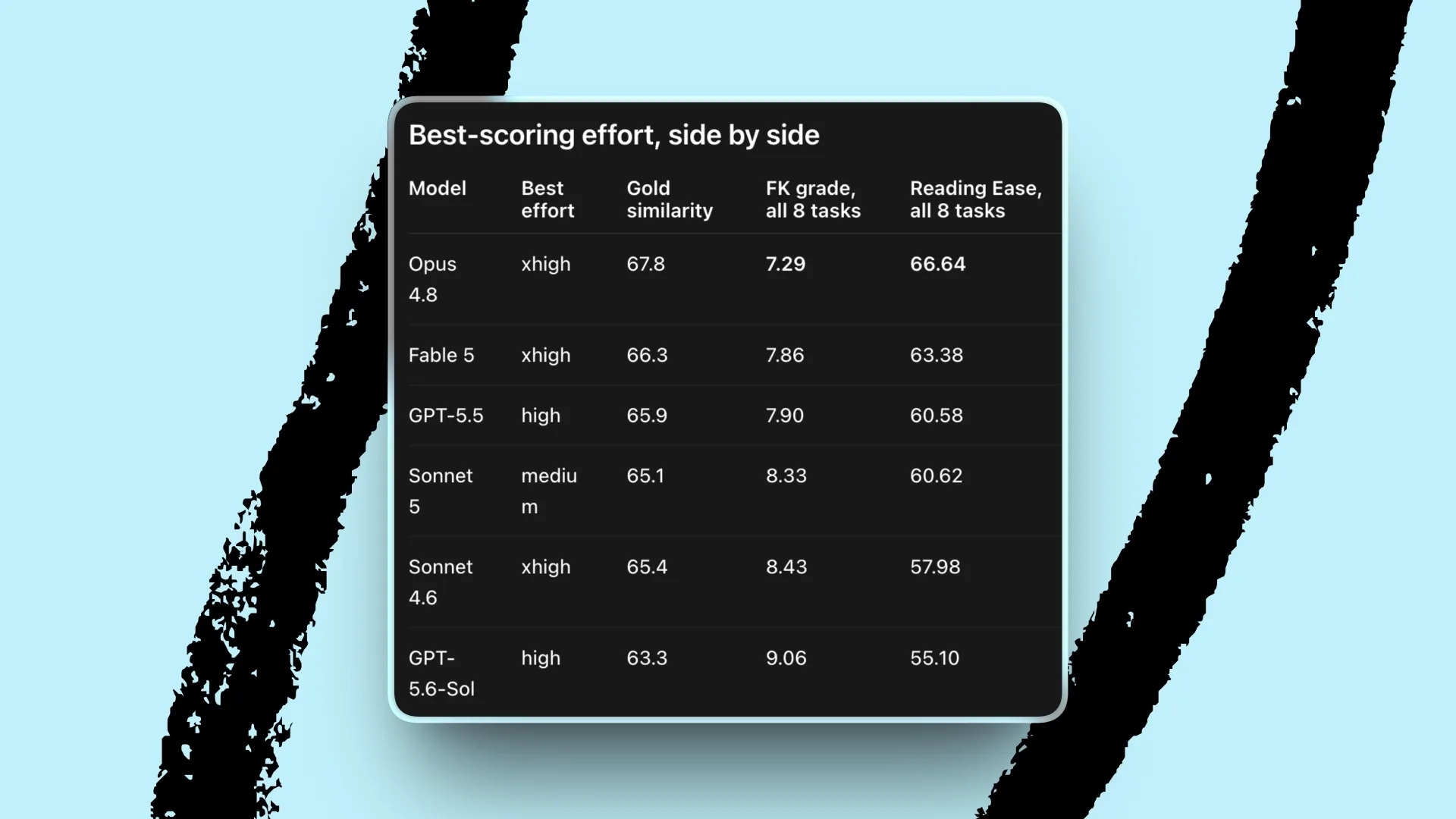
Copy quality: Tight sentences with bigger words
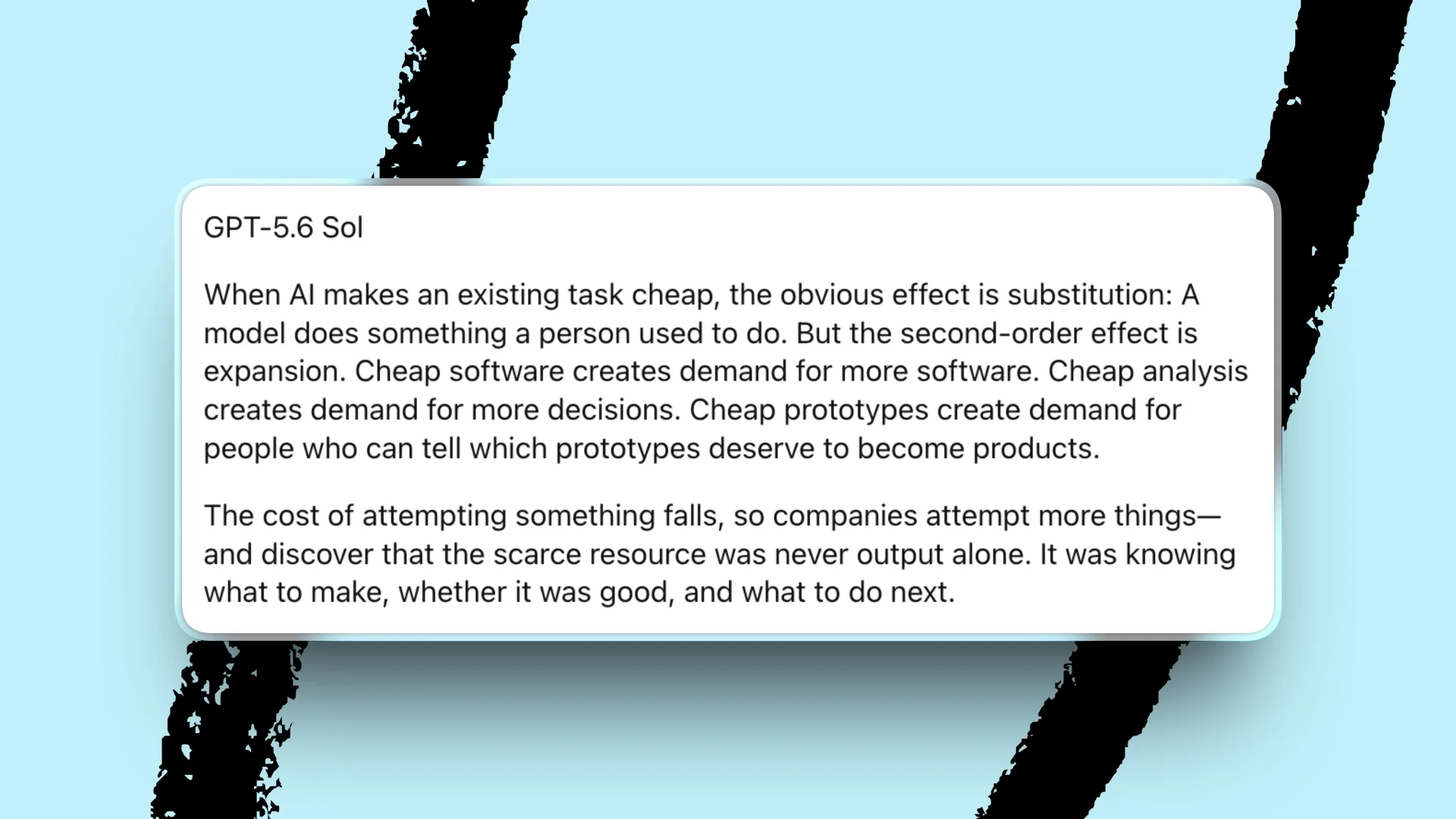
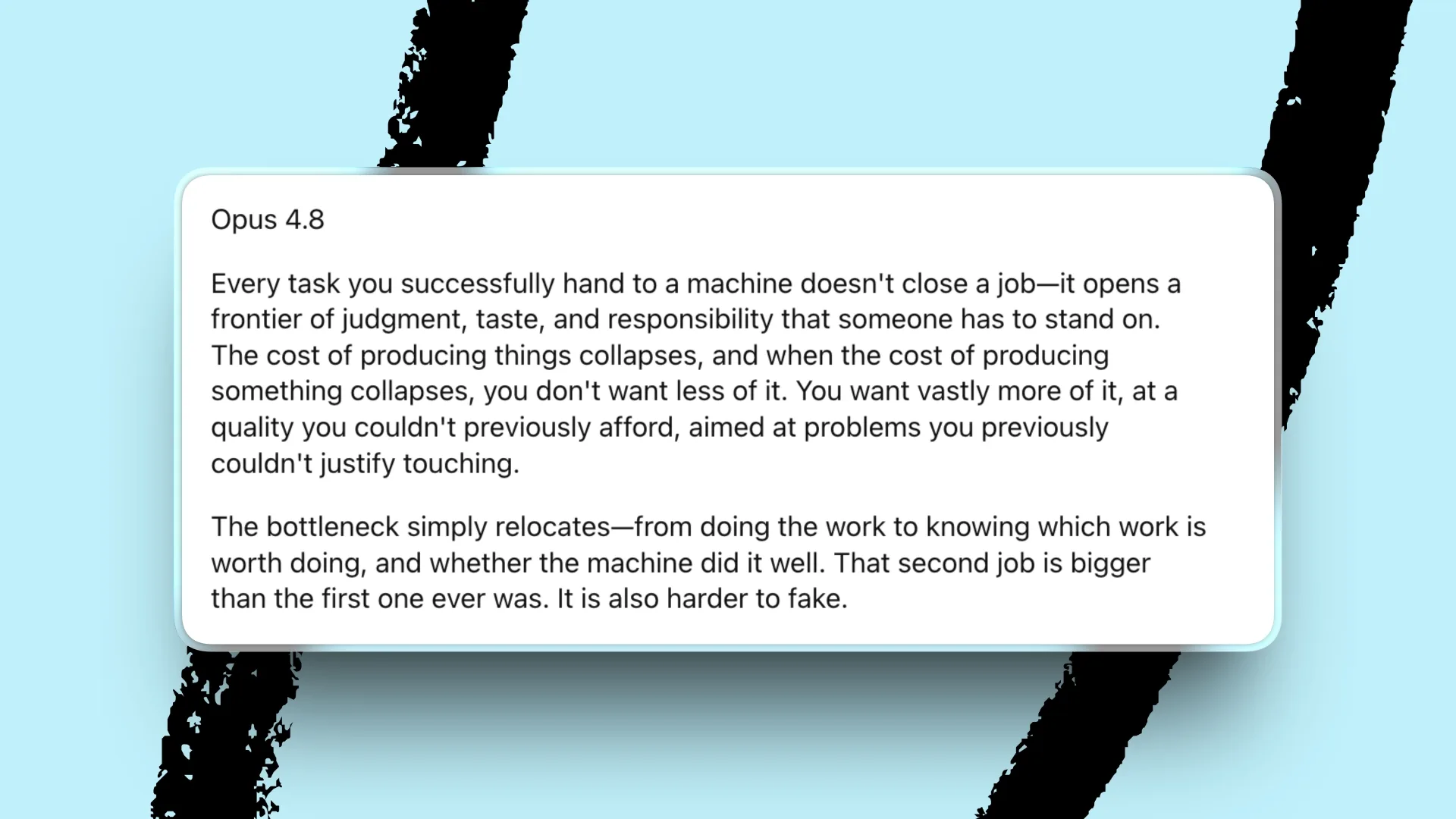
Sol writes relatively short sentences and breaks an argument into compact paragraphs. In its strongest attempt at the introduction to “After Automation,” it came closer to the rhythm of the published opening than Opus 4.8, which developed its version in fewer, larger blocks.
The difficulty is inside the sentences. Sol reaches for longer, more abstract words and phrases than Opus even when the two models write sentences of similar length (“the obvious effect is substitution” versus “the machine takes the task” from Opus; “the second-order effect is expansion” versus “it opens a frontier”). Opus uses plainer language inside more complicated syntax; Sol produces a page that is easy to scan and lines that take more work to understand.
Obvious AI tells did not drive its last-place finish, either. On my checks for canned transitions, false contrasts, stock vocabulary, and repeated rhetorical patterns, Sol landed in the middle of the group. Its prose can look clean without being so clear that you can send it off without a final check for robotic language.
Editorial judgment: Coherent drafts but predictable choices
Sol’s larger weakness is deciding what the piece should say. Asked to write an introduction for Dan’s “After Automation” article, it found the opening paradox, that the Every team has automated so much and yet has more work than ever. But the model broadened that observation into a familiar argument about automation raising a company’s ambition, while the published article made a more specific claim about the relationship between AI adoption and need for human work. Sol also missed the names, benchmarks, and reporting in the source packet that the models receive to inform their take on the assignment. It wrote a coherent introduction, but it blurred the mechanism that made the story worth telling.
The same gap appeared when Sol tried to anticipate the final edits of Kate Lee, Every’s editor-in-chief. It missed consequential changes and proposed too many revisions that were reasonable without being necessary. Sol could generate options without reliably telling which ones would make the piece better.
Sol’s strongest benchmark result came on a promotional email, and it also did well on social media copy. Those formats usually arrive with the audience, offer, length, and desired response already defined. Sol is better at writing within those decisions than making them itself for a complicated essay.
Context use: Stronger with a writing system
Our writing benchmark is intentionally scoped to see what the model does left to its own devices. But in real-world contexts, we give the model much more material to go on. When you see how GPT-5.6 absorbs and makes use of that context, its more impressive qualities start to show.
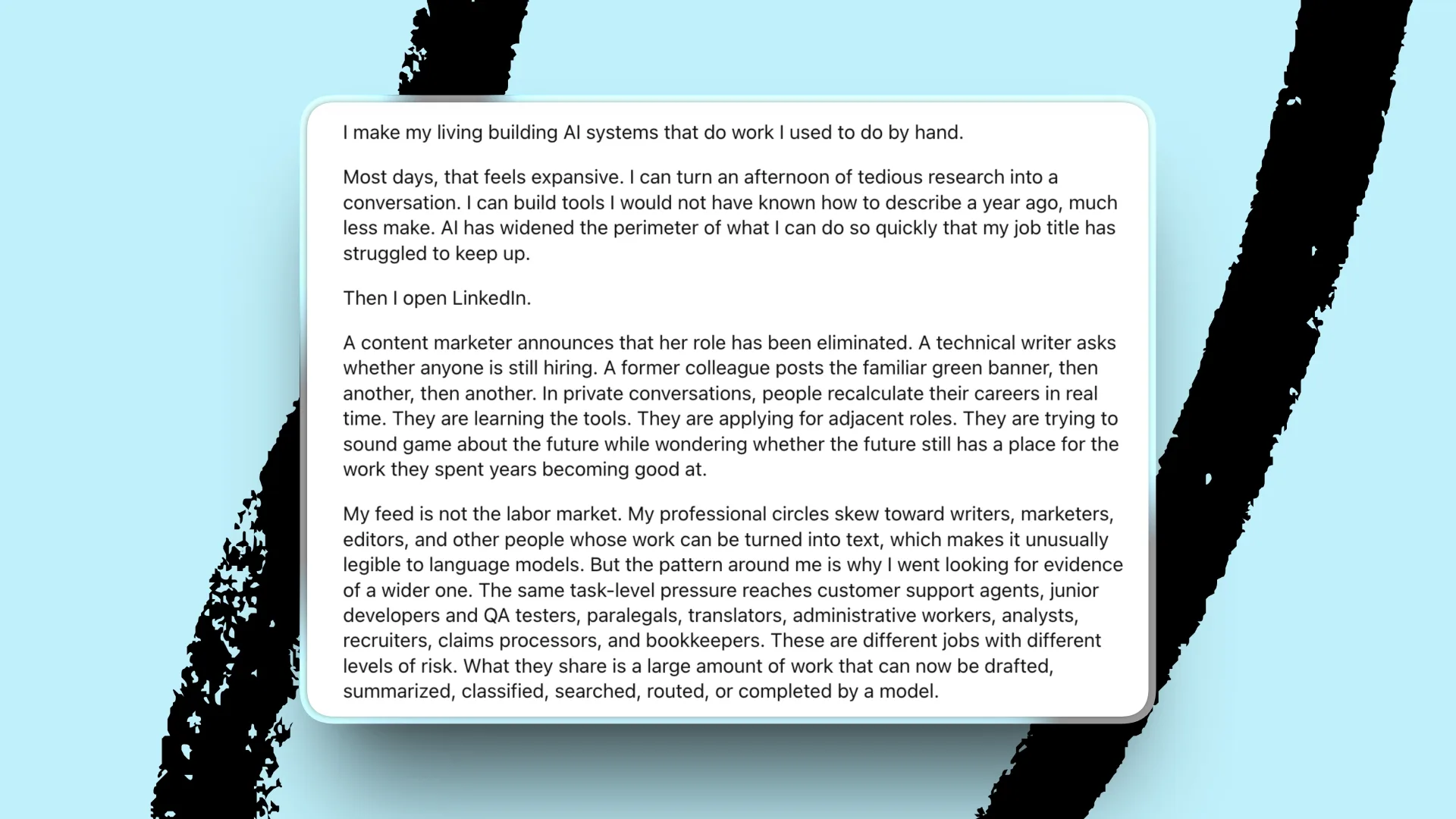
I gave Sol and Opus 4.8 the same article assignment, source materials, and direction and asked it to produce a first draft of an essay for my column Working Overtime. Sol came back with a compelling hook and a draft much closer to Working Overtime’s established voice and style, while Opus came back with much denser paragraphs that are hard to read and don’t match my voice as defined in my context files.
Austin saw something similar when he asked Sol to develop marketing copy. Without guidance, Sol was “a whatever writer”—generic and repetitive. With Spiral, company context, templates, and style guidance, it produced landing-page copy, social posts, and marketing emails that Austin felt comfortable sending with only minimal edits.
Sol is a model that thrives on context. Give it the source material, examples, and rules, and the quality rises. Ask it to determine the argument and standards from scratch, and the benchmark weaknesses return.
Collaboration: Fast drafts that respond to direction
Sol is strongest as a live writing partner. It returns revisions quickly and responds closely to editorial direction, so writers can test a new opening, restructure a section, or discard a weak pass without rebuilding the assignment each time.
For my day-to-day writing workflow—interview-driven and iterative, with lots of direction and feedback, and with style documentation and plenty of examples to go on—Sol is a clear win over Claude models. Where Opus is slow to respond and Sonnet 5 can be hard to steer, Sol adapts to new directions quickly and makes corrections based on feedback. I can ask for a different angle or structure, plainer language, or more evidence, and get another version to react to quickly. Sol also applies new information to future turns in the conversation, without overly fixating on the most recent information at the expense of the larger goal, which we found to be the case with Sonnet 5.
Head of tech consulting Mike Taylor has also started delegating writing and editing to Sol because it “basically never says anything objectionable.” It accepts correction, retains the sources and earlier decisions, and tries again quickly.
The human editor still supplies the judgment, but Sol makes that judgment cheaper to apply throughout the draft. Use it directly for promotional emails, social posts, and other assignments with a clear audience and goal. For essays, give it the inputs, examples, and editorial rules, then keep a human responsible for the final cut.
Knowledge work: It does the reading before it asks for help
Sol is our preferred model for everyday knowledge work because it reads the available context, identifies the decisions that need human judgment, and carries the answers into its next action. Fable remains stronger when a large, loosely specified assignment requires a bigger independent leap; Sol is faster and easier to guide through collaborative work that moves among research, analysis, writing, spreadsheets, and product changes.
Arielle Shipper, Every’s head of operations, gave GPT-5.5, Sol, and Fable the same initial prompt for a spreadsheet assignment. Each model had to find an email, reconcile data from 46 attached CSV files with an existing spreadsheet, and perform analysis that required judgment rather than a mechanical merge.
Sol found the email, inspected the files, noticed missing information, and came back with seven questions, like which sub-groups the analysis should apply to and how particular metrics should be calculated. Each question included a recommendation, giving Arielle something to approve or correct instead of another research assignment. It also extended her proposed analysis and produced a usable first pass.
GPT-5.5 asked where to find the email even though Arielle had named the sender, then produced an unusable first attempt. Fable proposed a useful summary tab explaining each field, but it asked Arielle to move files into Google Drive and make several smaller decisions before it proceeded.
Late in testing, Arielle caught Sol making a serious calculation error while analyzing ChatGPT usage data. The mistake shook her confidence in the result and showed that even a well-structured collaboration still requires careful review.
Austin’s daily workflow shows the same continuity across different kinds of work. He can begin with a campaign idea, draft the email, turn the copy into a landing page, and set up an experiment without leaving Codex or explaining the audience and offer again. Jack Cheng, Every’s senior editor, used Sol to combine paragraphs and remove jargon while building the public page where the copy would appear. He could judge each line in its final interface and keep working on the product around it.
Their workflows resemble most workdays more than a one-shot app does: Find the source, understand the request, ask about the decisions that need a person, and carry the answers into the finished artifact.
Agent behavior: It keeps working and responds well to correction
Sol is strongest as an agent when a person stays in the loop. It keeps working through long assignments, finds the files and tools it needs, makes sensible decisions inside a defined goal, and changes direction quickly when corrected. Its judgment is strongest during execution and weaker when it has to decide what the whole system should become.
It finds what it needs
Persistence is the clearest upgrade over GPT-5.5. Kieran watched Sol finish jobs that would have broken down with earlier GPT models. Mike said Codex’s improved compaction now makes Goals reliable enough that he has stopped experimenting with his own elaborate orchestrations.
Sol also does more work before asking the user for help. It searches the available files, reads standing project instructions, and uses connected tools instead of turning source retrieval into another assignment for the person.
Judgment is strongest inside a clear goal
The model makes good local decisions along the way. When a long-running engineering test failed, Sol found a leak in the system it had built and fixed the product instead of weakening the test. It also refused to push code until Dan gave permission. In Mike’s latest PowerPoint run, Sol chose its own visual direction instead of struggling to force the content into Every’s existing template—the first OpenAI model he had seen do so, though Opus 4.7 got there earlier.
Its judgment becomes less reliable as the goal gets broader. Sol understood the architecture in our Senior Engineer benchmark, then built a system far larger than the task required. The model is good at deciding how to proceed inside a clear assignment. It is less dependable when deciding what the assignment should become or when the work is finished.
Fast corrections make supervision easy
Fast responses make that boundary easier to manage. I can ask for a different structure, a narrower claim, or another interaction and see the result while I still remember what felt wrong. A failed direction costs minutes rather than half an hour. Mike has a rule that captures the difference: “If you’re a human in the loop, the Codex app is a way better place to live, but if you want to remove yourself from the loop, you need Fable.”
Codex adds reach and obscures the process
Codex gives that collaboration more reach. Files, plugins, browser control, Goals, and other threads let Sol gather context and act on it without forcing the user to rebuild the assignment in each tool. The same context can work against the model when it is stale. Naveen initially found Sol worse than GPT-5.5 for customer support. The output improved after he removed defensive rules written for older models. Sol had found the instructions and followed them; the instructions were the problem.
The remaining product weakness is visibility. Andrey Galko, Every’s engineering co-lead, likes Codex’s speed and interface but often has to work backward to learn what Sol tried, changed, and decided (a trend that Kieran observed at the recent AI Engineer conference). Opus explains more of its process while it works. Sol can complete the assignment successfully and still leave the user with less confidence about how it got there.
Sol executes while Fable sets direction
The team is beginning to route work around Sol’s strengths and limits. Dan uses Fable as the primary agent for difficult engineering jobs and gives defined execution to Sol. Mike has made Sol his daily driver and says it has “finally muscled out Opus,” while keeping Fable for its “sharp spiky intelligence” and stronger use of context. Use Sol when the desired outcome is clear and you want an agent that will keep moving while you stay involved. When defining the system is the main task, set checkpoints early, or give the architecture to Fable and let Sol carry the execution.
The verdict
Sol is the model most of us want nearby while the work is changing. It responds quickly enough for live iteration and can carry substantial execution. It also searches the available context before asking the user to restage the assignment. Fast turns and strong context use make Sol broadly useful even though Fable and Opus retain clear advantages on particular jobs.
Reach for Sol if…
You are writing, researching, building, or analyzing something you expect to revise as you go.
The project already contains useful sources, examples, instructions, or prior decisions.
You have a clear outcome and want the model to handle the steps, tools, and follow-through.
You are fixing a difficult bug or building a feature whose boundaries you can review before the implementation grows.
Keep Fable nearby if…
The brief is loose and deciding what the project needs is a large part of the job.
You want to hand over a long assignment, leave, and review the completed result later.
Simplification, architecture, and restraint matter more than rapid back-and-forth.
Reach for Opus if…
You want to see more of the model’s reasoning and progress while it works.
Together, Sol and Codex clarify what OpenAI is building toward: an ecosystem that can handle the work we hand off and remain responsive enough for the work we shape ourselves. Fable remains our first choice for the biggest jobs we delegate. OpenAI is building the place we want to stay.
Disclosure: OpenAI provided Every early access to GPT-5.6. OpenAI had no input on this review.
Katie Parrott is a staff writer at Every. You can read more of her work in her newsletter.
To read more essays like this, subscribe to Every, and follow us on X at @every and on LinkedIn.
Discover Every’s upcoming workshops and camps, and access recordings from past events.
For sponsorship opportunities, reach out to [email protected].