





Was this newsletter forwarded to you? Sign up to get it in your inbox.
‘AI & I’: More machine, more human work
Today, we’re releasing a new episode of our podcast, AI & I. In a format flip, Dan Shipper sits down with Every’s COO Brandon Gell not to interview a guest, but to be interviewed himself on why automating everything leads to more human work. The occasion is “After Automation,” Dan’s 8,000-word argument on the topic that became our most viral piece of the year, driving the AI discourse on X for a couple days.
It’s a counterintuitive thesis from someone who runs a company that’s automated every single thing it can. And yet Every has grown from four people to 30 in the GPT era, with agents embedded into nearly every workflow. Dan’s point isn’t that AI won’t change work—it already has—but that it drives up the demand for human expertise, judgment, and taste.
Watch on X or YouTube, or listen on Spotify or Apple Podcasts. You can also read the transcript.
Here are the highlights:
- AI makes experts more valuable. When everyone can produce a decent first draft—of code, writing, design—the floor rises, but so does the amount of comparable content. “You flood the zone with tons of stuff that’s close, but not quite right,” Dan says. Getting from close to memorable requires experts who can work with AI to rise above the new baseline.
- The goalposts will keep moving. Models improve exponentially on benchmarks precisely because benchmarks are fixed frames, or existing ways of posing a problem the model can train on. Humans remain indispensable because we can operate outside established frames entirely—we zoom out, recenter the problem, and make surprising, self-directed choices that don’t exist anywhere in the training data.
- “AI layoffs” are usually a cover story. Meta and ClickUp, among other tech companies, have recently laid off people and blamed AI. Dan and Brandon’s read on the trend is the same: AI is an easier explanation than admitting your company hired too many people or is in financial straits. AI will undoubtedly change how people do their jobs—and big, structurally rigid companies will have to reorganize around that—but that’s different from the technology eliminating jobs.
- Ride the models and you’ll be fine. The paradox at the heart of Dan’s essay is that AI creates more work for humans while raising the bar for how good that work needs to be. Agents are structurally built to rely on humans for direction; without someone deciding what matters and how to make it better, they produce mediocre results. To position yourself to thrive in an AI-native workplace, Dan says, use new models to do the tasks you’re already good at, and you’ll be more in demand than ever.
Miss an episode? Catch up on Dan’s recent conversations with LinkedIn cofounder Reid Hoffman; the team that built Claude Code, Cat Wu and Boris Cherny; Vercel cofounder Guillermo Rauch; podcaster Dwarkesh Patel; and others, and learn how they use AI to think, create, and relate.—Laura Entis
Signal
The Pope takes on the means of AI production
When Pope Leo XIV’s encyclical on AI, Magnifica Humanitas, hit the internet a little after 6 a.m. on Monday, the first thing I did was give it to an AI.
I’d been waiting on the Pope’s first major written teaching with the bated breath of a left-leaning agnostic secular humanist amateur Bible scholar slash knowledge worker in the AI economy. AI, labor, and the Book of Nehemiah, in one document? I’m not sure there’s ever been a more Katie Parrott-coded text.
Nevertheless, I gave AI the first crack at it. I had Andy, Every’s in-house editorial assistant, use Claude design to turn it into a comic-book infographic with the need-to-know information for the Every team. Our head of tech consulting, Mike Taylor, said the comic helped him wrap his head around the argument as a non-believer. Praise the Lord.
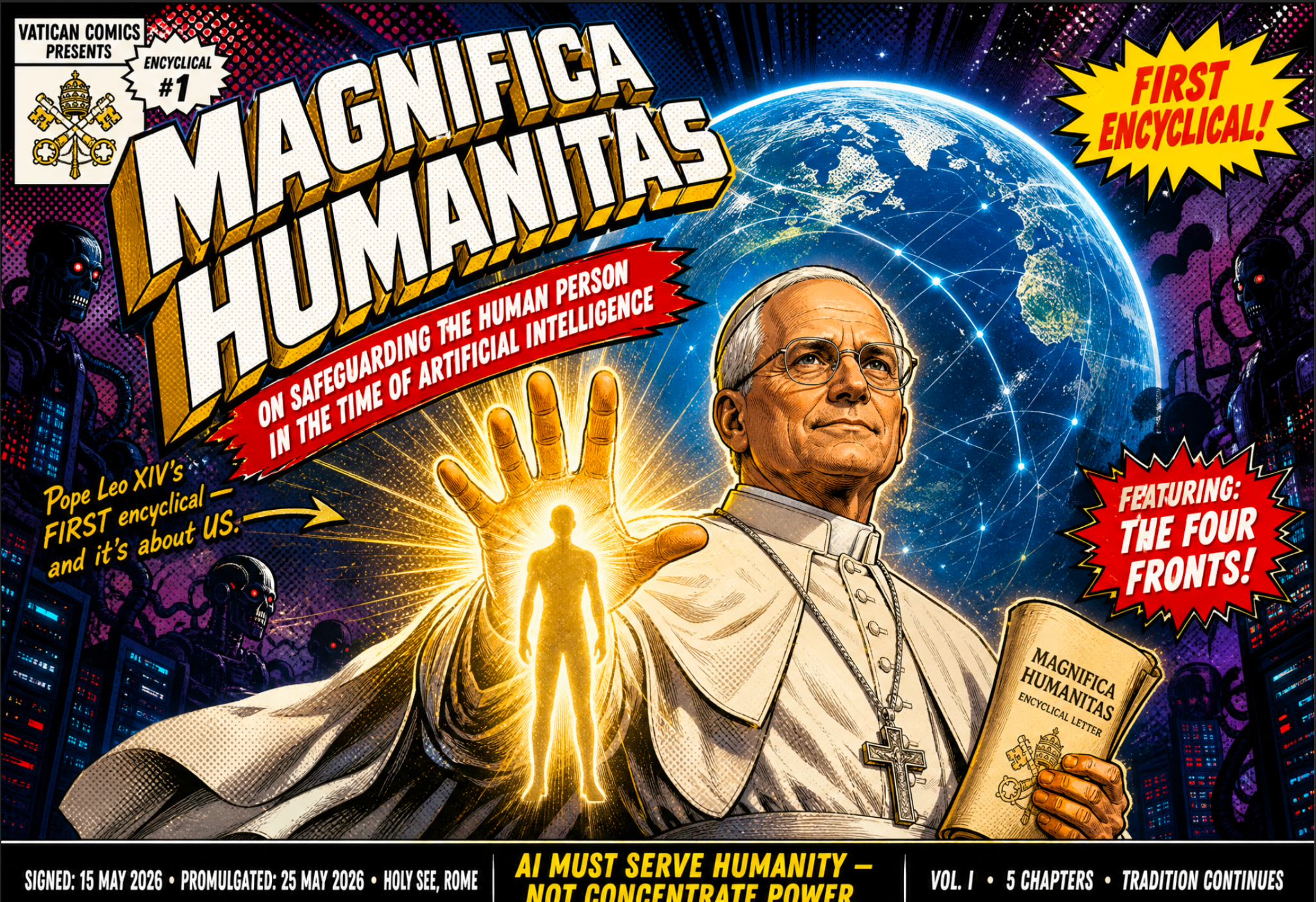
I can hear the objection, because I had it myself: Isn’t it a little rich—in bad taste, even—to run an encyclical on AI through an AI? To use the machine to skim the Pope’s warning about the machine? Feeling guilty, I closed the comic and read the whole thing myself, slowly.
The penance turned out to be unnecessary, because the guilt rests on a false premise. Magnifica Humanitas is not anti-AI. That’s not to say His Holiness doesn’t see something in AI to worry about, but the things that he’s worried about have more to do with the systems of power surrounding AI than they do with AI itself.
 Create a free account to continue reading
The Only Subscription
You Need to
Stay at the
Edge of AI
The essential toolkit for those shaping the future

"This might be the best value you
can get from an AI subscription."
- Jay S.
 Every Content
 AI&I Podcast
 Monologue
 Cora
Cora
 Sparkle
 Spiral
Join 100,000+ leaders, builders, and innovators

Email address

Already have an account? Sign in
What is included in a subscription?
Daily insights from AI pioneers + early access to powerful AI tools


 Front-row access to the future of AI
 In-depth reviews of new models on release day
Playbooks and guides for putting AI to work
Prompts and use cases for builders
In-depth reviews of new models on release day
Playbooks and guides for putting AI to work
Prompts and use cases for builders
In-depth reviews of new models on release day
Playbooks and guides for putting AI to work
Prompts and use cases for builders
In-depth reviews of new models on release day
Playbooks and guides for putting AI to work
Prompts and use cases for builders
 Bundle of AI software




.png)
 Every Staff
.png)
.png)
 Reviews of new AI models on release day
Comments
Don't have an account? Sign up!
I was pleasantly surprised to see you cover Magnifica Humanitas in this newsletter! You nailed it on the throughline from Rerum Novarum to Magnifica Humanitas.