


Rhea Purohit focuses on research-driven storytelling in tech. She writes about the psychology and history of adopting new technologies.
.jpg&w=64&q=90)
Reid Hoffman Makes Five Predictions About AI In 2026
LinkedIn’s cofounder on agents beyond coding, AGI, and the skill that matters next
Jan 7, 2026 · 7 min readUpdated Sep 1, 2026

TL;DR: Today, we’re releasing a new episode of our podcast AI & I, where Dan Shipper sits down with Reid Hoffman, the cofounder of LinkedIn, author, and venture capitalist to talk about Hoffman’s predictions about AI for 2026. Watch on X or YouTube, or listen on Spotify or Apple Podcasts.
Was this newsletter forwarded to you? Sign up to get it in your inbox. Plus: Help us scale the only subscription you need to stay at the edge of AI. Explore open roles at Every.
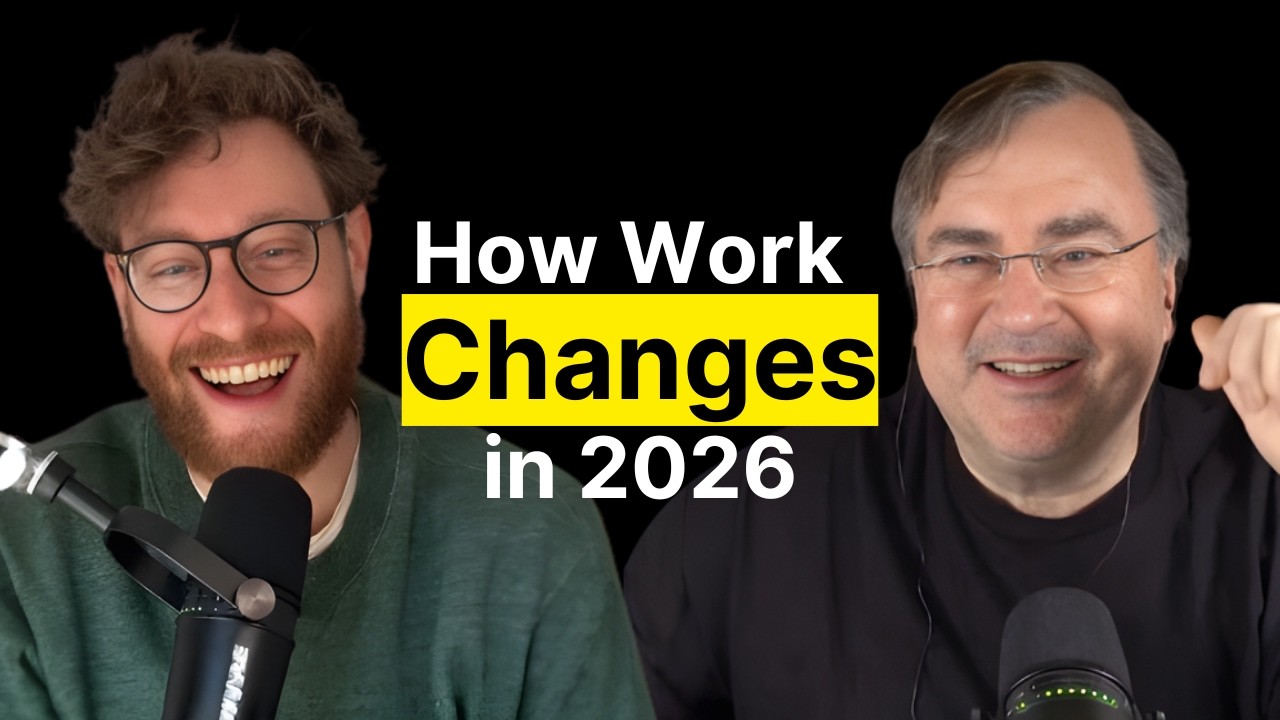
From cofounding LinkedIn to backing OpenAI early, Reid Hoffman is in the habit of being right about the future, so we wanted to know what he saw coming in 2026.
In his third appearance on AI & I, Hoffman lays out his predictions for where AI will go in the 12 months ahead. He talks to Dan Shipper about how agents will break out of coding into other domains and who’s winning the coding agent race. They also get into how Hoffman defines artificial general intelligence, the way he believes enterprises will use AI, and why public debate on AI might turn more negative, even as the technology becomes more empowering for individuals.
Hoffman’s other bets on the future include cofounding AI drug discovery startup Manas AI, investing at venture capital firm Greylock Partners, writing books, and hosting the Masters of Scale podcast. He’s also an investor at Every.
Here is a link to the episode transcript.
You can check out their full conversation here:

Here are some of the themes they touch on:
#1 Coding agents are the foundation for all AI tools
Hoffman sees coding as the category frontier AI labs have to get right, because the foundations that make coding agents powerful—such as planning, making agents work in parallel, and orchestrating complex tasks—are the same patterns needed to build AI tools for every other form of knowledge work.
Agents will break out of coding—and spread everywhere else
While many marked 2025 as the year of AI agents, Hoffman doesn’t think we’re quite there yet. There was significant development in agentic coding capabilities—which we saw in the rise in popularity of tools like Claude Code and Codex—but only a relatively small number of people benefited. He sees 2026 as the year we move from “agentic coding” to “agents in everything else.” In practice, that means that exponentially more people will know what it’s like to walk away from their computer, grab a coffee, and return to find productive work completed in their absence.
Going a level deeper, Hoffman predicts that as agents become more widespread, “orchestration,” or managing agents working in parallel, will become an important skill for knowledge workers. He expects this trend to accelerate in the last quarter of 2026 and land even more strongly in 2027.
Plan for a crowded field in the coding agent race
On the competitive landscape for companies making agentic coding tools, Hoffman expects 2026 to look like a horse race: the leaders such as OpenAI and Anthropic staying neck-and-neck, trading the front position back and forth as new launches push one contender slightly ahead, then the other. According to him, the era of OpenAI “blazing ahead alone” is over, and he credits Anthropic for what they achieved with Opus 4.5 and Claude Code using less capital and compute than competitors. None of the front-runners will fall out of the race completely, he predicts, while noting that companies who have scarcely entered, such as Apple, will only find it harder to catch up. Meanwhile, Hoffman is watching for breakout moves from smaller players like Replit and Lovable, predicting that “with pretty high probability, something will surprise us here.”
#2 AGI in 2026 will be one person with the capacity of a team
When asked for his take on humanity’s timeline for achieving AGI, Hoffman quips that his go-to joke is that AGI is “the AI we haven’t invented yet” because by some definitions, we already have it. For example, AI can already write research reports faster than humans, so a more useful question is what meaning we will give to the term AGI in 2026. While Hoffman doesn’t expect the sci-fi version—a “press-a-button, fully human-capable software engineer”—he does anticipate humans doing high-leverage work by directing teams of agents, so that a single person operates with the capacity of an entire team. That agent-driven “AGI,” Hoffman predicts, will expand beyond coding into broader domains in 2026.
#3 Enterprises that sleep on AI will be left behind
The current narrative is that enterprise AI deployments haven’t lived up to the hype. Hoffman thinks that will change—but big companies need to get out of their own way first. By the end of 2026, he predicts, any company that wants to be “a thriving, growing concern” will need to be recording every meeting and running agents on the output, to identify who should be notified, surface action items, and prepare briefings for the next meeting. If you’re not doing it by then, it’s like insisting “cars won’t be a big thing, we can keep doing horses and buggies.” Beyond meetings, he expects companies to systematically deploy groups of agents to solve problems across the organization—another reason he sees orchestration as the defining capability of the next phase.
#4 Discourse around AI might get uglier—even as the tools improve
Most people have never experienced what it feels like to succeed at creating something, and tools like Claude Code and OpenAI’s Sora are changing that, Hoffman says. However, he expects popular discourse about AI to become even more negative as the technology is blamed for causing broader social change. While he does believe that as AI becomes more capable and integrated, its real impacts will grow—job roles will change, for example—according to Hoffman, the technology will become a catch-all scapegoat for “things being…different than [people] would like.”
#5 Biology will be the next ‘language’ AI learns
When asked to name an unsung AI category we’ll be talking about by the end of 2026, Hoffman points to biology, an area he’s been focusing on through his work at drug discovery startup Manas AI. Right now, the frontier is dominated by AI that stays close to human language—either natural language itself or code. But he expects everything we’ve learned about building AI to be applied to “language sets” further from human language, like biological systems. In essence, that means treating biology as a kind of language to model molecules and pathways, and generate new hypotheses about how life works.
What do you use AI for? Have you found any interesting or surprising use cases? We want to hear from you—and we might even interview you.
Timestamps
- Introduction: 00:00:52
- The future of work is an entrepreneurial mindset: 00:02:20
- Creation is addictive (and that’s okay): 00:05:22
- Why discourse around AI might get uglier this year: 00:09:22
- AI agents will break out of coding in 2026: 00:17:03
- What makes Anthropic’s Opus 4.5 such a good model: 00:24:18
- Who will win the agentic coding race: 00:28:46
- Why enterprise AI will finally land this year: 00:36:13
- How Hoffman defines AGI: 00:43:16
- The most underrated category to watch in AI right now: 00:55:33
You can check out the episode on X, Spotify, Apple Podcasts, or YouTube. Links are below:
- Watch on X
- Watch on YouTube
- Listen on Spotify (make sure to follow to help us rank!)
- Listen on Apple Podcasts
Miss an episode? Catch up on Dan’s recent conversations with founding executive editor of Wired Kevin Kelly, star podcaster Dwarkesh Patel, LinkedIn cofounder Reid Hoffman, ChatPRD founder Claire Vo, economist Tyler Cowen, writer and entrepreneur David Perell, founder and newsletter operator Ben Tossell, and others, and learn how they use AI to think, create, and relate.
If you’re enjoying the podcast, here are a few things I recommend:
- Subscribe to Every
- Follow Dan on X
- Subscribe to Every’s YouTube channel
Rhea Purohit is a contributing writer for Every focused on research-driven storytelling in tech. You can follow her on X at @RheaPurohit1 and on LinkedIn, and Every on X at @every and on LinkedIn.
We build AI tools for readers like you. Write brilliantly with Spiral. Organize files automatically with Sparkle. Deliver yourself from email with Cora. Dictate effortlessly with Monologue.
We also do AI training, adoption, and innovation for companies. Work with us to bring AI into your organization.
Get paid for sharing Every with your friends. Join our referral program.
For sponsorship opportunities, reach out to [email protected].
The Only Subscription
You Need to
Stay at the
Edge of AI
The essential toolkit for those shaping the future

"This might be the best value you
can get from an AI subscription."
- Jay S.
 Every Content
 AI&I Podcast
 Monologue
 Every Agent
Join 100,000+ leaders, builders, and innovators

Already have an account? Sign in.
What is included in a subscription?
Daily insights from AI pioneers + early access to powerful AI tools

 Front-row access to the future of AI
 In-depth reviews of new models on release dayPlaybooks and guides for putting AI to workPrompts and use cases for buildersIn-depth reviews of new models on release dayPlaybooks and guides for putting AI to workPrompts and use cases for builders
 Bundle of AI software





 Katie Parrott
 Every Staff
 Kieran Klaassen
Comments