


Laura Entis is a staff writer at Every.

Welcome to Efficiencymaxxing
Plus: Why intent beats volume, a new AI productivity status metric, and a tool for squeezing the most out of cheaper models
Jul 8, 2026 · 11 min readUpdated Aug 2, 2026

For a brief period, AI was an affordable novelty. Every use case felt like magic, and even the silliest task was worth a try when frontier labs were subsidizing compute costs to get consumers hooked. Power users proved their status by maxing out their token consumption.
Now, AI is ubiquitous—even required in many workplaces—and easy to use for anything from code to text to visuals. But this flood of production has a price: in cash, as powerful new models grow more token-hungry and the labs roll back those generous subsidies, but also in the time and effort required to make sense of the results. (If you’ve ever tried to debug an AI-generated codebase, edit AI-generated text, or decipher the meaning behind an AI-generated email, you know how labor-intensive it can be to wade through poor-quality LLM outputs.)
Focus has evolved accordingly from how much you’re using AI to how you’re using it—and what you can show for it. Does the benefit justify the significant cost?
Today’s Context Window explores various answers and solutions to that question. First up, author and technologist Craig Mod explains why cheap software creation has made him more protective of his writing time; Monologue general manager Naveen Naidu shares a new efficiency metric he heard making the rounds in San Francisco; senior applied AI engineer Nityesh Agarwal shows us how he audits agents for wasted tokens; and Spiral general manager Marcus Moretti explains how OpenRouter helps him manage a 12-plus-model stack.
Was this newsletter forwarded to you? Sign up to get it in your inbox.
A different kind of accelerator
The entire economy is up for grabs in a post-AI world. What will you build?
Elbow Grease is a new accelerator from Gutter Capital in NYC. This is not a finishing school for fundraising—it’s where you build a business with people who’ve done it before. The program offers a $300,000 initial investment, weekly coaching from Gutter partners Dan Teran and James Gettinger, and 1:1 mentorship from a Series B+ or exited founder. Come work among the Gutter portfolio and learn from industry veterans Scott Belsky, Gokul Rajaram, and Hunter Walk, to name a few. Apply by July 31!
‘AI & I’: AI that helps you work on what you care about
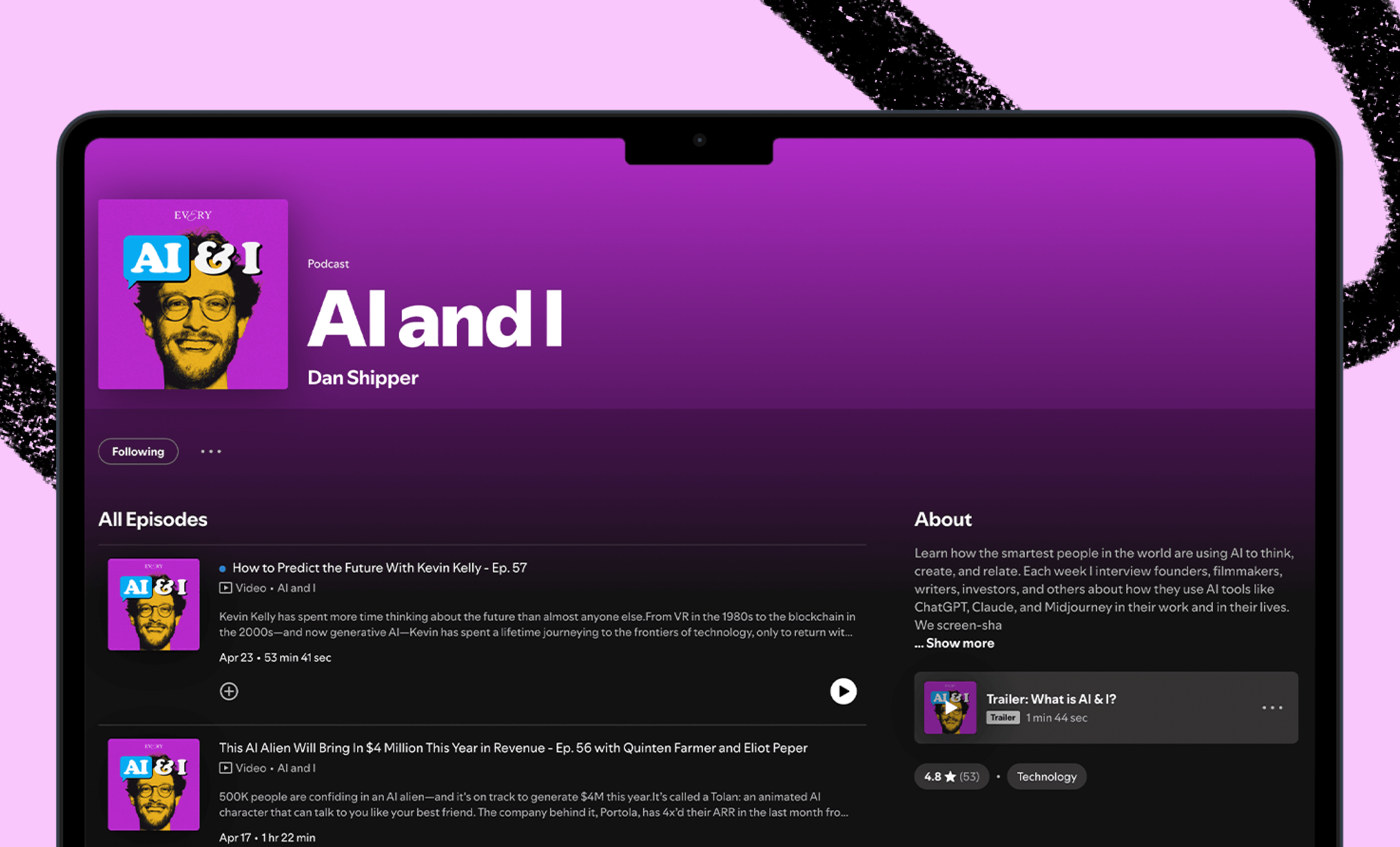
AI is powerful. According to CEO Dan Shipper, it’s also a “slot machine.” How, then, can you use the technology to create stuff that matters while avoiding the hunt for the next dopamine hit?
To help answer that question, Dan had author and technology enthusiast Craig Mod on the show to discuss how to be ruthless about preserving his time.
Watch on X or YouTube, or listen on Spotify or Apple Podcasts. You can also read the transcript.
- AI is great at making better versions of the products you already pay for. Mod’s been using LLMs—primarily Opus, more recently Fable— to vibe-code alternatives to SaaS products like the email marketing platform Campaign Monitor and personal finance software Quicken. The benefit is twofold: He can tailor the service to his exact specifications, and a $1,200-a-year Claude fee is way cheaper than paying for multiple subscriptions. “I think we’re going to enter this golden age of tool building,” Mod says. “There’s going to be more competition in the marketplace forcing more innovation”—a net-positive “except for incumbents.”
- It puts a higher premium on intent. AI allows you to attempt all sorts of things that previously required years of expertise and training. The possibilities are dizzying, which makes it easy to lose sight of what you want to devote your energy toward in the rush of endless production.
Somewhat counterintuitively, the ease with which software can be made now has reaffirmed Mod’s commitment to writing. “There are plenty of people playing around with this stuff,” he says. “But there aren’t that many people who are going to think about or write the weird books I feel drawn to write, and as a human, that feels like the valuable thing for me to put my effort into.”
While he’ll use AI for research and fact-checking, he still writes every word himself. Outsourcing that process to an LLM would defeat the purpose when “being in the mess of writing” is the point—and the way to get the results he’s looking for.
- Mod creates intentional barriers to maintain focus. He keeps his phone on a separate floor from where he sleeps—and does his best not to check it until after lunch—and writes on a dedicated MacBook that isn’t connected to the internet. As soon as his brain encounters WiFi, he says, “I feel the chemicals shift and I can’t go into any kind of deep thinking place, deep attention, deep focus.”
Miss an episode? Catch up on Dan’s recent conversations with LinkedIn cofounder Reid Hoffman; the team that built Claude Code, Cat Wu and Boris Cherny; Vercel cofounder Guillermo Rauch; podcaster Dwarkesh Patel; and others, and learn how they use AI to think, create, and relate.
Overhead in SF
A new AI status metric
While on the ground in San Francisco for Apple’s Worldwide Developers Conference last month, Monologue general manager Naveen Naidu noticed a new metric for measuring enterprise productivity making the tech-circle rounds: revenue per million tokens.
A purported measure of a company’s efficiency, revenue per million tokens is a potential successor to revenue per employee, a rough estimate for how much money each worker at a company generates. (AI-native companies tend to score significantly higher on this scorecard than their traditional SaaS counterparts.)
By explicitly tying ROI to how efficiently a company makes money with AI, revenue per million tokens acknowledges that engineering has become cheap while the cost of compute is more expensive than ever. Or more simply: “If you say, ‘I wrote a million lines of code,’ did it actually increase your revenue or not?” Naveen says.
Inside Every
A peek into a more token-efficient future
I’ve started to think of senior applied engineer Nityesh Agarwal as Every’s resident AI seer, particularly when it comes to Anthropic. Three to six months before the AI lab released...
Become a paid subscriber to Every to unlock this piece and learn about:
- Why the era of subsidized AI experiments is ending sooner than you think
- The manual token audit that reveals where your agent is quietly burning compute
- How one LLM gateway keeps Spiral running across 12 different models without interruption
A different kind of accelerator
The entire economy is up for grabs in a post-AI world. What will you build?
Elbow Grease is a new accelerator from Gutter Capital in NYC. This is not a finishing school for fundraising—it’s where you build a business with people who’ve done it before. The program offers a $300,000 initial investment, weekly coaching from Gutter partners Dan Teran and James Gettinger, and 1:1 mentorship from a Series B+ or exited founder. Come work among the Gutter portfolio and learn from industry veterans Scott Belsky, Gokul Rajaram, and Hunter Walk, to name a few. Apply by July 31!
 Create a free account to continue reading
The Only Subscription
You Need to
Stay at the
Edge of AI
The essential toolkit for those shaping the future

"This might be the best value you
can get from an AI subscription."
- Jay S.
 Every Content
 AI&I Podcast
 Monologue
 Every Agent
Join 100,000+ leaders, builders, and innovators

Already have an account? Sign in.
What is included in a subscription?
Daily insights from AI pioneers + early access to powerful AI tools


 Front-row access to the future of AI
 In-depth reviews of new models on release dayPlaybooks and guides for putting AI to workPrompts and use cases for buildersIn-depth reviews of new models on release dayPlaybooks and guides for putting AI to workPrompts and use cases for builders
 Bundle of AI software




 Katie Parrott
 Every Staff
 Kieran Klaassen
Comments