


Laura Entis is a staff writer at Every.

The Ops Team That Routes Work Across Models
Plus: Granola’s founder on why starting a company is a 'knife fight,' AI enters the C-suite, and who we’re following on X
Jul 15, 2026 · 9 min readUpdated Aug 12, 2026

AI models have never been smarter or more capable. But using them to their full potential still requires AI skills, fluency, and most of all, the willingness to hand over complex work to an agent—or agents. Today, we show how our business operations team works across Fable, Codex, and the customer support platform Fin, then look at Granola’s plan to turn meetings into context any agent can use. We also explain why Sonnet 5 still isn’t great at writing (but does better at more tightly scoped tasks), examine three roles emerging in the AI era, and share some of our favorite people to follow on X.
Was this newsletter forwarded to you? Sign up to get it in your inbox.
Inside Every
Biz ops at the frontier
Executive operations manager Jalaiyah Bolden had a couple of days to turn around a customer-support plan for the launch of Every All Access, a new annual membership for builders that includes unlimited access to Every products, among other perks. The information she needed was scattered across half a dozen sources. “It was information overload,” she says—the kind that could have sunk much bigger ops teams.
Instead of scrambling, Jalaiyah took a deep breath and surfed the models.
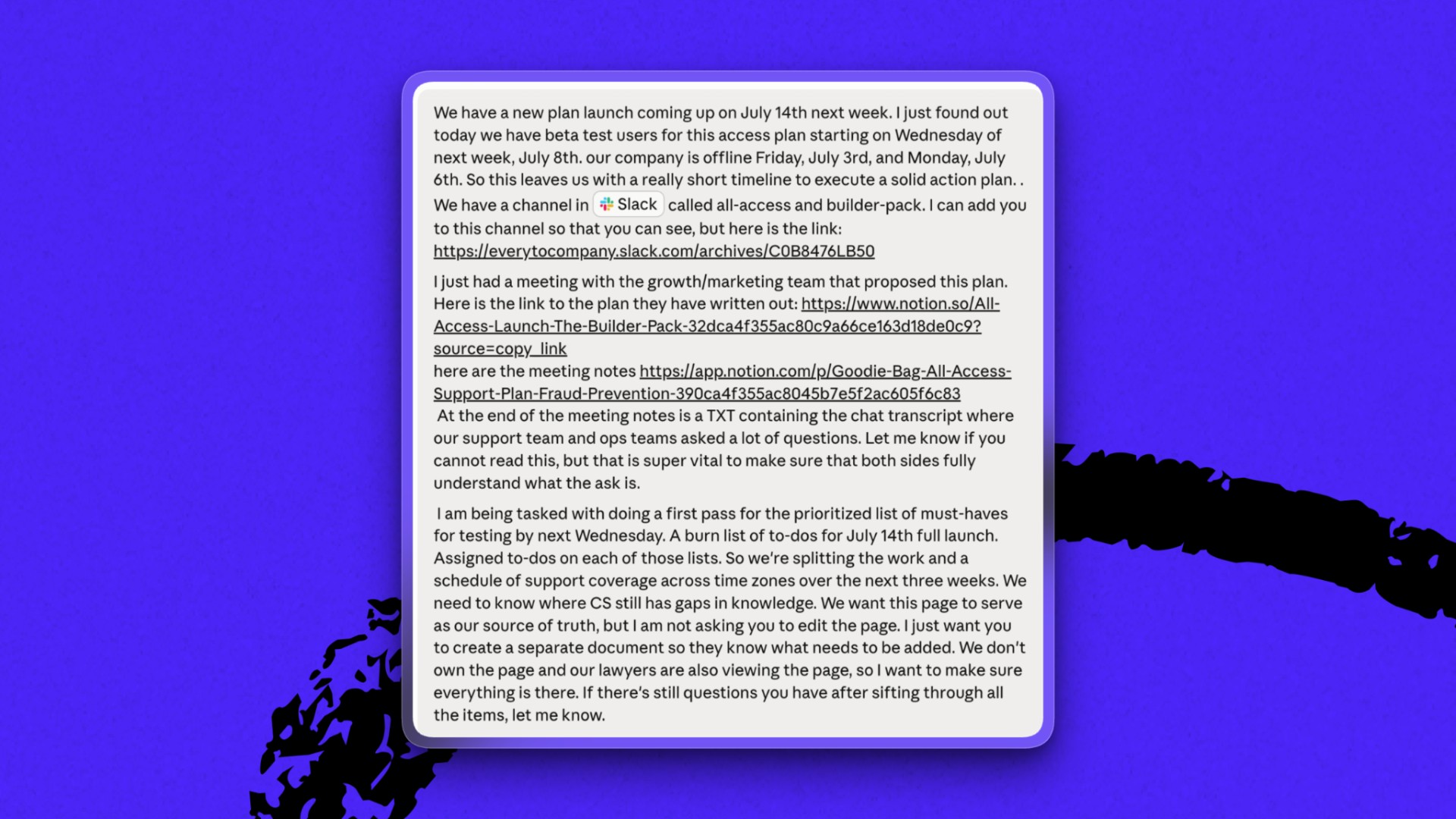
First, she summoned Fable. Giving the model access to all relevant context, she instructed it to ask clarifying questions about anything that was missing, and then get to work.
Fable audited Slack channels and read the Notion documents and meeting transcripts. It visited the launch’s staged websites, clicked through buttons to confirm they worked, and flagged places where a page contradicted information from a meeting or source document. Then it turned the findings into a prioritized action plan and drafted support material: three user-facing help articles, a half dozen snippets written for Fin—formerly Intercom, a customer support platform—and 17 templates human support agents could use to respond to users. The whole process took about 90 minutes—mostly in the background—freeing up Jalaiyah to focus on other things.
After reviewing and “humanizing” the language, Jalaiyah handed everything to head of operations Arielle Shipper, who fired up Codex to proofread the documents and create a Notion tracker so they could all see who owned what and stay on track. The customer-support plan came together smoothly with time to spare. Knowing when and how to use different models allows the team to regularly meet seemingly impossible deadlines.
Steal this workflow
Turn a bad support chat into better agent instructions
When Fin’s customer support agent handles a customer conversation incorrectly, CS manager Waqqas Mir doesn’t rewrite its entire support setup. Instead, he uses Codex to turn the mishandled chat into a targeted new instruction. Using this method, he’s added a rule specifying when the agent should escalate an angry customer to a human and an explicit instruction to patch a bug in which Fin would generate code for a user if they asked—a guardrail Waqqas put in after he got Fin to write him a file-conversion script during a test.
Waqqas’s workflow:
- Connect Codex to Fin through the platform’s Model Context Protocol (MCP) server. Once authorized, the MCP lets Codex retrieve conversations from your Fin workspace. In a Codex prompt, enter the identification numbers for two or three chats where Fin made the wrong call and ask Codex to pull the full conversations and diagnose what went wrong.
- Ask Codex where the instructions broke down. Follow up by asking, “Why did it not follow my instructions? Can you identify what is causing the confusion?” Codex will identify missing, unclear, or contradictory guidance, and propose concise additions to fix the issue.
- Add the proposed rule and retest the scenario. The MCP connection allows Codex to analyze Fin data, but Codex cannot directly change Fin’s setup. Waqqas adds the new guidance himself, then runs the same type of conversation again. If Fin repeats the mistake, he gives Codex that conversation’s chat ID and asks it to pinpoint which instruction is still causing the issue.
‘AI & I’: Granola looks beyond meeting notes


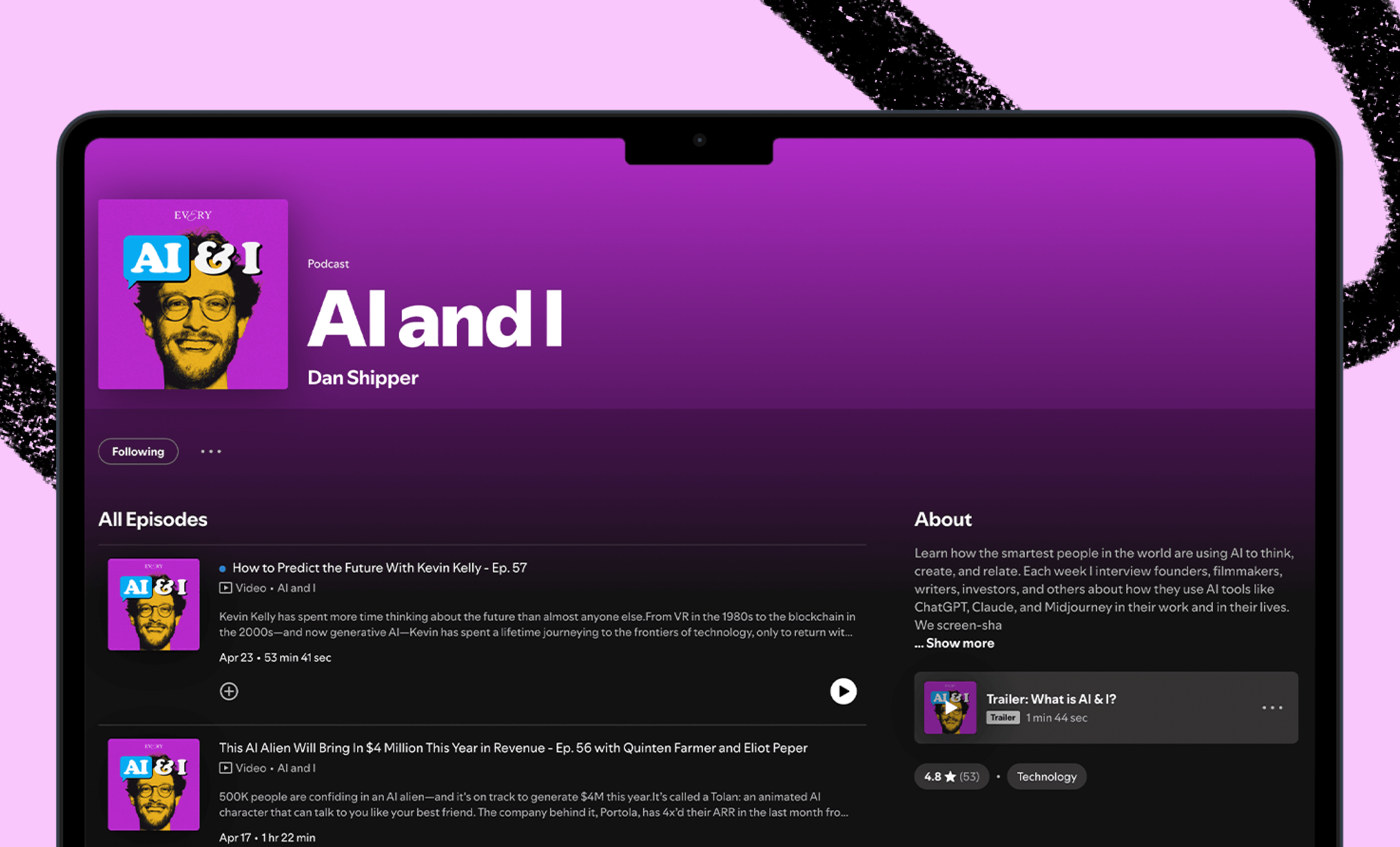
On this week’s AI & I, Granola cofounder and CEO Chris Pedregal says running a startup is “a knife fight” that never ends. The company built its name—and achieved a $1.5 billion valuation—on making a killer AI notetaker, but it can’t coast: Notion, OpenAI, and Zoom now offer tools that transcribe and summarize meetings, too.
Chris tells Every CEO Dan Shipper that the larger battle is over “what interface we use for work and what work looks like in an AI-native world.” That’s why Granola plans to own the work around meetings: preparing people beforehand, helping them act afterward, and making meeting context available to whatever agent they use.
Over the next few months, Granola plans to improve its API and MCP so it can be a leader in this space. “There’s an incredible opportunity ahead, and we have a shot at it, along with a few other companies,” Pedregal says.
He’s bullish on the company’s direction and strategy but knows it’s still early days—the knife fight will never be over.
“When people say, ‘Granola’s doing really well,’ in my mind it’s easy come, easy go,” he says. “Meeting notes are useful, but a lot is going to change, and just because people use us today doesn’t mean they’ll use us for that in the future if we’re not the best at the next thing.”
Watch on X or YouTube, or listen on Spotify or Apple Podcasts. You can also read the transcript.
Pulse Check
Spiral’s general manager settles in with Sonnet 5
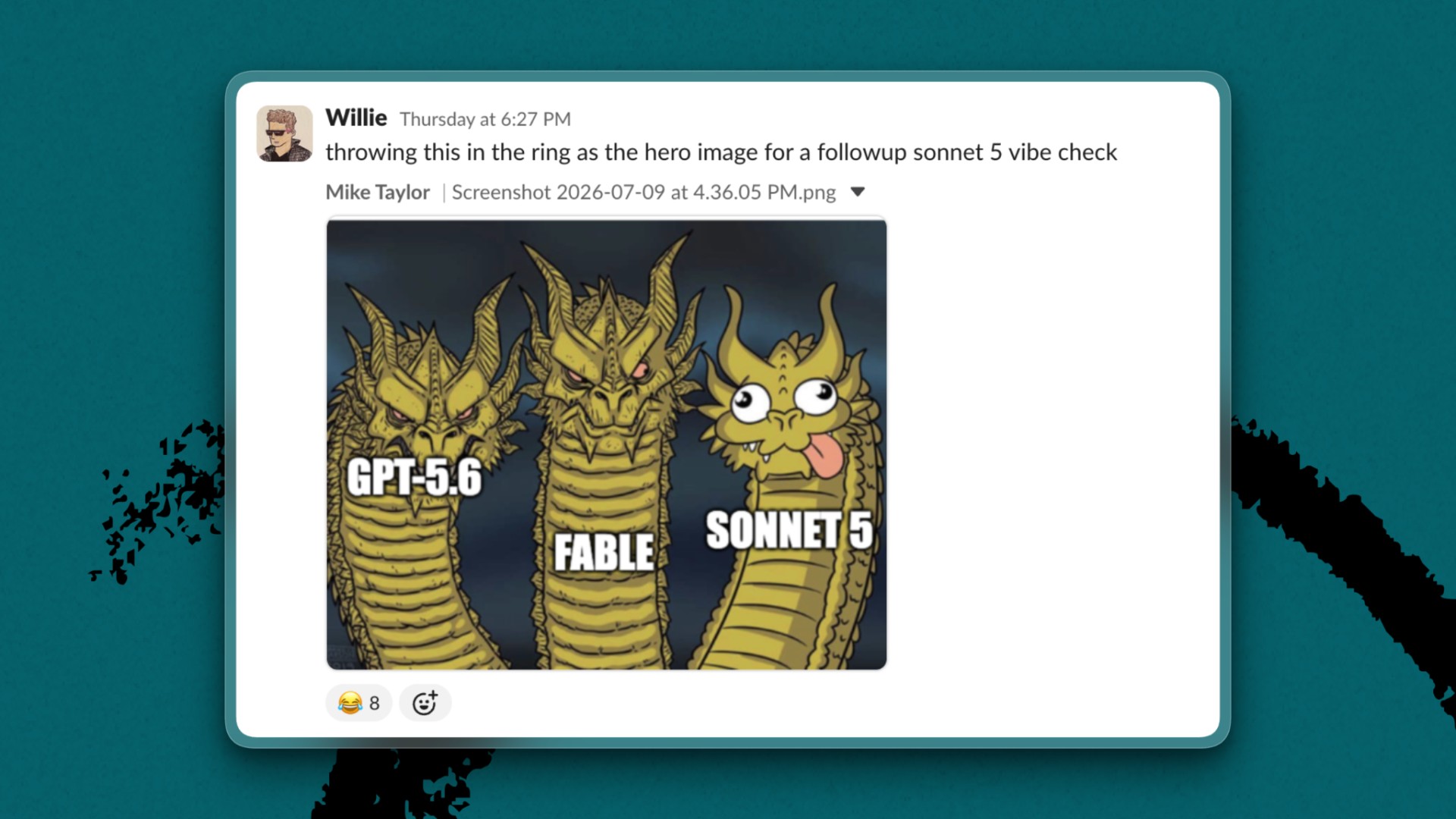
Initial reviews of the model here at Every were lackluster at best. Two weeks into testing Sonnet 5 in his workflows, Marcus Moretti finds the sentiment largely holds—although he has found an area where Sonnet 5 justifies its existence.
Sonnet generates most of the text in Spiral, Every’s writing app. Spiral billing is token based, and Sonnet 5 was announced to use around 30 percent more tokens for similar outputs than Sonnet 4.6. That was a big reason not to drop it into Spiral. On another, internal product, swapping in Sonnet 5 produced more formatting errors and lower-quality responses. Not wanting to pay more for worse results, we reverted to Sonnet 4.6 after a few days of testing—and decided to keep Spiral running on 4.6 until the next release.
That said, Sonnet 5 does appear to perform well at the specific task of analytics reporting. On several products, we run the compound engineering /ce-product-pulse command—essentially a product health report—on a daily loop. Sonnet 5 does this really well.
For those kinds of recurring, tightly scoped tasks, Sonnet 5 balances affordability and performance.—Marcus Moretti
Log on
Get hands-on with how Every uses AI. These are the live camps, workshops, and meetups where team members teach the workflows behind our work.
Upcoming event
- Every IRL (July 15): An in-person meetup at Every’s Brooklyn headquarters, for paid subscribers only, from 6–8 p.m. ET. RSVP.
- Office Hours: All Access Builders (July 24): In the kick-off to what will be a recurring series, the Every team will share how we use the tools in the Builder Pack, before working through member questions and projects together. Bring one thing you want to build or improve. This virtual event is only available to All Access members.
Net new jobs
The chief AI officer role is growing
More non-technology companies are adding this position to the leadership team in an effort to understand how best to use AI and measure its impact...
Become a paid subscriber to Every to unlock this piece and learn about:
- Why chief AI officers are becoming a fixture in banks, consultancies, and law firms
- How “full-stack AI creators” are helping startups stand out in a crowded market
- Six AI builders and engineers Every staffers recommend following on X
 Create a free account to continue reading
The Only Subscription
You Need to
Stay at the
Edge of AI
The essential toolkit for those shaping the future

"This might be the best value you
can get from an AI subscription."
- Jay S.
 Every Content
 AI&I Podcast
 Monologue
 Every Agent
Join 100,000+ leaders, builders, and innovators

Already have an account? Sign in.
What is included in a subscription?
Daily insights from AI pioneers + early access to powerful AI tools


 Front-row access to the future of AI
 In-depth reviews of new models on release dayPlaybooks and guides for putting AI to workPrompts and use cases for buildersIn-depth reviews of new models on release dayPlaybooks and guides for putting AI to workPrompts and use cases for builders
 Bundle of AI software





 Katie Parrott
 Every Staff
 Kieran Klaassen
Comments