



Life After Automation
Plus: One person running an engineering team of agents, what it costs to stay at the frontier, and the case for AI writing
Aug 23, 2026 · 6 min readUpdated Sep 18, 2026

Hello, and happy Sunday! This week we launched Thesis Statements, where 100 AI leaders call their shots on work after automation. The project sets the stage for November’s Thesis: 2027 conference. Elsewhere, life on the frontier got expensive—and organizational: Every’s AI bill jumped 230 percent, one engineer turned Codex into a team of specialists, and mental healthcare company Headway built the secure assistant it couldn’t buy. We also made the case for AI writing that keeps human judgment in the loop, and introduced a frontier team to keep weird experiments going amid urgent work.
Was this newsletter forwarded to you? Sign up to get it in your inbox.
Knowledge base
“What Does Human Work Look Like After Automation?” by Dan Shipper/On Every: When execution is cheap and intelligence is abundant, what’s left for people to do? Thesis Statements collects 100 specific, contestable predictions from AI leaders who live on the frontier. The first 25 are live: Linear CEO Karri Saarinen argues that AI’s biggest problem will be design; Ness Labs founder Anne-Laure Le Cunff says answers will become abundant and questions will become the hard part; and Granola cofounder Chris Pedregal predicts some of your hardest problems will solve themselves. We’ll share more statements weekly until the conference and revisit the claims to see which pan out. You can also submit your own.
“Our AI Costs Jumped 230 Percent. I’m Not Setting Token Budgets—Yet.” by Arielle Shipper/Every: When GPT-5.6 Sol landed, Every’s daily credit usage jumped from 11,520 to 26,685 credits—more than twice its baseline. Head of operations Arielle Shipper had to control spend without killing the experimentation the business runs on. Her answer: Parameters, not policies. Rather than hard limits, she interrogates any big run with three questions—what it cost, what it bought us, and what we learned—and shares four lessons for managing operations at the frontier.
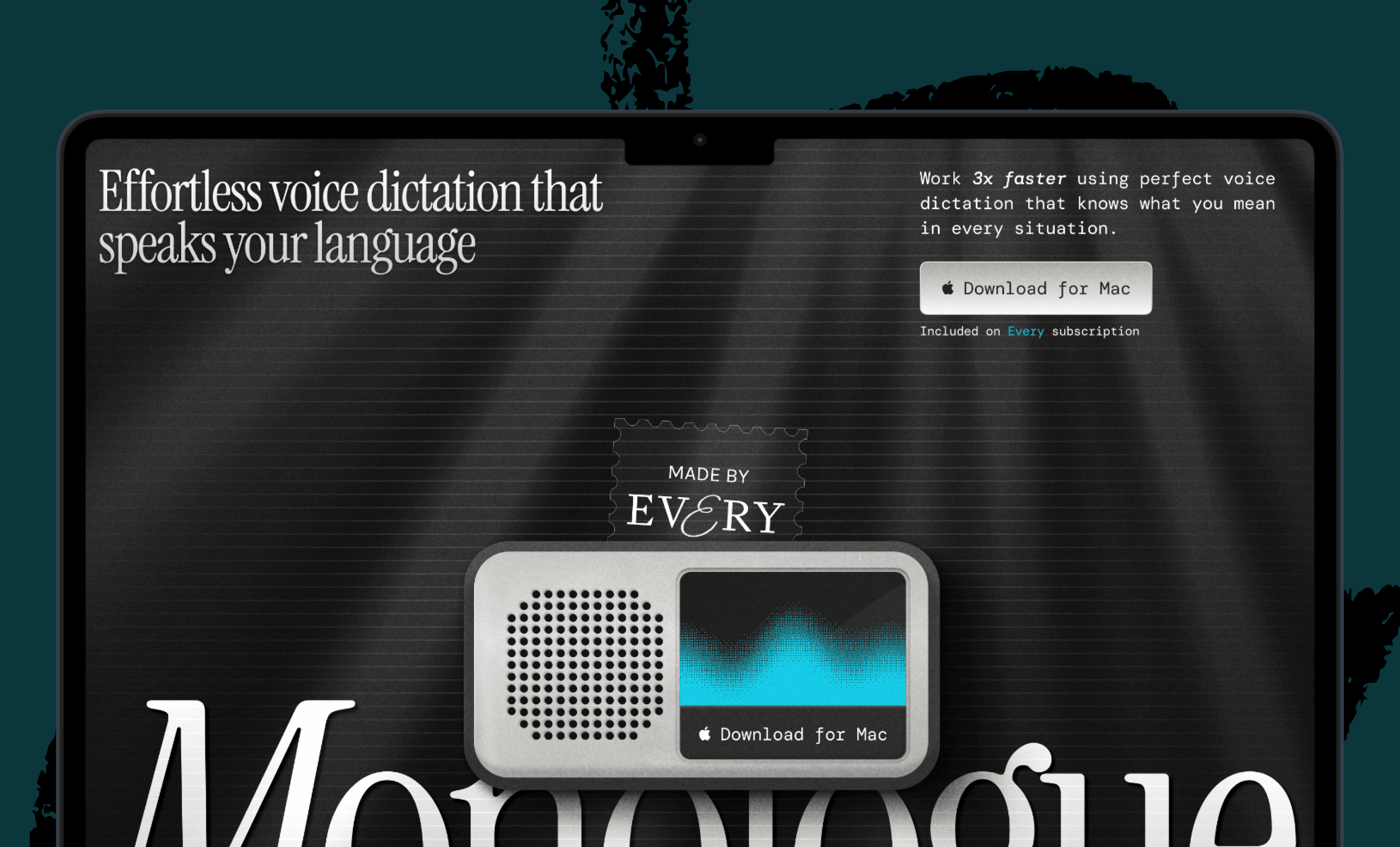
“An Engineering Team for the Cost of Codex” by Laura Entis/Context Window: With GPT-5.6, one person can now manage a team of specialized AI agents that functions like a full engineering team. Naveen Naidu runs his Monologue shop as a roster of specialized Codex agents that hand work off to each other like coworkers. Also inside: Naveen’s specific workflow; a breakdown of the tech stack lead designer Daniel Rodrigues used to build Every’s Thesis: 2027 brand and website; a “discuss” on whether harness engineering will go the way of prompt engineering; and an AI & I episode from the archive on why AI companions are a new art form, with Portola cofounder Quinten Farmer and head of story Eliot Peper. 🎧🖥 Listen on Spotify or Apple Podcasts, watch on X or YouTube, or read the transcript.
“In Defense of AI Writing” by Laura Entis/Context Window: Is AI writing automatically slop? Not always. Every’s head of tech consulting Mike Taylor writes many of his posts with AI assistance—dictating tests he ran himself, then letting a model format them—a workflow that shrinks a day of writing to two hours and gets his ideas in front of more people. Also inside: a “signal” unpacking the fight over Anthropic’s plan to watermark Claude’s text, and a “steal this workflow” on how senior editor Jack Cheng batches Google Docs edits with Codex and the ChatGPT Chrome extension.
“The Healthcare Company That Built the AI Tool It Couldn’t Buy” by Katie Parrott/Every: When off-the-shelf AI couldn’t meet Headway’s security and compliance needs, mental healthcare company Headway built its own internal assistant, Eddy, on the Claude Code SDK. Today, 650 of its 900 employees now use it daily. Katie Parrott traces how Headway made an autonomous agent safe by running every conversation in a sealed, disposable container, and distills a wait-buy-build framework for deciding when owning your AI tooling beats waiting for a vendor to catch up.
Log on
Get hands-on with how Every uses AI. These are the live camps, workshops, and meetups where team members teach the workflows behind our work.
Recordings you may have missed
Office Hours: All Access Builders: In Friday’s monthly session, the Every team shared what it’s building and what’s coming next, then opened the floor to subscriber questions about stuck agents, drifting workflows, and tools they’re unsure whether to adopt. Watch the recording or upgrade to All Access.
From Every Studio
Meet Every’s frontier team
As Every has grown to almost 30 people, urgent work kept winning over weird experiments. Building reliable products, services, and a daily newsletter takes focus—but odd experiments are often how important discoveries happen. So we’ve given a small group explicit permission to prioritize the experiments and share what they learn. Each week, they’ll test ideas and move the best ones from practice to product. The team members:
- Dan Shipper, CEO
- Katie Parrott, staff writer
- Mike Taylor, head of tech consulting
- Jack Cheng, senior editor
- Kieran Klaassen, general manager of Cora
- Jannik Jung, software engineer
- Arielle Shipper, head of operations
At our weekly show-and-tell, the team shared work on Hands, an experiment designed to let Every Agent start Codex or Claude on your computer from a Slack request. They demonstrated a review queue where experts can evaluate an agent’s choices to improve them over time. They also showed a prototype of an AI-generated map that groups the team’s experiments relative to patterns in how we use various tools—and to our own theses about the future of work after automation.
Inside Every
The Homer Simpson car was ahead of its time
My first lesson in product design came from The Simpsons.
In a classic episode from the show’s second season, Homer reunites with his long-lost half-brother Herb, who runs a struggling Detroit automaker. Herb entrusts his brother to do what his Ivy League executives with their reams of market research can’t: Design the perfect car for the average American man.
The resulting vehicle is so idiosyncratic to Homer—shag carpets, bubble domes, horns that play “La Cucaracha”—and thus costly to manufacture that it bankrupts the company.
Even watching as a kid, I understood that the Homer car showed how not to design a consumer product. It has long represented software feature creep and what happens when you confuse the needs of an individual or small group of people with those of the broader market.
Today, I have my own Homer car. Several, actually—vibe-coded apps with features that fit my unique needs and no one else’s. Friends send me screenshots of their Homer cars, and I see new ones daily in my X feed. SpaceXAI engineer Eric Zakariasson wires up apps for friends and family so they make changes on their own. Bb lets users prompt new features into personal versions of the agent development environment. Larger companies, too, seem to be shipping and open-sourcing what previously might have been too weird to make public; Berd’s quasi-creepy avatars are the shag carpeting of desktop agent apps. Malleable software is upon us.
I’m here for all of it. Because the Homer car has always been more charming than most vehicles on the road—vehicles that in companies’ quests to maximize the total addressable market end up looking like every other. 35 years later, its economics finally make sense.—Jack Cheng
That’s all for this week! Be sure to follow Every on X at @every and on LinkedIn.
Everyone’s a builder now. Every All Access gets you the full membership plus the Builder Pack—$9,000+ in credits for the tools we build with.
 Create a free account to continue reading
The Only Subscription
You Need to
Stay at the
Edge of AI
The essential toolkit for those shaping the future

"This might be the best value you
can get from an AI subscription."
- Jay S.
 Every Content
 AI&I Podcast
 Monologue
 Every Agent
Join 100,000+ leaders, builders, and innovators

Already have an account? Sign in.
What is included in a subscription?
Daily insights from AI pioneers + early access to powerful AI tools


 Front-row access to the future of AI
 In-depth reviews of new models on release dayPlaybooks and guides for putting AI to workPrompts and use cases for buildersIn-depth reviews of new models on release dayPlaybooks and guides for putting AI to workPrompts and use cases for builders
 Bundle of AI software






 Katie Parrott
 Every Staff
 Kieran Klaassen
Comments