
.png&w=3840&q=75)

Rhea Purohit focuses on research-driven storytelling in tech. She writes about the psychology and history of adopting new technologies.
.jpg&w=64&q=90)
Inside an AI High School, Through the Eyes of a 17-Year-Old Founder
Alpha High School student Alex Mathew on how AI changes learning—and what Gen Z really thinks about college, social media, and books
Feb 25, 2026 · 9 min readUpdated Jul 27, 2026

TL;DR: Today, we’re releasing a new episode of our podcast AI & I, where Dan Shipper sits down with Alex Mathew, a 17-year-old student from Alpha High School, an unconventional AI-forward high school in Austin, Texas. Watch on X or YouTube, or listen on Spotify or Apple Podcasts.
Was this newsletter forwarded to you? Sign up to get it in your inbox.
Depending on whom you ask, AI is either the best or worst thing that can happen to the next generation. The arguments come from educators, venture capitalists, op-ed writers, and anxious parents—but rarely from the young people in question.
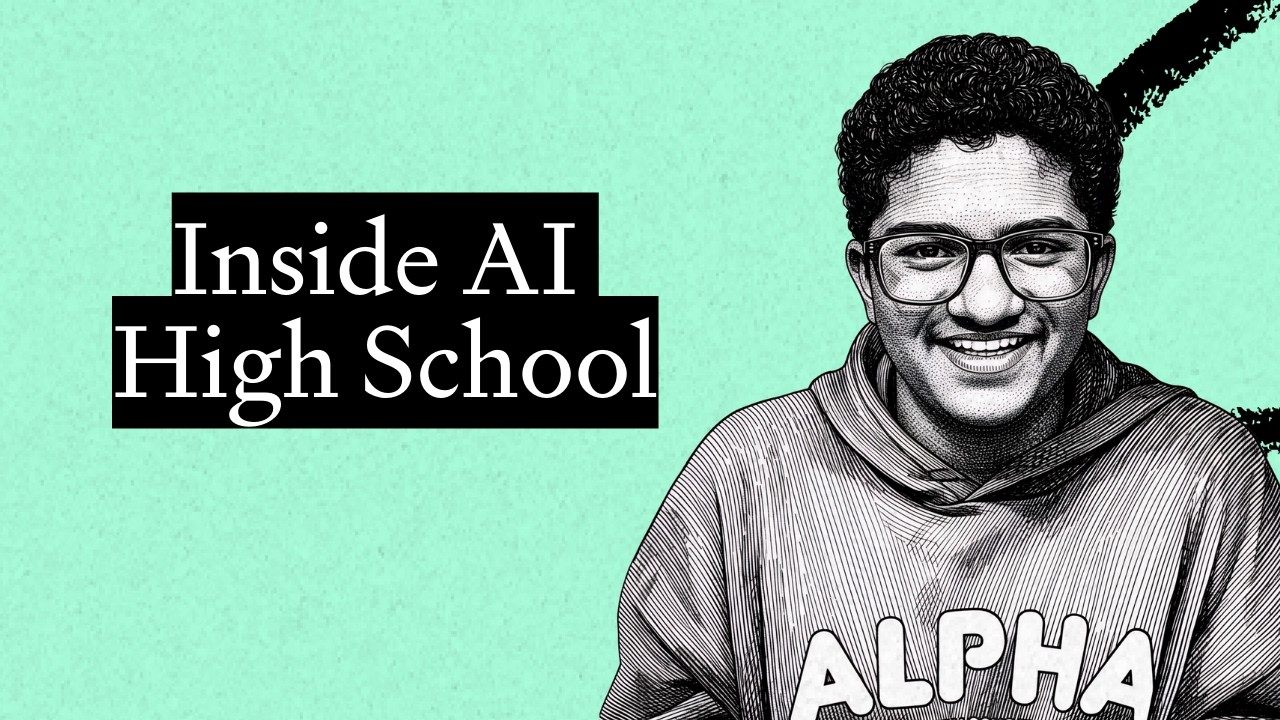
On this episode of AI & I, Dan Shipper sat down with one: Alex Mathew, a 17-year-old high-school senior at Alpha High School in Austin, Texas.
Alpha School, a rapidly expanding network of kindergarten through grade 12 private schools, is not without controversy. Inside Alpha High School, there are no traditional teachers, all academic content is delivered through an AI-powered platform, and the adults in the classroom, known as “guides,” focus solely on supporting the students emotionally and keeping them motivated to learn. The students have two- to three-hour learning blocks every morning and spend the rest of the day going deep on a project in an area they care about, spanning art, sport, life skills, and entrepreneurship.
Mathew’s project is a startup called Berry, built around an AI stuffed animal designed to help teenagers with their mental health. His vision is for teens to talk to the plushie for five to 10 minutes a day and, in the process, learn to recognize and cope with their problems in the right way. In this episode, Dan and Mathew talk about what a day at Alpha High looks like, what keeps students from cheating when AI is everywhere, and how Generation Z—people born between 1997–2012—really feels about college, social media, and books.
Here is a link to the episode transcript.
You can check out their full conversation:

Here are some of the themes they touch on:
A peek inside the doors of Alpha High
Mathew’s day starts at 8:30 a.m. with what he describes as “Tony Robbins for kids,” a 15-minute opening session designed to shift students from “home mode” to “school mode.” They might do a puzzle, hold a debate against an LLM, or just riff on a post someone found interesting on X. Students gather by “house,” Alpha’s Hogwarts-style groupings based on personality and the progress they’ve made on their projects.
Then comes the academic block: two to three hours of learning, chunked into 27-minute intervals with five-minute breaks. During each interval, students work through a learning platform the school calls Timeback, which aggregates videos, articles, and quizzes—some built by Alpha, others curated third-party resources. Each week, students meet with their guide to plan which subjects to prioritize in their learning blocks. Students then dedicate the rest of the school day to their projects.
Mathew emphasizes that there’s no AI chatbot tutoring the children. He says the school tested that way of learning and it didn’t work. When left unfettered, students used the chatbot to cheat, and when restricted, the bot was useless. Instead, AI runs in the background of Timeback, customizing the content that each student sees and tracking their learning gaps.
How Alpha keeps students honest when AI is everywhere
Dan raises an obvious question: What stops a student from having an AI agent click around the videos and quizzes, especially for courses they aren’t interested in? Mathew says the school has layers of monitoring in place. Guides can see students’ screens in real time and track how long someone spends on each lesson. There’s also a “waste meter,” a computer vision tool that monitors student activity to identify behaviors like mindless scrolling or being distracted by friends, and gives them real-time feedback about how much time they’re wasting.
“The big thing about Alpha is we want to measure everything to make sure that you’re actually getting the experience you deserve,” Mathew says. “I’ll be honest, it’s 90 percent motivation, 10 percent [education technology].” That motivation comes in a few forms. For subjects a student loves—Mathew breezes through AP Psychology because it connects to his startup—the content is its own reward. For subjects they dislike, Alpha gets creative, incentivizing students with money toward their projects or invitations to outings the school calls “FOMOs,” like hot chocolate on a rooftop around Christmas time.
The deeper motivator, at least for Mathew and his friends, is the flexibility they’re afforded in return. Mathew, for example, negotiated with his guides to finish his first semester early so he can fly to San Francisco to work on his project full-time, then return to complete the next semester without losing credits.
The Gen Z perspective on college, AI, social media, and books
Beyond the school day, Mathew weighed in on how his generation thinks about the questions that adults won’t stop worrying about.
Do 17-year-olds care about going to college?
Mathew is trying to be intentional about his decision to go to college by surrounding himself with different perspectives. His parents both followed traditional career paths as dentists (and approved his coming onto the podcast). He also describes friends who are already doing real-world things—making products, earning money, building audiences—but who haven’t written off college. Instead of treating college as the default, they’re thinking about whether it makes sense for them in particular.
Mathew sees three paths for himself: an elite university like Harvard or Berkeley, an alternative institution like the University of Austin with free tuition, or skipping college entirely to go all in on a startup. His goal right now is to keep his options open.
Mathew’s classmates are doing similar calculations. One friend has 2 million TikTok followers and pulls in $10,000–15,000 per brand deal—but still wants to go to Stanford for the college experience. Another built an AI-powered teen dating coach with 70,000 users and collaborates with popular YouTuber MrBeast—but also wants Stanford because her sister goes there and loves it.
What do the kids think of AI?
Mathew estimates that half of Gen Z is pessimistic about AI, a quarter is uncertain, and a quarter is optimistic—but that 70–75 percent have used it at least once. He sees the tension between disliking AI and using it constantly everywhere among his cohort. Their top concerns are environmental effects (energy and water consumption), job uncertainty, and a vague fear that AI is replacing something essentially human.
But people use it anyway: to cheat on schoolwork, to write college essays, and increasingly, for companionship. Mathew cites a statistic that 72 percent of teens have used AI companions at least once, and 52 percent do so every day. “There’s a huge loneliness crisis,” he says, “and [AI] is easy and seamless and frictionless.”
Is social media a boon or a bane?
Mathew agrees that social media has “rotted” the brains of the younger generation, pointing to familiar problems: fractured attention, constant overstimulation, and the compulsion to compare yourself to curated versions of other people’s lives.
But he also wants to give it some credit. It’s how his generation connects—some friendships run almost entirely on sending each other Instagram reels, and many romantic relationships start on Snapchat. “Some people might view it as bad [because] there’s less oxytocin released,” he says, citing his research into the subject, “but it’s also just the way we are connecting with each other—we’re laughing together, it’s part of the optimism and joy we get in life.”
It’s also how ideas travel. Mathew credits social media with what writer Matt Ridley calls “idea sex”: the rapid collision and recombination of knowledge across people and communities. The catch, Mathew says, is the gap between consuming information and processing it.
Does Gen Z still read?
Mathew has never been a big reader, but he has lots of friends who read for different reasons, though fewer than four or five years ago. When he does read, it’s for the ideas, not the experience. He finds the static nature of a book limiting now that you can ask ChatGPT to summarize the most important points, or take a picture of a page and have an AI expand on a concept. Reading for entertainment, he says, has been replaced by TV, video games, and social media.
At the same time, he gushes about using the “deep research” features of different models to collect information on topics that pique his interest throughout the day, which he reviews at times he’s blocked off. “Most people, when they think of reading, picture someone sitting under a tree with a book,” he says. “That doesn’t really happen anymore.”
Mathew ranks his favorite AI tools
Claude is his top foundation model, partly because Artifacts is his favorite feature of any LLM, and partly because he trusts Anthropic’s leadership and research direction. (He cold-emailed Anthropic cofounder Dario Amodei for advice—and Amodei replied.)
ChatGPT is second: Its deep research feature is the best for his use case, according to Mathew. It’s also his go-to model when he has a quick question.
Gemini and Grok are roughly tied for third, with Gemini slightly ahead because he’s impressed by Gemini 2.0 and bullish on Google’s trajectory. He respects Grok for its willingness to experiment, but it’s the model he uses least.
Beyond the foundation models, some of Mathew’s favorite AI apps include code editor Cursor, meeting note-taker Granola, speech-to-text tool Wispr Flow, and Sublime, a knowledge tool designed for creative thinking. He’s also deep into AI hardware, having tried most of the physical capture devices on the market like Pocket and the Pendant from Limitless.
What do you use AI for? Have you found any interesting or surprising use cases? We want to hear from you—and we might even interview you.
Timestamps
- Introduction: 00:01:30
- A typical day inside Alpha High School: 0:04:08
- Why Alpha replaced teachers with “guides” focused on motivating students: 00:06:54
- Why Mathew doesn’t use AI to cheat, even though he could: 00:12:09
- Do ambitious teenagers care about going to college?: 00:19:51
- Mathew’s take on how Gen Z thinks about AI: 00:25:12
- How Mathew thinks about the effects of social media: 00:27:52
- Gen Z’s relationship with books and reading: 00:31:29
- Mathew ranks ChatGPT, Claude, Gemini and Grok: 00:38:57
- Why Mathew is building Berry, an AI stuffed animal for teen mental health: 00:47:12
You can check out the episode on X, Spotify, Apple Podcasts, or YouTube. Links are below:
- Watch on X
- Watch on YouTube
- Listen on Spotify (make sure to follow to help us rank!)
- Listen on Apple Podcasts
Miss an episode? Catch up on Dan’s recent conversations with LinkedIn cofounder Reid Hoffman; the team that built Claude Code, Cat Wu and Boris Cherny; Vercel cofounder Guillermo Rauch; podcaster Dwarkesh Patel; and others, and learn how they use AI to think, create, and relate.
If you’re enjoying the podcast, here are a few things I recommend:
- Subscribe to Every
- Follow Dan on X
- Subscribe to Every’s YouTube channel
Rhea Purohit is a contributing writer for Every focused on research-driven storytelling in tech. You can follow her on X at @RheaPurohit1 and on LinkedIn, and Every on X at @every and on LinkedIn.
We build AI tools for readers like you. Write brilliantly with Spiral. Organize files automatically with Sparkle. Deliver yourself from email with Cora. Dictate effortlessly with Monologue.
We also do AI training, adoption, and innovation for companies. Work with us to bring AI into your organization.
Get paid for sharing Every with your friends. Join our referral program.
For sponsorship opportunities, reach out to [email protected].
The Only Subscription
You Need to
Stay at the
Edge of AI
The essential toolkit for those shaping the future

"This might be the best value you
can get from an AI subscription."
- Jay S.
 Every Content
 AI&I Podcast
 Monologue
 Every Agent
Join 100,000+ leaders, builders, and innovators

Already have an account? Sign in.
What is included in a subscription?
Daily insights from AI pioneers + early access to powerful AI tools
 Front-row access to the future of AI
 In-depth reviews of new models on release dayPlaybooks and guides for putting AI to workPrompts and use cases for buildersIn-depth reviews of new models on release dayPlaybooks and guides for putting AI to workPrompts and use cases for builders
 Bundle of AI software




 Katie Parrott
 Every Staff
 Kieran Klaassen
Comments