
.png&w=3840&q=75)

Nir Zicherman is the cofounder and CEO of Oboe. Previously, he cofounded of Anchor and was the vice president of audiobooks at Spotify.
How AI Image Models Work
An entirely non-technical explanation of image generators
Sep 4, 2025 · 9 min readUpdated Jul 27, 2026

To follow up on our latest podcast episode with Decart cofounder Dean Leitersdorf—about AI video generation—we're re-publishing Nir Zicherman's piece about how AI image models work. (Nir is also an upcoming guest on AI & I.) Plus: Paid Every subscribers are invited to Every Demo Day on Friday (tomorrow), September 5 at 12 p.m. ET. Sign up to attend, or upgrade your subscription to register.—Kate Lee
Was this newsletter forwarded to you? Sign up to get it in your inbox.
I can vividly recall the day I got access to the DALL-E beta. It was the summer of 2022. For months, I’d been on the waitlist, hearing about this magical new tool that could take any description and output a matching image.
One of the first images I created used the prompt “80s tv commercial showing a hippo fighting a pegasus.” This was the output:
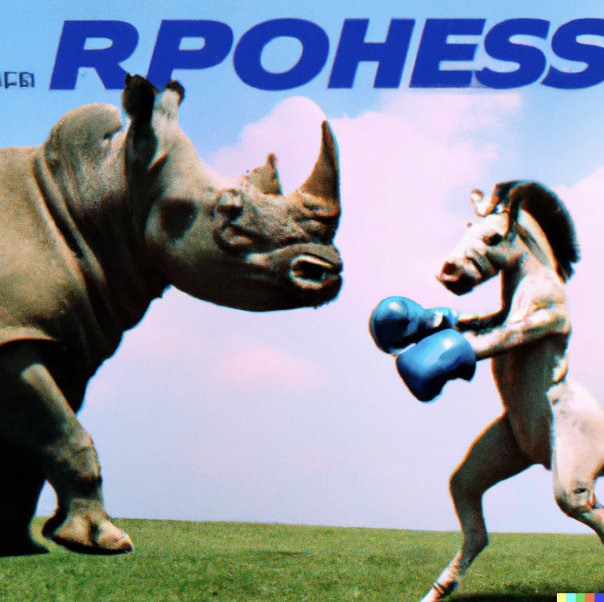
Fast-forward to today, less than two years after the advent of that mind-blowing capability. The same prompt, in ChatGPT 4o, yields this:

Despite persistent flaws and hallucinations (that hippo has three legs!), it is mind-boggling how far we’ve come in such a short period of time. Dream up anything, with any text description, and a machine will create a matching image in seconds.
Yet despite the technology’s sudden ubiquity, few people who regularly use it understand how it works or how these improvements come about.
Several months ago, I published a primer that explained how large language models (LLMs) work using no technical language. I’d like to do the same now for image generators. As with LLMs, I believe that the core concepts are straightforward. The fancy calculus and ground-breaking computing power used to train these models is simply the application of something we can explain with an analogy to a kids’ game.
Make your team AI‑native
Scattered tools slow teams down. Every Teams gives your whole organization full access to Every and our AI apps—Sparkle to organize files, Spiral to write well, Cora to manage email, and Monologue for smart dictation—plus our daily newsletter, subscriber‑only livestreams, Discord, and course discounts. One subscription to keep your company at the AI frontier. Trusted by 200+ AI-native companies—including The Browser Company, Portola, and Stainless.
The story plot game
Become a paid subscriber to Every to unlock this piece and learn about:
- How noise becomes signal in AI image generation
- The incremental training method behind image generators
- Why random noise is the foundation of AI creativity
- Why finding patterns in randomness is the essence of generative AI
Thanks to our Sponsor:
Make your team AI‑native
Scattered tools slow teams down. Every Teams gives your whole organization full access to Every and our AI apps—Sparkle to organize files, Spiral to write well, Cora to manage email, and Monologue for smart dictation—plus our daily newsletter, subscriber‑only livestreams, Discord, and course discounts. One subscription to keep your company at the AI frontier. Trusted by 200+ AI-native companies—including The Browser Company, Portola, and Stainless.
 Create a free account to continue reading
The Only Subscription
You Need to
Stay at the
Edge of AI
The essential toolkit for those shaping the future

"This might be the best value you
can get from an AI subscription."
- Jay S.
 Every Content
 AI&I Podcast
 Monologue
 Every Agent
Join 100,000+ leaders, builders, and innovators

Already have an account? Sign in.
What is included in a subscription?
Daily insights from AI pioneers + early access to powerful AI tools

 Front-row access to the future of AI
 In-depth reviews of new models on release dayPlaybooks and guides for putting AI to workPrompts and use cases for buildersIn-depth reviews of new models on release dayPlaybooks and guides for putting AI to workPrompts and use cases for builders
 Bundle of AI software


 Katie Parrott
 Every Staff
 Kieran Klaassen
Comments