


Katie Parrott is a staff writer. She writes Working Overtime and contributes to Vibe Checks, Source Code, and Context Window.

I Hired ChatGPT as My Career Coach
AI changed how I think about work—and myself
Oct 7, 2024 · 13 min readUpdated Sep 1, 2026

When Katie Parrott lost her job, she turned to an unlikely source for career guidance: ChatGPT. In this piece, Katie details her experiment using AI as a career coach, exploring its strengths and limitations in providing originality, accountability, structure, empathy, and clarity. Her journey reveals both the potential and pitfalls of AI in personal development, underscoring that while AI can be a powerful tool for self-reflection, the real work of career growth remains deeply human.—Kate Lee
Was this newsletter forwarded to you? Sign up to get it in your inbox.
A few weeks ago, my therapist floated the idea that I should hire a career coach. It would have been a great idea—if I hadn’t just lost my job.
I’m certainly the type who could benefit from a career coach. My relationship with work has always been fraught, and I am at a particularly murky spot in my career. In the past 10 years, I’ve worn a lot of hats: I’ve worked at companies, agencies, and as a freelancer. I’ve worked in software, healthcare, and venture capital. I’ve been an individual contributor and a people manager. And yet, I feel no closer to knowing “what I want to do with my life” than I did when I graduated from college.
So yes, I wanted help. But while I’m lucky enough to have “runway,” as startups say, that doesn’t mean I have $100–$150 per hour to spend on a career coach.
Something I do have, however, is a subscription to ChatGPT.
I figured if I couldn’t retain the services of a human career coach, why not try AI? I consider myself an AI skeptic, but even I am often astonished by what large language models can do. I’ve read Dan Shipper’s essays in Chain of Thought; I’ve seen how you can use AI for deeper thinking. If ChatGPT really is a copilot for the mind, as I’ve been promised, shouldn’t it be able to help me navigate the big, messy question of what I am doing with my life?
So, one day last month, I opened ChatGPT—with some dread, some hope, and lots of curiosity—and typed this prompt:
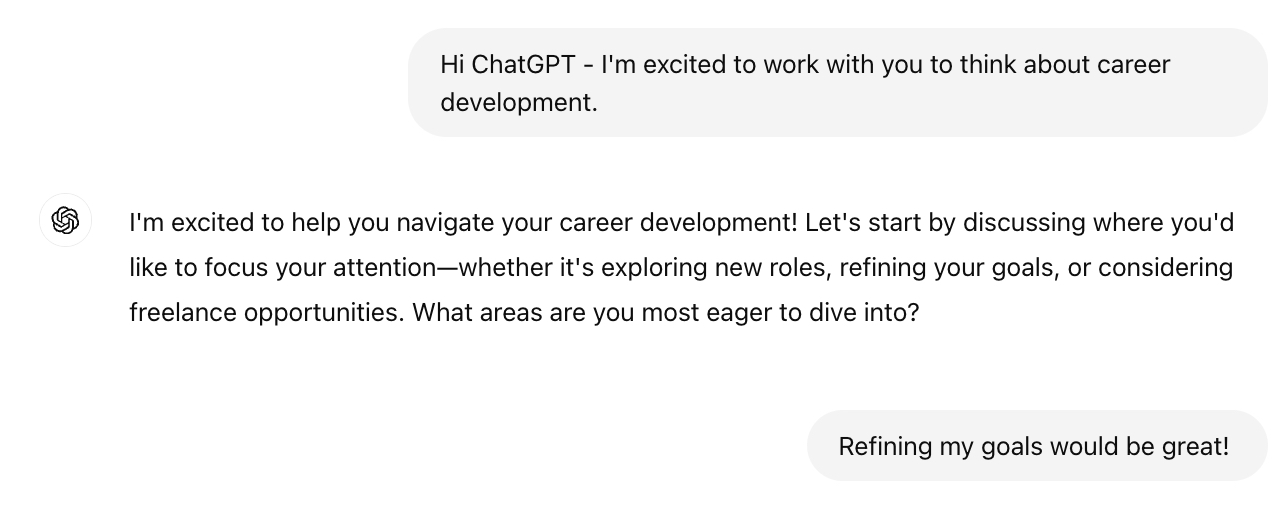
What follows is part performance review of ChatGPT in the role of my career coach and part descent into AI’s uncanny valley. Let’s start at the very beginning.
What I wanted from my ChatGPT career coach
At the outset of this experiment, I spent some time thinking about what I would want in a career coach. If I could program mine (which, let’s be clear, is exactly what I am doing), what features would I want it to have?
I wanted originality—not the same platitudes I could read on LinkedIn or in the Personal Growth section at Barnes & Noble. I definitely needed accountability and structure—something to motivate me and keep me from getting distracted. And on a certain level, I just craved empathy. The last few years have been a slog, professionally. Each role I’ve taken on has felt, to one degree or another, like trying to fit a round peg into a round hole. I just wanted someone who could understand what that felt like. And finally, clarity. That’s really what I was after, ChatGPT or no ChatGPT: a sense of direction for the next stage of my career.
The question in front of me, the question this whole experiment revolves around, was: Could ChatGPT give me all of that?
Become a paid subscriber to Every to unlock this piece and read about:
- Structuring your prompts for better results
- The unexpected benefits of AI-assisted introspection
- Clarity through conversation—with a chatbot
 Create a free account to continue reading
The Only Subscription
You Need to
Stay at the
Edge of AI
The essential toolkit for those shaping the future

"This might be the best value you
can get from an AI subscription."
- Jay S.
 Every Content
 AI&I Podcast
 Monologue
 Every Agent
Join 100,000+ leaders, builders, and innovators

Already have an account? Sign in.
What is included in a subscription?
Daily insights from AI pioneers + early access to powerful AI tools
 Front-row access to the future of AI
 In-depth reviews of new models on release dayPlaybooks and guides for putting AI to workPrompts and use cases for buildersIn-depth reviews of new models on release dayPlaybooks and guides for putting AI to workPrompts and use cases for builders
 Bundle of AI software



 Katie Parrott
 Every Staff
 Kieran Klaassen
Comments