



Just-In-Time PM #7: Interaction Over Consumption
In Part 6, I recommended treating any deliverable (whether it’s a simple email all the way to a full-fledged product) as a series of evoluti
May 22, 2018 · 5 min readUpdated Jul 11, 2026

In Part 6, I recommended treating any deliverable (whether it’s a simple email all the way to a full-fledged product) as a series of evolutionary artifacts, each one intended to test an assumption or make forward progress.
But there is a deeper reason for downscoping deliverables and then evolving them through a series of stages.
So often our attitude toward information is one of consumption. We treat information intake as a preliminary stage, where we gather research and knowledge, followed by a planning stage, where we make decisions and lay out the steps, and then an implementation stage, where we actually put that knowledge into practice.
That model doesn’t make sense in the modern world. There is so much uncertainty and things are changing so fast, it makes much more sense to dive in and take action, than try to meticulously plan everything in advance.
We need to collapse these three stages into one interwoven thread, by prioritizing interacting with information over merely consuming it.
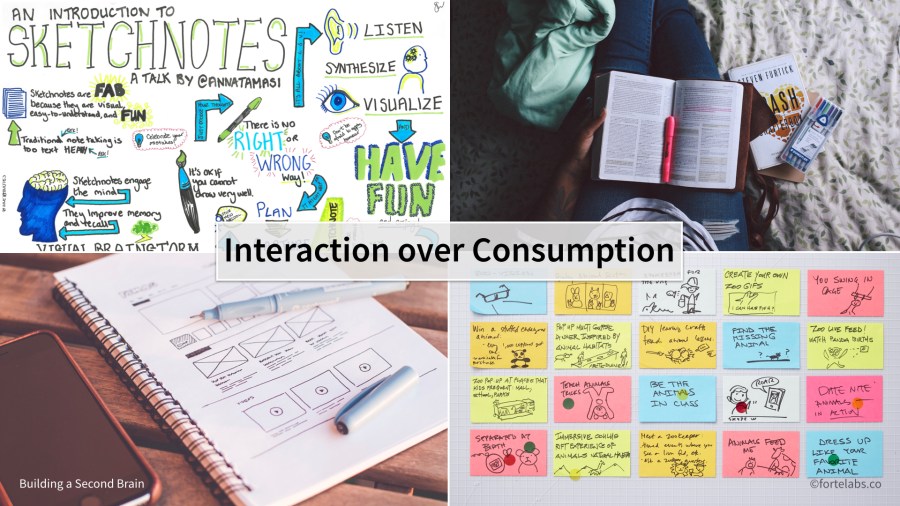
This is known as the Constructivist Approach to Learning, which says that learning is an active process in which people “construct” knowledge based on their own experience.
The main factor that distinguishes adult learning from other kinds of learning is that adults learn to solve a problem. So of all the things we could construct, I believe the most effective is a personally relevant and professionally useful product that solves a current problem.
Instead of trying to intake all the best sales techniques, it is much more useful to go out and try to make a sale. Instead of spending months reading about productivity strategies, you’ll learn faster if you perform some experiments on your own productivity. If you want to become a better writer, you don’t need a master’s degree in writing. You just need a personal blog where you can practice publishing every week.
In other words, information only becomes knowledge when you wrestle with it. When you put it to the test, put something on the line, and allow yourself to fail. Luckily, there are countless ways of doing this today:
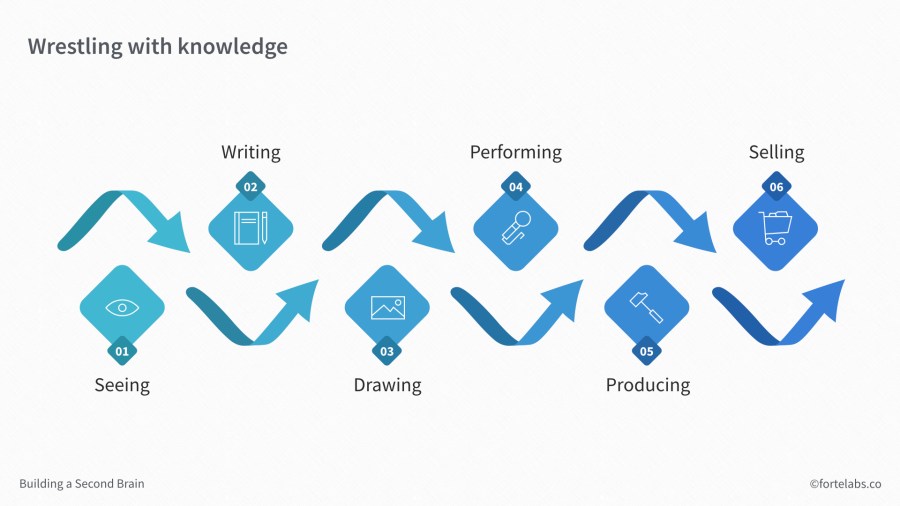
Seeing
Being able to see things in a new way is a crucial skill as you begin to create things. This can include:
- Switching contexts, such as working from a different location or traveling
- Getting feedback on something you’re working on from friends or colleagues
- Getting feedback from customers or potential customers, through interviews or surveys
Writing
Writing is an excellent practice for anyone developing new ideas, because it forces you to clarify your thinking. This can include:
- Highlighting and underlining passages in books and articles you find compelling
- Taking notes on sources you read, with your own commentary or questions
- Live-tweeting book notes, a personal favorite, which involves tweeting a stream of the most important points in a book, drawn from the Kindle highlights I made while reading it
Drawing
Drawing is an excellent way to change how you perceive things, and sharpening your powers of observation. This can include:
- Making sketchnotes (such as the ones above) with visual depictions of the main ideas in a book or presentation
- Making drawings, diagrams, or infographics of ideas or models you find interesting
- Creating a slide presentation explaining an idea or theory
Performing
Putting yourself in high stakes situations is an excellent way to learn, as your full attention and emotions are fully engaged. This can include:
- Recording a video of yourself explaining a concept or giving your opinion on a topic (and uploading it to YouTube, Facebook, or Snapchat)
- Presenting your work at a local event or meetup, which are often looking for speakers
- Applying to speak at a conference, TEDx, or Ignite event (each of which will have its own requirements)
Producing
Any time you can translate information into an artifact of your own creation, your learning goes through the roof. This can include:
- Writing a blog post or recording a video giving your interpretation or critique of a book, or a demo of a software program you like
- Putting on an event or meetup to gather like-minded people around the topic you want to learn about
- Translating a source (or several sources) into a different format, such as turning a popular book into an online course, a blog post into an audio recording, or a series of blog posts into an ebook
Selling
Of all the forms of interacting with information, I believe selling is the most powerful. Because trying to sell something always puts you in direct contact with reality. This can include any exchange of value, not just financial, for example:
- Selling a project, by asking others to collaborate with you (either at work or outside of work)
- Teaching a course or webinar on a subject you care about, including templates or checklists to help people put that knowledge to use
- Making a sellable product or service out of the knowledge you’ve acquired, such as an ebook or a consulting service
All of these activities are generative, in that they position you as a maker and a creator, instead of a passive consumer. By taking action, you will learn things about your topic of choice that no amount of books or courses could ever teach you – the tacit, social, and subconscious skills that actually lead to true mastery.
Not to mention, producing these tangible artifacts will open up countless new opportunities for learning and growth. People will comment appreciatively on your YouTube videos. They’ll share your blog posts with their colleagues or friends. They will take time out of their week to come to your events. It might take awhile to “go big,” but if you treat the whole process as a learning experiment, you will get the rewards from day one.
The 18th century philosopher Gianbattista Vico put it this way:
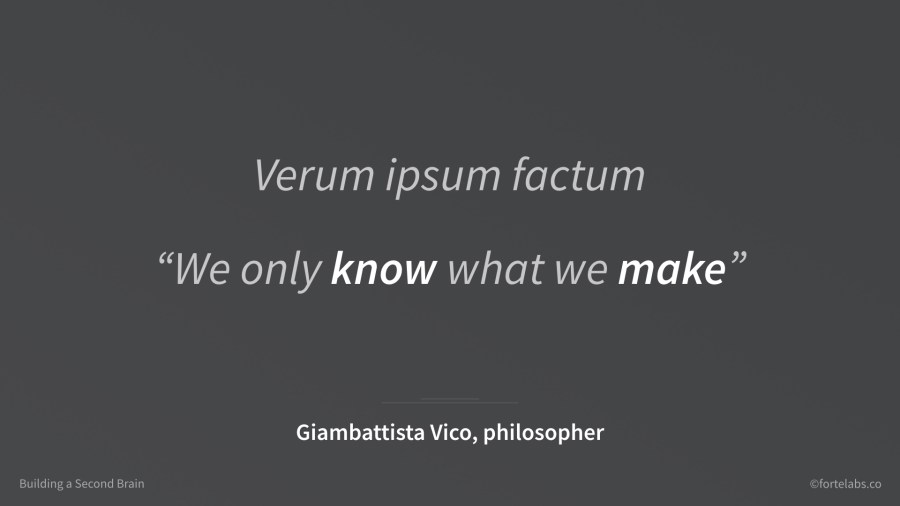
If that is true, the only way to know more things is to make more things. By manifesting our learning as a series of ever-evolving, intermediate packets, we become the authors of our own story, instead of just reading about the stories of others.
Follow us for updates on Twitter, Facebook, Instagram, LinkedIn, or YouTube.
The Only Subscription
You Need to
Stay at the
Edge of AI
The essential toolkit for those shaping the future

"This might be the best value you
can get from an AI subscription."
- Jay S.
 Every Content
 AI&I Podcast
 Monologue
 Every Agent
Join 100,000+ leaders, builders, and innovators

Already have an account? Sign in.
What is included in a subscription?
Daily insights from AI pioneers + early access to powerful AI tools
 Front-row access to the future of AI
 In-depth reviews of new models on release dayPlaybooks and guides for putting AI to workPrompts and use cases for buildersIn-depth reviews of new models on release dayPlaybooks and guides for putting AI to workPrompts and use cases for builders
 Bundle of AI software


 Katie Parrott
 Every Staff
 Kieran Klaassen
Comments