

Rhea Purohit focuses on research-driven storytelling in tech. She writes about the psychology and history of adopting new technologies.
.jpg&w=64&q=90)
He Built AI Agents to Launch a Million Businesses
Henrik Werdelin on why every lasting AI business starts with knowing your customer—and yourself
Nov 12, 2025 · 6 min readUpdated Aug 1, 2026

TL;DR: Today we’re releasing a new episode of our podcast AI & I. Dan Shipper sits down with Henrik Werdelin, the founding partner at the startup studio Prehype, and cofounder of Audos, a platform where you can build your own AI startup. Watch on X or YouTube, or listen on Spotify or Apple Podcasts. Here’s a link to the episode transcript.
Was this newsletter forwarded to you? Sign up to get it in your inbox.
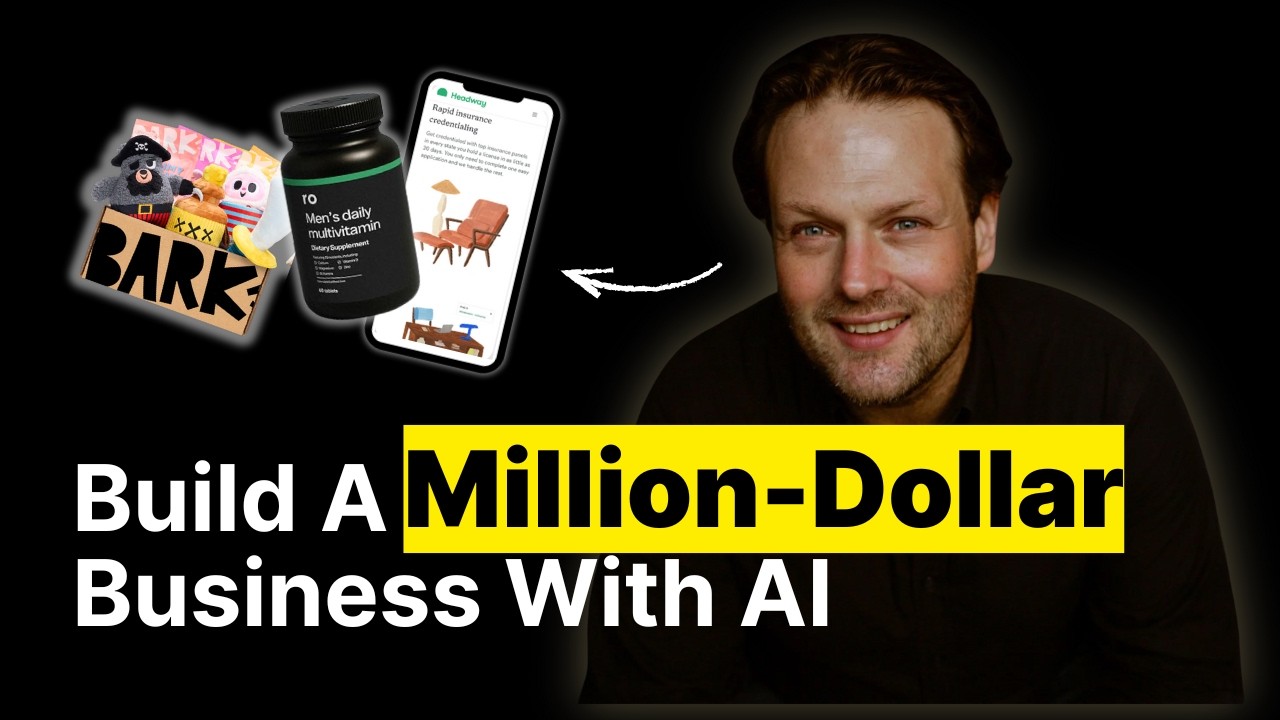
Henrik Werdelin wants to launch 1 million businesses that make $1 million each.
As the founding partner of Prehype—the startup studio behind companies like Barkbox and Ro Health—he’s spent the last decade helping founders turn ideas into successful, venture-backed companies. Now, he’s taking everything he’s learned and building it into Audos, a platform that helps everyday entrepreneurs use AI agents to brainstorm ideas, finance and market their products, and find niche audiences. He also recently co-authored a book, Me, My Customer, and AI, about the new shades of entrepreneurship that AI is creating.
After years of building companies and helping others do the same, Werdelin has developed a sharp eye for what really makes a startup work. In this episode of AI & I, Dan Shipper and Werdelin talk about what separates successful AI businesses from the rest. (We had Werdelin’s cofounder at Audos, Nicholas Thorne, on the podcast back in March of 2024.)
Here is a link to the episode transcript.
You can check out their full conversation here:

Here are some of the themes they touch on:
Build for someone specific
Werdelin is tired of people asking him why “Catbox” doesn’t exist, and no, it isn’t because he has a bone to pick with felines. Barkbox has always defined itself by “who they serve”—dogs and people who love them—and not “what they did”—sell subscriptions. “[S]o our next big business was a [first-class] airline for dogs,” he says, “not another stuff-in-a-box business;” and indeed, that airline, Bark Air, isn’t just “dog-friendly,” it’s built for dogs, with comfortable travel quarters, a personal concierge, and a set of FAQs literally addressed to your dog.
According to Werdelin, founders must start by asking themselves who they want to serve for the next 10 years, not by chasing the biggest market or the hottest technology. This is reflected in other Prehype-companies like Ro Health, which started from a specific kind of person with specific needs—men dealing with sensitive health issues like hair loss and erectile dysfunction.
Know your customer better than their bank
When you invest in truly knowing your customer, you build what Werdelin calls “relationship capita.l” It’s the advantage you get from having a deep understanding of customers’ needs, aspirations, and values. He thinks of relationship capital as having three areas:
- Depth: “How much does a customer feel seen by you?” You can measure this in the small, human gestures—how you respond to their social media posts about your company, and how quickly you do it.
- Density: “How much do they feel that you belong in the community that you serve?” Think of how Patagonia employees are known to be outdoor enthusiasts, or how Peloton’s team includes the same fitness-obsessed people they design for.
- Durability: “Are you allowed to offer more than the initial thing that you offered?” As Werdelin puts it, “You can imagine what a Nike hotel would look like, but it’s very difficult to compute what a Hilton shoe would be.” He’s alluding to the idea that some brands earn the right to evolve—when customers trust what you stand for, they’ll follow you into new product categories. In the age of AI, he says companies will have an advantage if they “have very clear permission, authenticity, [and] authority to serve their customers in different ways.”
Know yourself as well as you know your customers
For Dan, building a business with staying power has gone beyond knowing his customer to knowing himself: It took him years to admit that he wanted to be a writer, a desire that once felt at odds with his identity as a founder. Over time, he learned to design his days around both sides of himself: the part that writes and reflects, and the part that loves business and technology. That clarity of identity made Every itself more durable.
Werdelin calls this “customer-founder fit”: the alignment between who you are and who you serve. Without it, you lack the authenticity and authority to build something that your customers would buy.
In his book, Werdelin offers a framework for finding it—the five Ps: powers, passions, possessions, positions, and potentials. Each is a way of asking where your innate strengths lie and how you can build from them. “Every time that I try to build something to make it successful, I end up not building something great,” he says, “and every time I basically go for, ‘I want to build cool shit with people I like,’ then I end up doing something that seems to resonate with people.”
A generation of agentic startups is taking shape
Werdelin believes we’re still in the earliest days of figuring out what “agentic businesses”—companies built around AI agents—will actually look like. He compares it to the early 2000s when he was building an internet video startup before YouTube came around. Back then no one knew how to answer simple questions like: Should videos autoplay when you open a link, or require a click? Should the next one start automatically? As he builds Audos, Werdelin is realizing that many of these basic features simply don’t exist yet for generative AI.
But even amid all this uncertainty, one pattern is becoming more and more clear to Werdelin:
Startups are creating a constellation of agents, each solving a different problem for the same customer; echoing Dan’s idea about how our role will shift to being managers of AI agents.
What do you use AI for? Have you found any interesting or surprising use cases? We want to hear from you—and we might even interview you.
Here’s a link to the episode transcript.
Timestamps
- Introduction: 00:01:33
- Dan and Henrik on the new breed of entrepreneurship that AI makes possible: 00:02:50
- Why Henrik believes the future belongs to 1 million million-dollar companies: 00:11:08
- How to build “relationship capital” with your customers: 00:16:14
- Why “customer-founder fit” shapes lasting companies: 00:21:35
- Everything Henrik learned about himself from a decade of building companies: 00:23:01
- How Henrik finds focus and meaning in the daily chaos: 00:31:44
- How Henrik is parenting two kids in the age of AI: 00:34:17
- The way AI can fix what social media broke: 00:50:33
- What happens when AI agents become part of how we tell stories: 00:56:59
You can check out the episode on X, Spotify, Apple Podcasts, or YouTube. Links are below:
- Watch on X
- Watch on YouTube
- Listen on Spotify (make sure to follow to help us rank!)
- Listen on Apple Podcasts
Miss an episode? Catch up on Dan’s recent conversations with founding executive editor of Wired Kevin Kelly, star podcaster Dwarkesh Patel, LinkedIn cofounder Reid Hoffman, ChatPRD founder Claire Vo, economist Tyler Cowen, writer and entrepreneur David Perell, founder and newsletter operator Ben Tossell, and others, and learn how they use AI to think, create, and relate.
If you’re enjoying the podcast, here are a few things I recommend:
- Subscribe to Every
- Follow Dan on X
- Subscribe to Every’s YouTube channel
Rhea Purohit is a contributing writer for Every focused on research-driven storytelling in tech. You can follow her on X at @RheaPurohit1 and on LinkedIn, and Every on X at @every and on LinkedIn.
We build AI tools for readers like you. Write brilliantly with Spiral. Organize files automatically with Sparkle. Deliver yourself from email with Cora. Dictate effortlessly with Monologue.
We also do AI training, adoption, and innovation for companies. Work with us to bring AI into your organization.
Get paid for sharing Every with your friends. Join our referral program.
For sponsorship opportunities, reach out to [email protected].
The Only Subscription
You Need to
Stay at the
Edge of AI
The essential toolkit for those shaping the future

"This might be the best value you
can get from an AI subscription."
- Jay S.
 Every Content
 AI&I Podcast
 Monologue
 Every Agent
Join 100,000+ leaders, builders, and innovators

Already have an account? Sign in.
What is included in a subscription?
Daily insights from AI pioneers + early access to powerful AI tools
 Front-row access to the future of AI
 In-depth reviews of new models on release dayPlaybooks and guides for putting AI to workPrompts and use cases for buildersIn-depth reviews of new models on release dayPlaybooks and guides for putting AI to workPrompts and use cases for builders
 Bundle of AI software




 Katie Parrott
 Every Staff
 Kieran Klaassen
Comments