





Was this newsletter forwarded to you? Sign up to get it in your inbox.
I’ve been feeling personally attacked by my X feed lately. Well, even more than usual. Alongside the usual headline horror shows and barrage of bad takes, writers I respect and admire are on the warpath against writing with AI.
The discourse kicked off late last month when Washington Post columnist Megan McArdle posted about how she uses AI in her work. The reposts were merciless. “Genuinely an insane thing to admit.” “Journalistic dishonesty out in the open.” One person suggested that admitting to AI use should be made “deeply taboo,” even though he acknowledged in the same post that everyone’s going to do it anyway. But the one reaction that stuck with me was journalist Charlotte Alter: “Research is thinking. Outlining is thinking. Writing is thinking. Any portion of that done by AI is less thinking done by you.”
The problem is that so much of AI writing happens in a black box. The critics are imagining the laziest possible version of AI-assisted writing, and the writers who use AI seriously haven’t been showing their work, though that’s starting to change. That silence lets the worst assumptions fill the gap.
I’d rather just show you the whole mess—what is happening in my head when I write with AI, and it’s not what the discourse imagines. By the end, you can decide for yourself whether what I do counts as thinking.
What writing with AI is (and what it isn’t)
Many critics treat the use of AI in writing like a binary: Either the machine wrote it, or you suffered for it. But writing has never been binary. It’s always been a mess of drafting and revising, leaning on editors and borrowing structures, following formulas and breaking them. And no two kinds of writing are exactly alike: A journalist’s process relies on source calls and document requests. A novelist’s includes plotting arcs across 80,000 words. A personal essay, like the ones I write for Every, involves sitting alone with your feelings until they become a thesis statement.
Every writer’s process is different, and most of them would sound unhinged if described in detail. But throw AI into the mix, and suddenly everyone has opinions about the “right” way to get words on a page.
My process, start to finish
When people picture “writing with AI,” they picture a transaction. You type a prompt, the AI hands you text, you paste it somewhere, and move on. My process has about as much in common with that as cooking has with microwaving a frozen dinner.
And it’s evolved over time. In 2024, I was the human conveyor belt: Copy a prompt into ChatGPT, paste the output into a Google Doc, tweak it by hand, repeat. In 2025, I got smarter about context—I uploaded my past writing, built a style guide, and gave the AI something to work with beyond a cold prompt. The outputs got closer to my voice, but the process was still me wrestling with a chat window.
Now I have a dedicated writing agent—a set of detailed instructions that plug into Claude and guide me through every stage, from first idea to final polish. It has phases: brainstorm, interview, outline, draft, and review. It has a panel of critics who tear my work apart from different angles—skills I wrote to invoke certain kinds of feedback, whether it’s for length, pacing, or the soundness of the argument. It has style checks, AI-pattern detectors, and a line editor that tightens my prose sentence by sentence. Think of it as a very opinionated editorial workflow that happens to be powered by AI.
Brainstorming: ‘Interview me to find out what I think’
When I sit down to write a piece, and before I even write a word, I have the agent interview me. It asks questions to draw out what I’m thinking about the topic. For example: “Why is this on your mind? How has this shown up in your work? What do you want readers to walk away thinking about?” For this piece, since it was a reaction, it asked me: “What’s the friction for you personally here? When you read these tweets, what makes you want to write about it—is it that you think the critics are wrong? That they’re right but for the wrong reasons? That the whole frame is off?”
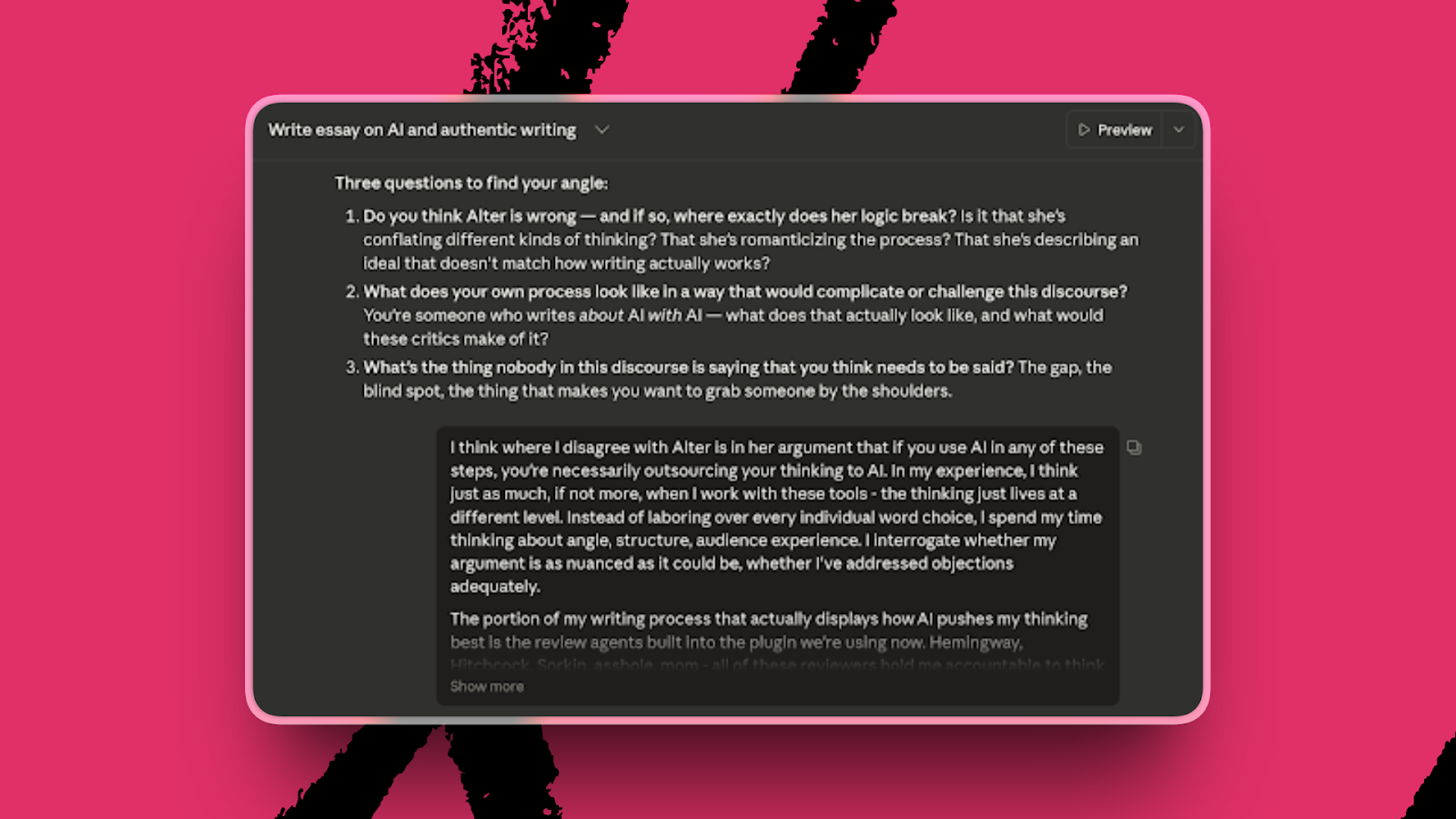
I spend a lot of time sitting with these questions. Sometimes I’ll struggle so much to find an answer that it forces me to realize I haven’t thought through the idea enough yet and need to spend more time reflecting on what I want to say. At least once per interview session, the AI will ask me something that feels irrelevant to the piece I want to write, and I say so. When I was writing this piece, for example, it asked me to critique another writer’s use of AI in their writing process. I said I didn’t want to go there; ranking other writers’ workflows wasn’t the piece I was writing.
 Create a free account to continue reading
The Only Subscription
You Need to
Stay at the
Edge of AI
The essential toolkit for those shaping the future

"This might be the best value you
can get from an AI subscription."
- Jay S.
 Every Content
 AI&I Podcast
 Monologue
 Cora
Cora
 Sparkle
 Spiral
Join 100,000+ leaders, builders, and innovators

Email address

Already have an account? Sign in
What is included in a subscription?
Daily insights from AI pioneers + early access to powerful AI tools





 Front-row access to the future of AI
 In-depth reviews of new models on release day
Playbooks and guides for putting AI to work
Prompts and use cases for builders
In-depth reviews of new models on release day
Playbooks and guides for putting AI to work
Prompts and use cases for builders
In-depth reviews of new models on release day
Playbooks and guides for putting AI to work
Prompts and use cases for builders
In-depth reviews of new models on release day
Playbooks and guides for putting AI to work
Prompts and use cases for builders
 Bundle of AI software




 Katie Parrott
.png)
.png)
 Reviews of new AI models on release day
Comments
Don't have an account? Sign up!
Hey! I use "delve". Unspoken perhaps (haven't read all the complaints), is the use of wives and girlfriends as un- and undercredited editors and co-authors. I think it happens less now than it did before, say, 1980.
@cinntech I love that parallel! Successful writers have always operated with a lot of support around them, but not everyone has access to those resources. AI is a way to level the playing field, for sure!
I love the detail about the process. And the major point is the one I don't understand how people miss it. Every serious writer uses external feedback to end up with a better product. In this case it just happens to be machine learning.
EVERY emails are a highlight of my day, but my favorites are written by Katie Parrott. Katie, you are standing up in the wind and weather (whether generated internally or externally) and dealing with it in ways that help all of us who grapple with the intelligent use of tools to create unique, original, valuable, vulnerable work. Who's driving? What's at stake? How do we use tools to build the creative muscles vs letting them atrophy. Thanks for standing out in the weather, in your self-directed spotlight, so we can learn from you.
Thanks for adding thoughtful reflections on using AI. I’m journalist. It hasn’t helped me become a better writer-yet. But it sure helps me research faster.
Thanks again for another revealing and helpful article, Katie. Your ability to be candid and descriptive about your writing process is most illuminating! Tell me, tho', since I cannot observe the step-by-step: How much of your conversations with your AI and agents involves cut&pasting to/from a prompt (text box), or do you have a more sophisticated means of capturing the conversation? Maybe I'm misguessing the mechanics of what you do entirely?