
.png&w=3840&q=75)

Katie Parrott is a staff writer. She writes Working Overtime and contributes to Vibe Checks, Source Code, and Context Window.

I Started Talking to My Computer Instead of Typing. It Changed How I Think.
Voice-first AI removed the invisible friction between my brain and the page
Sep 2, 2025 · 9 min readUpdated Jul 10, 2026

Was this newsletter forwarded to you? Sign up to get it in your inbox.
I didn’t notice how much typing slowed my thoughts down until I realized I’d stopped.
It hit me on a Saturday afternoon. I was minding my own business when an idea popped into my head that I knew I wanted to capture. I ran to my computer; but instead of my fingers flying to the keyboard, I started talking—and my AI assistant wrote it down.
It happens by muscle memory, as tends to happen when you do something enough times. At this point, I’ve drafted seven full articles this way. “It takes 21 days to form a habit” might be a myth, but in my case, it took around that long for the whole “talking to my computer” thing to take hold.
On the surface, nothing about typing feels laborious—I’ve been doing it since I was a fifth-grade Mavis Beacon all-star. I average 120 words per minute talking; I can hit that while typing if I focus really hard on my fingers. There are tiny frictions that slow me down, micro-decisions about phrasing and punctuation and rhythm that pull focus from where I want my thoughts to be: on the ideas.
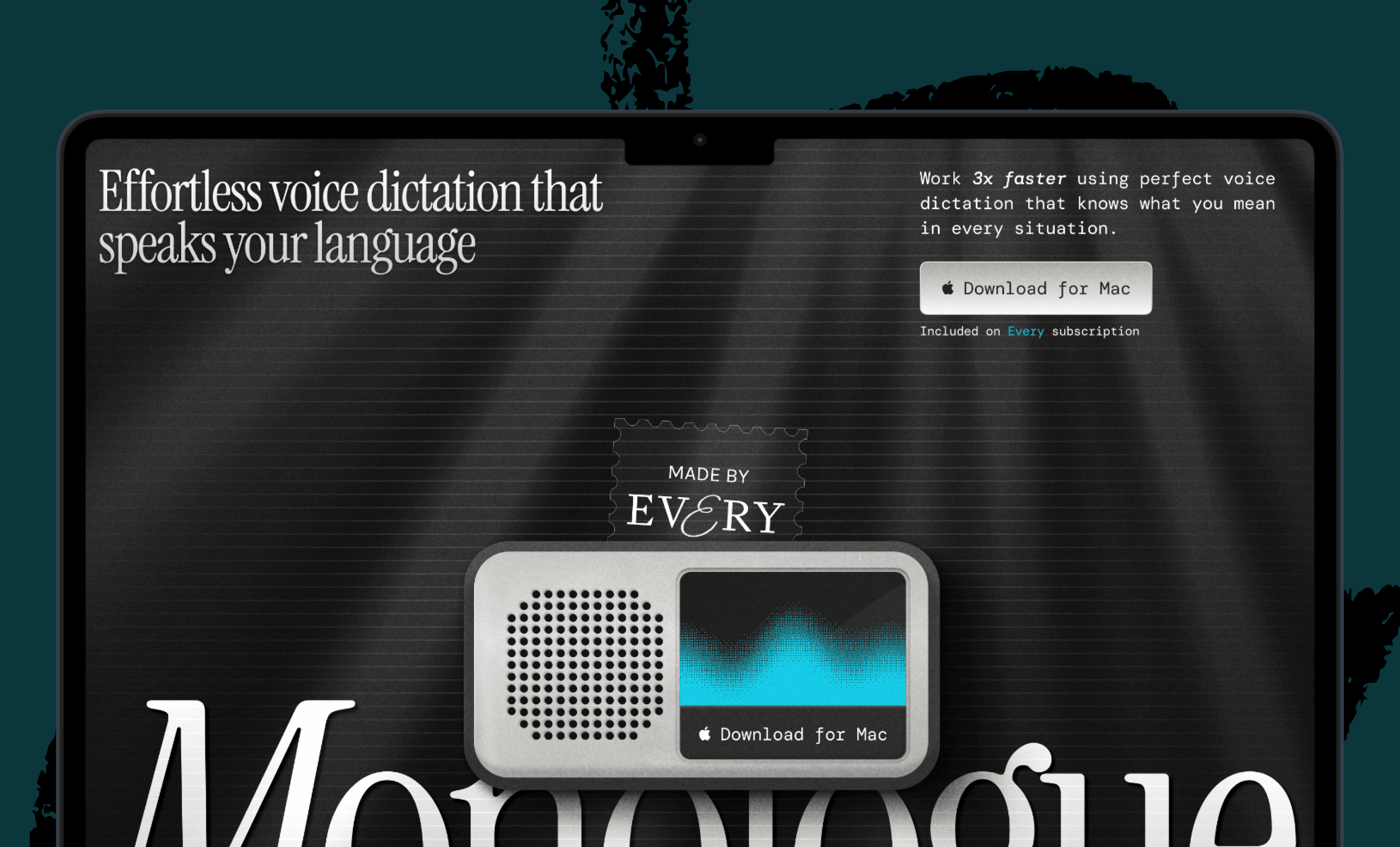
These days, I bypass the speed bumps with a setup that’s become like an extension of my brain. First, there’s my Working Overtime workspace, a ChatGPT project I have set up to help me brainstorm ideas, do research, and flesh out drafts for my column. Then there’s Monologue, the AI-powered transcription app that Naveen Naidu Mummana, entrepreneur in residence at Every, is building (it’s currently in public beta). I just press a key to talk; Monologue relays the message; the alien superintelligence inside my project tells me what it “thinks.”

ChatGPT has its own built-in voice-to-text mode, and there are other popular voice dictation tools on the market, like Whispr Flow. But I found frustrations with each: The dictation lags, or the output is unclear, or opening the app slows down my computer to the point where I can’t use it. Using Monologue paired with ChatGPT was the first time that talking to my computer felt like the evangelists promised it would: easy.
Once I stopped treating the keyboard as my only entry point, the whole shape of my work changed: Ideas flow faster, structure emerges in conversation, and clarity comes from rounds and rounds of “How’s this?” and “What about that?” If you haven’t tried talking to your computer yet, I highly recommend it. Let me tell you why.
Building agents is no longer just for engineers
Instead of relying on ChatGPT, your team can build secure agents that fit their workflows and tools. With Vellum, AI becomes part of how your org ships faster.
- Build agents that adapt to your workflows
- Share and maintain composable workflows across the org
- Turn AI into a team skill, not a silo
- Build, evaluate, and monitor agents in one platform
Book a demo call today. Start with Vellum.
Talking as a mode of work
Here’s how it looks in practice...
Become a paid subscriber to Every to unlock this piece and learn about how:
- Voice dictation transforms thought into workflow
- AI collaboration creates executive-like productivity patterns
- The ergonomics of thought without keyboard constraints
- Mental ergonomics requires intentional boundary-setting
Thanks to our Sponsor: Vellum
Building agents is no longer just for engineers
Instead of relying on ChatGPT, your team can build secure agents that fit their workflows and tools. With Vellum, AI becomes part of how your org ships faster.
- Build agents that adapt to your workflows
- Share and maintain composable workflows across the org
- Turn AI into a team skill, not a silo
- Build, evaluate, and monitor agents in one platform
Book a demo call today. Start with Vellum.
 Create a free account to continue reading
The Only Subscription
You Need to
Stay at the
Edge of AI
The essential toolkit for those shaping the future

"This might be the best value you
can get from an AI subscription."
- Jay S.
 Every Content
 AI&I Podcast
 Monologue
 Every Agent
Join 100,000+ leaders, builders, and innovators

Already have an account? Sign in.
What is included in a subscription?
Daily insights from AI pioneers + early access to powerful AI tools
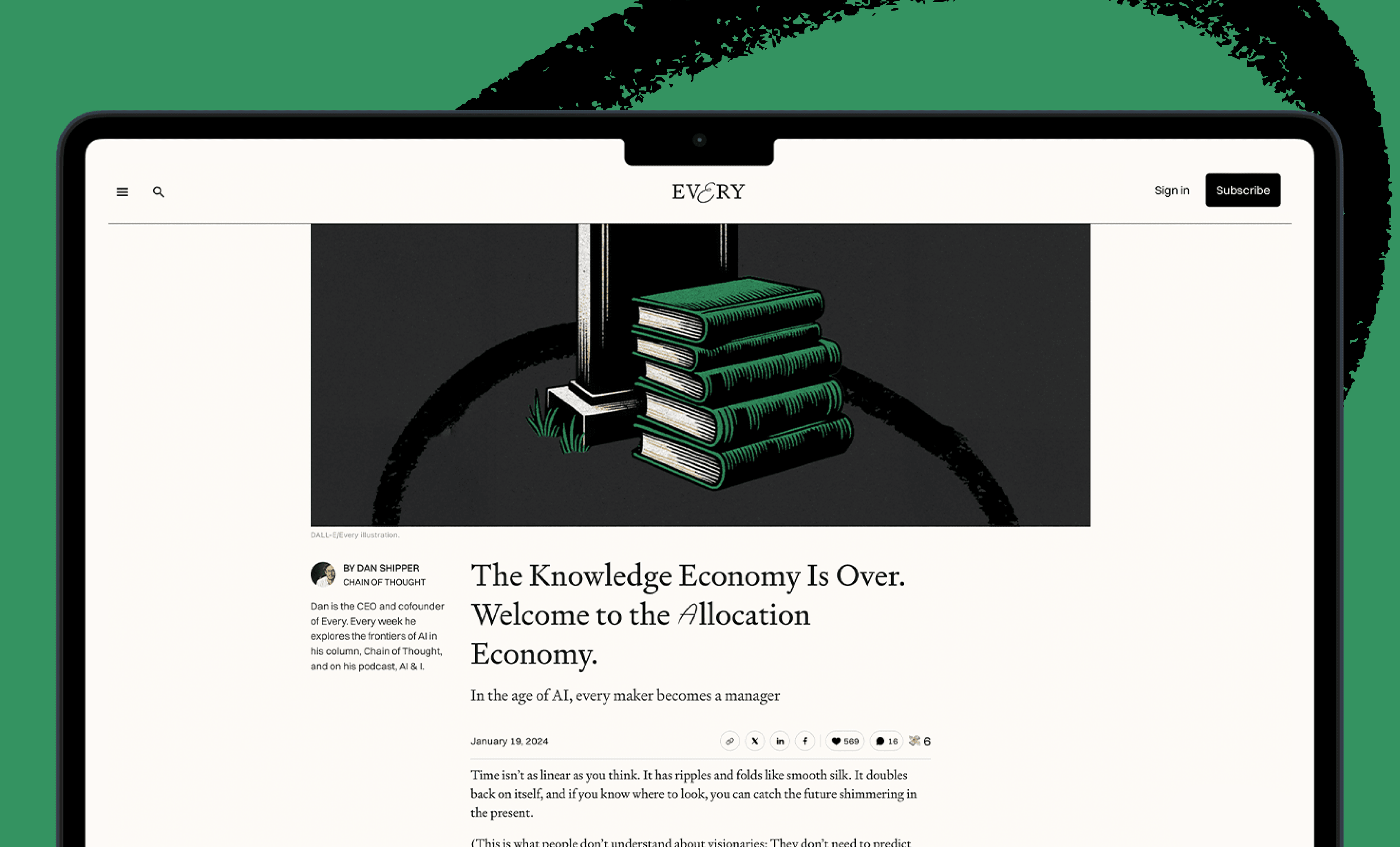
 Front-row access to the future of AI
 In-depth reviews of new models on release dayPlaybooks and guides for putting AI to workPrompts and use cases for buildersIn-depth reviews of new models on release dayPlaybooks and guides for putting AI to workPrompts and use cases for builders
 Bundle of AI software




 Katie Parrott
 Every Staff
 Kieran Klaassen
Comments