


Laura Entis is a staff writer at Every.

Token Tightening
Plus: An easy way to level up your AI usage, and how Every’s head of growth writes with LLMs
Jun 23, 2026 · 8 min readUpdated Jul 19, 2026

AI has entered its allocation era: Companies are starting to ask who gets access to the most powerful models, what those models should be used for, and when the cost is worth it. Today, head of tech consulting Mike Taylor argues that token budgets may start to look like trading portfolios, with the biggest compute budgets going to the people who can prove the biggest returns. Elsewhere, head of operations Arielle Shipper stress-tests her own AI habits, head of growth Austin Tedesco shares how he writes with Spiral and Codex, and senior designer Daniel Rodrigues tracks the resurgence of trad design on social media.
Was this newsletter forwarded to you? Sign up to get it in your inbox.
Signal
ROI comes for tokens
Just a few months ago, heavily subsidized AI plans and a manic push by corporations to get their employees familiar with the technology led to aggressive tokenmaxxing, or measuring AI adoption by how many tokens employees use.
That era appears to be over. Shifting pricing models from the frontier labs, the transition from chatbots to long-running agents, and the emergence of powerful, incredibly costly new models have converged to create massive AI enterprise bills, often without tangible results. Uber, Meta, Amazon, and Walmart have all moved to place caps on employee AI use.
These companies will still spend big on AI. But they’re beginning to think more
strategically—or restrictively— about how to get capable, token-hungry models and workflows in the hands of people who can maximize the return on investment (ROI).
One solution is to give engineers a set percentage of their salary to spend on tokens per month. Head of tech consulting Mike Taylor thinks the financial industry offers a possible model: Capable engineers will receive multiples of their salary to manage on token spend just as financial traders manage portfolios many times the size of their annual compensation. Getting the most out of current models already requires real capital—recently, Cora general manager Kieran Klaassen spent $2,000 in Cursor credits in the span of a couple of days, a number that will look quaint as the models continue to improve.
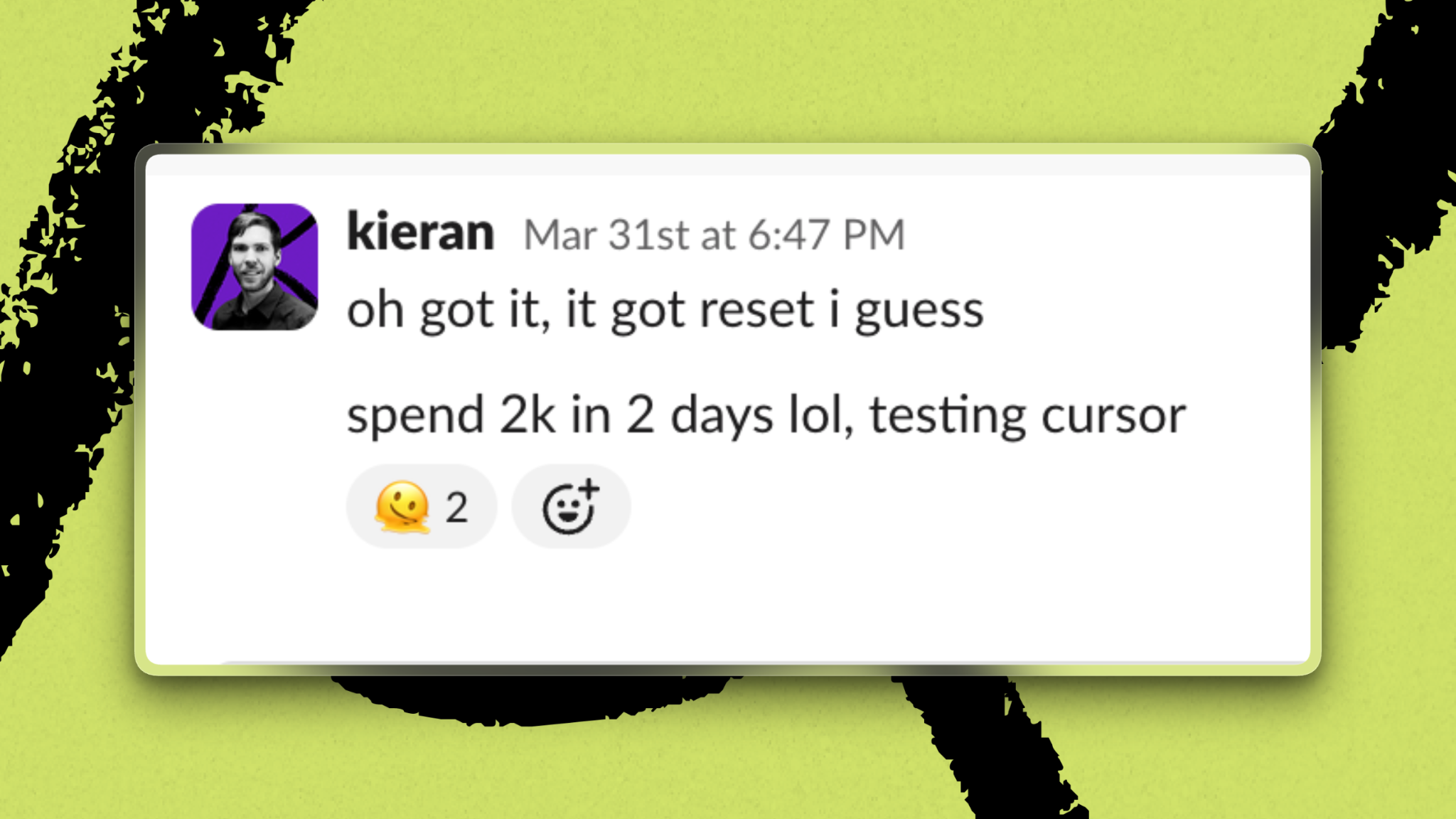
Mike predicts that tokens will be allocated and controlled on a stricter basis under this system: “Just like with trading, you’ll have risk limits, auditing, and you’ll have to get certain-size bets approved.” More broadly, we’re likely headed for a world with more restrictions placed on who is granted a token budget and what they’re allowed to do with it. Top engineers who can prove ROI will benefit, as will managers. “Who are you going to give a token budget to, an IC [individual contributor] who prefers to handcraft their code anyway, or a manager who is already accustomed to directing 5x or 10x their own salary in resources?” Mike asks.
In this version of the near future, an intern might have access to Composer 2.5, most employees will work out of Codex or an equivalent, while Fable-grade models are reserved for top engineers. There’s too much money on the line to hand over frontier access to anyone but an elite few.
Attio is the CRM for teams who set the pace
It compounds every customer signal into context, then acts across your funnel to let you move at unmatched speed and scale. With agents and automations that build pipeline, chase signals, and move deals forward, Attio orchestrates your revenue work around the clock.
Loved by high-growth startups like Granola, Modal, and Wispr Flow, Attio amplifies what you can achieve.
Discuss
“Can we downgrade the model a little bit and still get the same outcome?”—Joel Neeb, chief transformation officer of the software company 8x8, in Wired
Even aggressively AI-forward companies like 8x8 are testing ways to rein in token spend. Wired reports that 8x8 encourages all 1,800 full-time employees to use Claude and tracks usage on internal dashboards. But as Opus 4.8 drives up spend—it costs 1.7 times more than a model Anthropic released earlier this year—the company has discussed requiring employees to prove older models cannot do the job before they get access to the newest one.
Data point
6.6
That’s head of operations Arielle Shipper’s current level on Every’s eight levels of AI adoption, according to a weekly Codex review she set up for herself. Her prior baseline was 5.5, or agent-first but not orchestrating multiple agents or workstreams at once.
Become a paid subscriber to Every to unlock this piece and learn about:
- The exact Codex prompts to use to assess your AI ability
- How to steal Every’s head of growth’s AI writing workflow
- The tools that Every’s senior designer Daniel Rodrigues reaches for every day
Attio is the CRM for teams who set the pace
It compounds every customer signal into context, then acts across your funnel to let you move at unmatched speed and scale. With agents and automations that build pipeline, chase signals, and move deals forward, Attio orchestrates your revenue work around the clock.
Loved by high-growth startups like Granola, Modal, and Wispr Flow, Attio amplifies what you can achieve.
 Create a free account to continue reading
The Only Subscription
You Need to
Stay at the
Edge of AI
The essential toolkit for those shaping the future

"This might be the best value you
can get from an AI subscription."
- Jay S.
 Every Content
 AI&I Podcast


 Katie Parrott
 Every Staff













 Kieran Klaassen
Comments