

Midjourney/Every illustration.

How to Get the Most Out of Fable 5

Like 6 Comments

We’re hosting two live camps for paid Every members to put the latest frontier tools to work: Fable 5 Camp this Friday, June 12, followed by a rescheduled Codex for Power Users Camp on Friday, June 26. If you already registered for this Friday’s camp, your seat is saved for the Fable deep dive, and you can RSVP for the Codex Camp.


‘AI & I’: How Anthropic uses Claude Fable 5 with Mike Krieger

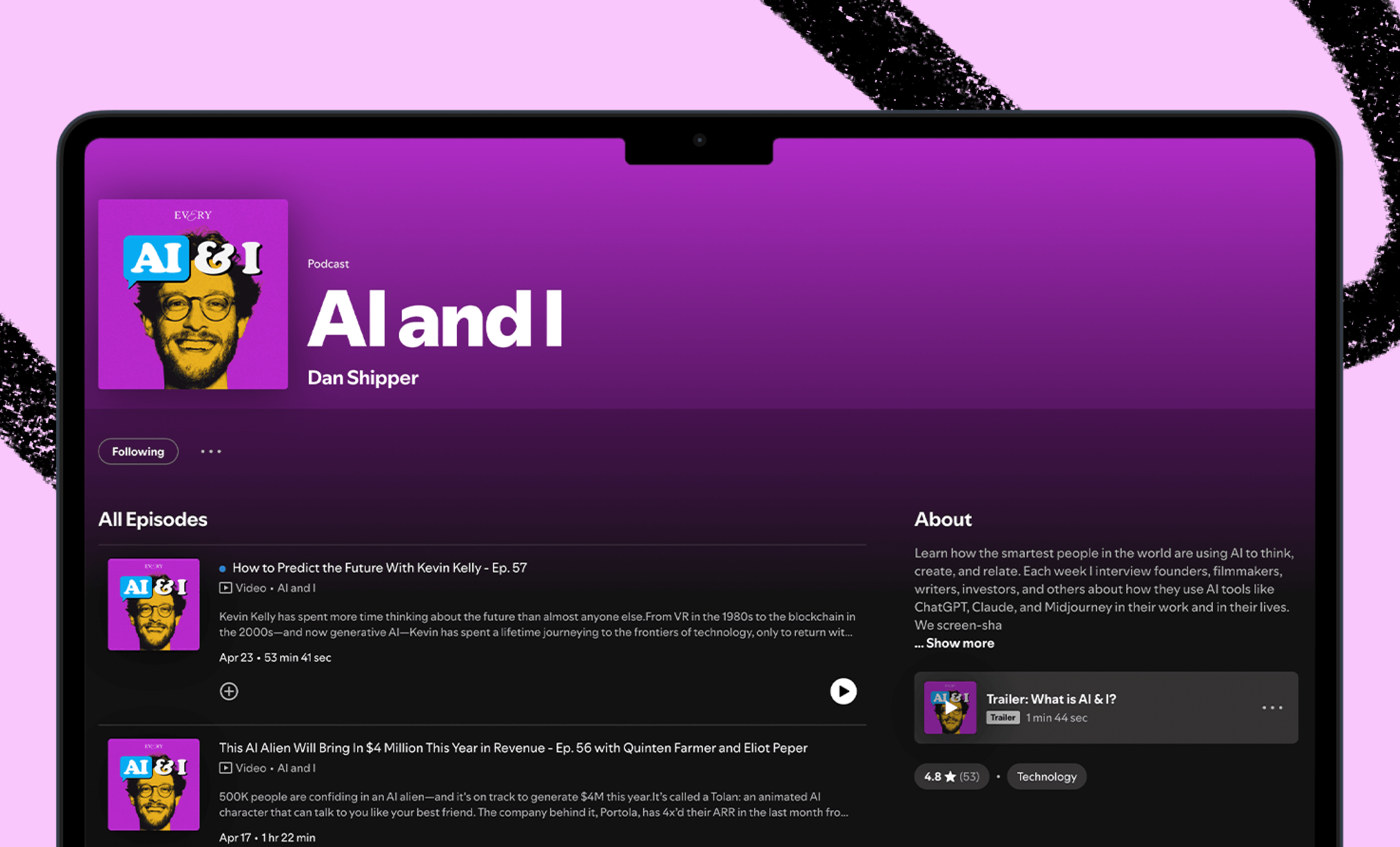
Today, we’re releasing a new episode of our podcast AI & I. Dan Shipper sits down with Mike Krieger, the cofounder of Instagram and head of Anthropic Labs, to discuss what it feels like to build with Fable 5, a model powerful enough that it’s forcing him to rethink the very definition of productivity, engineering, and creative agency.

As someone who built one of the most popular consumer apps in the pre-GPT era and has had access to Fable 5 for months, Krieger has a rare vantage point on what the radical compression of the product development arc means for builders.

Watch on X or YouTube, or listen on Spotify or Apple Podcasts. You can also read the transcript.

Here are the highlights:

  1. More work is happening overnight. Fable 5 is the first model capable enough that you can hand it a complex task, walk away, and trust it will be completed by morning. When it hits an obstacle—a remote service goes down, say, or a tool stops working—it writes a workaround and forges ahead. That resilience has changed the daily rhythm of Krieger’s work: He now ends his workday by briefing the model on what needs to get done while he sleeps, rather than sitting down to do it himself.
  2. The gap between what’s in your head and what exists in the world is closing. Given access to Fable 5 and a set of internal MCPs, an Anthropic recruiter described the experience as, “The first time in my life where I feel like the thing that’s in my head and the thing that exists in the world are right next to each other. I can just do it.” This is the most meaningful thing about the new model class, Krieger says—it allows non-engineers to create the exact products they need to get more done.
  3. Software engineering is dead. Long live software engineering. Engineers now spend less time writing code and more time setting direction, reviewing what their AI agents have built, and making judgment calls when something breaks in production. The divide between product managers and engineers has blurred. “There is a feeling of loss, I think, in some of the better engineers that I talk to, as well as the feeling of, ‘Oh my God, but I can do insane amounts of work now at the same time.’ We’re holding both ideas in our heads at once,” Krieger says.
  4. All eyes are on verification. If we can delegate more to the model, it becomes more important to check what it has built works in practice. Krieger’s approach combines regression testing on known workflows, visual checks—including giving the model video captures of its own work so it can catch animation glitches screenshots would miss—and mock backends for anything too complex to test live. When a bug arrives via Slack, Fable 5 makes the fix, posts the pull request, then follows up hours later.

Miss an episode? Catch up on Dan’s recent conversations with LinkedIn cofounder Reid Hoffman; the team that built Claude Code, Cat Wu and Boris Cherny; Vercel cofounder Guillermo Rauch; podcaster Dwarkesh Patel; and others, and learn how they use AI to think, create, and relate.

How the Every team is using Fable 5

The easiest way to be disappointed by Fable 5 is to use it as if it were GPT-5.5 or Opus 4.8, smart models that require specific instructions and careful prompting for the best results.

Instead, Fable 5 feels like working with a capable coworker—at least that’s Every’s consensus after a week of testing.

“It feels like you have an engineer on your team that you just gave a problem to, and they’ll figure it out,” says Cora general manager Kieran Klaassen.

That means, to get the most out of Anthropic’s first Mythos-class model available to the public, you have to think like a manager: Equip the model with context, goals, and a way to verify the work, then step aside. It may even stumble on a solution you hadn’t considered.

Not every task deserves this treatment. Smart colleagues don’t come cheap, and neither does Fable 5. Here’s how to get the most out of this powerful new model and some of the workflows the team is using.

Pick the right tasks

Tasks that are good candidates for Fable 5 have four qualities: You’re able to give the model organized and deep context, a well-defined goal, and a clear definition of what good or done looks like, and the importance of the task justifies the cost.

The model is smart enough to reason its way through complex problems and likes to carry tasks through to the end, but if your data is wrong or out of date, or your goals conflict, it will likely reach the wrong conclusion. That’s less of a concern on earlier, less powerful models, where you’re giving feedback more frequently during a task and could catch those mistakes.

Advanced users of AI—who operate at Level 7 or Level 8 on our AI adoption curve—are already comfortable delegating to their agents. For everyone else, using the model demands a mental reframing. Instead of iterating back and forth, the work gets frontloaded into providing the right context and establishing clear directives, letting Fable 5 do its thing, and only reviewing the results once it’s completed the entire task. The examples below are entry points to get you started.

Example 1: Fix a broken workflow

Senior engineer Nityesh Agarwal built a Claude Code skill to help Every’s consulting team create first drafts of PowerPoint decks. It worked, but it kept hitting the same snags: Boxes were slightly misaligned, images weren’t the right size, and sometimes a footer would be updated on one slide but not another. One run with Claude Code took about 30 minutes, used roughly 100 million tokens, and still came back with errors.

Nityesh pointed Fable 5 at the Claude Code session log and asked it to review where the PowerPoint skill was breaking down.

Fable 5 found the root problem. Under the hood, a PowerPoint file is a bundle of XML files that store the position, size, styling, and order of everything on a slide. Claude was being asked to edit those hidden files directly, so a simple request like “change this phrase” or “move this image two inches left” required the model to find the right hidden text and rewrite the surrounding layout code without disturbing anything else.

Fable 5 built a command-line tool that gives agents a more natural way to work with PowerPoint— if the text on a specific slide needs to be updated, for example, or an image has to be resized, the agent can use the tool to make these targeted changes instead of having to rewrite the entire XML file.

Nityesh’s takeaway: Use Fable 5 to diagnose broken workflows, create the tools or skills that fix them, and then let cheaper models use that infrastructure going forward.

Nityesh's prompt

Here is a session log from an agent trying to complete this workflow: [describe workflow]. It struggled in these ways: [time, cost, errors, bad outputs, repeated failures]. Take a step back and analyze where the current tool, skill, or workflow is breaking down. What is the root cause of the failure, and how would you fix it? Make a plan first. Then build or specify the upgrade. Test it against the same kind of task, and explain how cheaper models could use it later.

Example 2: Create a go-to-market strategy

Austin Tedesco, Every’s head of growth, had a lackluster first experience using Fable 5 to generate a go-to-market strategy for this week’s model launch. He asked it to look across Slack and Notion for relevant context, but the output didn’t feel meaningfully better than what he might have gotten from GPT-5.5 or Opus 4.8. “It did a good job of synthesizing what we had all said and compiling it. But I thought, ‘This plan isn’t any better than what we would have done,’” he says. “It’s acting as a very expensive, verbose executive assistant.”

For his next attempt, Austin put more effort into framing a more complex problem, asking Fable to look at a large set of Every audience insights—survey results, PostHog data, brand positioning work—and audit them against the actual Every.to website experience, while considering the team’s quarterly plans and internal goals. Then he gave it a clear business objective—increase paid subscriptions among those target customer profiles.

He was also more specific in what he wanted back: a Notion report with 10 data insights that might change how the team operated, plus a stack-ranked list of 10 things Every should ship or try.

The difference was striking. “Dan [Shipper] and I kept saying, ‘This is nuts,’” Austin says. “If we hired a go-to-market engineer to do this and they turned this around in two weeks, we would say, ‘This was an incredible hire.’”

Austin’s takeaway: Fable 5 performs much better on knowledge work when you give it a complex problem, full access to relevant sources of truth, a clear goal, and a specific output. If you ask it to “make a plan,” it may summarize what people already agree on. If you ask it to use data to test assumptions and produce a ranked set of decisions, the results are much sharper.

Austin's prompt

Use the attached source pack to analyze [business area/launch/audience/funnel].
Sources include: [survey data, customer research, analytics dashboards, website context,
planning docs, meeting notes, Slack discussions, internal goals].
Our goal is [specific business goal] for [target customer/profile].
Do not just summarize internal consensus. Use the data and source material to test our
assumptions and identify what should change.
Produce:
1. The 10 most important insights that could change how we operate.
2. A stack-ranked list of 10 things we should ship, try, or stop doing.
3. The evidence behind each recommendation.
4. Any source conflicts, stale rules, unclear analytics definitions, or assumptions
I should verify before acting.
If you find a conclusion that depends heavily on one data source or project rule,
flag it and explain how you would check whether it is true.
/lfg—This command sends the agent on a full compound engineering workflow, including planning, building and reviewing. It’s a reliable way to get the most out of Fable.

Example 3: Turn feedback into batched changes

Before Fable 5, Kieran trusted agents with narrow, well-defined product fixes, such as making a keyboard shortcut work or resolving a bug from a screen recording. His broader workflow was already in place: Pull feedback from Slack or videos, give it to an agent, and review the result at the end. He calls it the “AI sandwich”: human at the start, machine in the middle, human at the end.

This weekend, Kieran had Fable 5 pull everything a colleague had said about Cora over the previous two days on Slack, analyze it, and make a list of product fixes. His agent handled all the fixes, and Kieran checked the result at the end. In one run, he made 30 fixes in a single batch and had the agent check the changes didn’t interfere with one another, instead of reviewing 10 small tasks one by one.

Now he’s working on building the next layer: having the agent automatically pull product feedback from Slack on a schedule, evaluate it against Cora’s vision document and user personas, surface changes that seem to be worth making, and present it to him for approval.

That kind of loop depends on the quality of the raw material. Screen recordings are useful because they show the model what a written bug report often leaves out, such as what someone clicked on, what happened next, and how that differed from what they expected. Slack can also work as a source of signal, especially when the comments come from people with strong product judgment.

Kieran’s takeaway: Fable 5 is strongest when the work is connected to a feedback loop. The model can gather, group, and act on feedback, but the quality of the result still depends on the quality of the input. His role is to decide which ideas are worth acting on.

Kieran's Prompt

Collect product feedback about [product/feature/workflow] from these sources:
[Slack channel, support tickets, screen recordings, screenshots, production logs,
customer calls, meeting notes].
Group the feedback into themes. Identify:
1. What is clearly actionable
2. What needs my judgment before acting
3. What conflicts with our strategy, personas, or product direction
4. What evidence you used
For the actionable items, create one batch plan. If you have the tools and approval
to make the changes, implement them together. Make sure the fixes do not conflict.
When you are done, show me what changed, what you skipped, what still needs my
review, and how you verified the work.

Example 4: Build from an original plan

Years ago, Willie Williams, Every’s head of platform, built a website for a friend who was in school to become a therapist and needed a better way to create genograms, a kind of annotated family tree used in some therapeutic intake processes. The original version took him a couple of weeks, and it had a stubborn bug: While running, the site would get slower and slower until it crashed.

Willie had tried to fix the issue with other models before, to no avail. Fable 5 didn’t get it on the first try either. When Willie asked it to only look at the code, it confidently suggested a fix that didn’t work. Then, he told Fable 5 to run the app locally, watch what was happening, and figure it out from there. Once it could see the site running, it fixed the bug.

After that, Willie gave Fable 5 a bigger assignment: Build the product from scratch using the original spec, without looking at the version he had already built. The spec included who the product was for, what users needed to create, how the visual workspace should behave, and the edge cases the app needed to handle. Willie ran the same test against Opus 4.8, GPT-5.5, Fable 5. Fable 5 was significantly better than Opus or GPT-5.5.

Willie’s takeaway: Fable 5 is well suited to assignments where you can give it the same materials you would give a senior engineer: the product goal, relevant domain context, tricky edge cases, and a clear sense of what the first version needs to do. It can work from a plan, make judgment calls, and produce a first version without being walked through every step.

Willie's prompt

I want you to build a first working version of [product/website/tool].
Here is the original product spec: [paste spec]
Here is who it is for: [users]
Here is the domain context you need: [terms, workflows, examples, constraints]
Here are the tricky cases the product must handle: [edge cases]
Here is what the first version needs to do: [requirements]
Here is what can be rough for now: [scope boundaries]
Make a plan first. Then build the first version. Run it locally or otherwise test
it in the environment where it will actually be used. When you are done, show me
how to try it, what decisions you made, what you left out, and what I should
review carefully.

Cost is only part of the decision

Fable 5 is powerful—and expensive. The model is available on Claude’s paid plans until June 22, after which it will move to token-based pricing. (It costs $10 per million input tokens and $50 per million output tokens, making it roughly two times the cost of Opus 4.8 and three times the cost of Sonnet 4.6.)

But cost is only one part of the decision. Fable 5 is also slow, especially when you run it at higher effort levels, so it makes the most sense for large, complex, delegable jobs you can trust the model to complete and review later, such as fixing a broken workflow, building a feature or app, synthesizing a lot of source material, or reviewing a codebase. For quick edits, small bugs, and back-and-forth brainstorming, faster and cheaper models remain the better option. Read more about the model’s strengths and weaknesses in our hands-on Vibe Check.


Laura Entis is a staff writer at Every. You can follow her on LinkedIn. To read more essays like this, subscribe to Every, and follow us on X at @every and on LinkedIn.

For sponsorship opportunities, reach out to [email protected].

Help us scale the only subscription you need to stay at the edge of AI. Explore open roles at Every.

The Only Subscription
You Need to Stay at the
Edge of AI

The essential toolkit for those shaping the future

"This might be the best value you
can get from an AI subscription."

- Jay S.

Mail Every Content
AI&I Podcast AI&I Podcast

Monologue Monologue

Cora Cora
Sparkle Sparkle
Spiral Spiral

Join 100,000+ leaders, builders, and innovators

Community members

Already have an account? Sign in

What is included in a subscription?

Daily insights from AI pioneers + early access to powerful AI tools

Pencil Front-row access to the future of AI
Check In-depth reviews of new models on release day
Check Playbooks and guides for putting AI to work
Check Prompts and use cases for builders

Comments

You need to login before you can comment.
Don't have an account? Sign up!

We use analytics and advertising tools by default. You can update this anytime.