


Dan Pupius is chief technology officer at the General Partnership.

Your AI Strategy Is Making Bets. Do You Know Which Ones?
A framework for making your AI startup’s implicit bets explicit
Jun 30, 2026 · 23 min readUpdated Jul 27, 2026

Forget vague heuristics such as “AI wrappers.” Dan Pupius, chief technology officer at The General Partnership, argues that founders need a more robust framework to understand the risks and opportunities of building with AI. He encourages founders to look holistically at the implicit assumptions underneath their AI strategy, from the cost of intelligence, model self-sufficiency, platform lock-in, and the regulatory environment. I worked with Dan more than a decade ago at Medium, and the same quiet, thoughtful brilliance I knew him for then shines in his nuanced analysis.—Kate Lee
I’ve built products on ideas that people thought were wrong—and watched those same ideas become inevitable.
When I helped to rebuild Gmail at Google in 2005, we were betting that communication was becoming faster, more conversational, and increasingly browser-native. So we built GChat, which put real-time chat inside your browser for the first time, right next to your email. When I was running engineering at Medium, the bet was that social feeds were not enough for deeper thinking and publishing, so even while signups to Twitter, Snapchat, and Vine were exploding, we championed long-form writing.
In each case, we started with an insight about where behavior, technology, and markets were moving—and built our bets on top of it. But now, the rapid pace of change in AI means that the assumptions and insights underlying a strategy can shift mid-execution, causing those bets to crumble.
Founders need a more flexible way of thinking about which bets to take. Instead of asking “What do we think will happen?”, ask yourself two fundamental questions. First: What assumptions are irreversible? If you build deeply on top of one provider, such as one model provider, you need to rewire the product to move away from that provider. Second: What assumptions can we still revise? Assuming tokens will stay expensive is a bet you can hold loosely—if costs fall, you can change your approach without rebuilding anything.
At The General Partnership, where I am the chief technology officer, we developed a framework to help founders understand which bets they’re making, and which ones they can reverse when building with AI. The four-axis framework moves the conversation away from broad labels like “AI wrapper” and toward the specific futures a company is betting on. The goal is to recognize sooner when you’re wrong and move before the market forces you to—not to predict the future more precisely.
The four bets
We kept seeing a pattern with founders. A team would walk us through their strategy. It would sound reasonable and exciting, but the more we looked, the more often these companies’ fates seemed to hinge on factors outside their control.
Those factors mapped to four axes of bets that startups were taking. The companies that understood this knew where the tailwinds and risks of building with AI were. Those that didn’t were exposed.
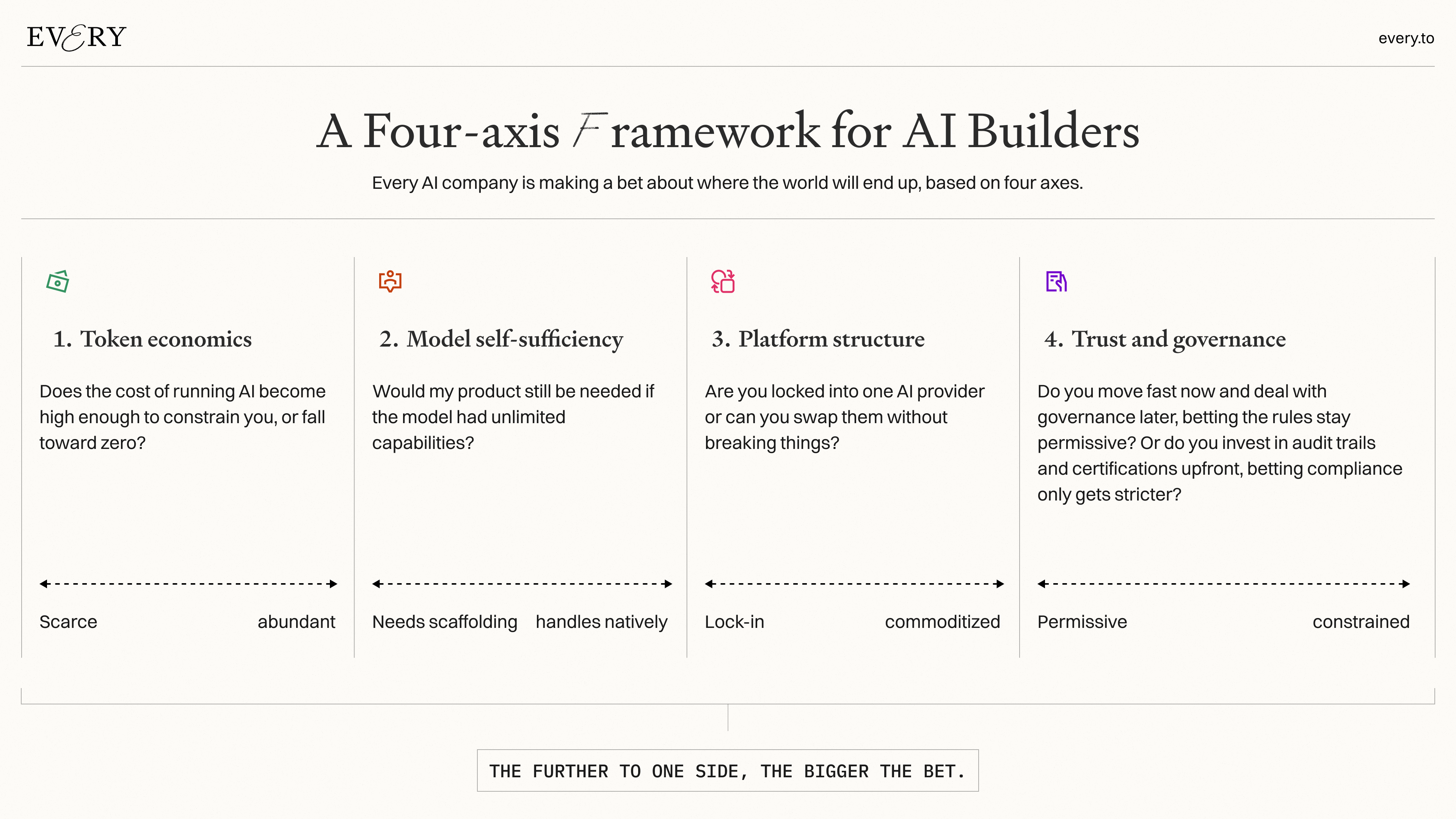
Token economics: Scarce ↔ abundant
If you’re a token consumer—which most AI startups are—abundance is good news, and right now we’re in an era of fragile token abundance. Your margins improve. You can do more, experiment more freely, and build features that would have been prohibitively expensive a year ago. Cursor and its ilk exist as a category because the cost of running AI got cheap enough for products to run constantly in the background and still make money.
But abundance is a trap: If everyone can build what you’re building for pennies, what’s your advantage? As a founder, you need to know whether you’re betting on costs rising enough to be a barrier—or whether you have a defensible advantage that holds even if they don’t.
Ask yourself: Does the cost of running AI become high enough to constrain you, or fall toward zero?
If you’re betting on scarcity, you need to articulate why falling token costs won’t destroy your advantage. One example: applications where agents run constantly, not just on demand—at that volume, even cheap tokens add up, so squeezing cost out of every call becomes difficult. Another is latency-sensitive work, like voice agents built on Vapi, where any delay makes the conversation feel broken. There, you’re stuck paying for the fastest models even as other models get cheaper.
If you’re betting on abundance continuing, you need to build an advantage with one of the following: proprietary data, domain expertise, distribution, or knowing what to build. We believe that tokens will keep getting cheaper. But we see value in companies that reduce cost variance—making spend predictable and insulating customers from volatility. A startup that helps customers cap their maximum bills is more defensible than one competing on average price. We’ve seen it in healthcare: Companies processing huge volumes of data still need to manage their worst-case costs and avoid expensive reprocessing of documents, transcripts, and session logs. Even as per-token prices fall, being able to tell a client “Your bill won’t exceed X” is valuable.
Model self-sufficiency: Needs scaffolding ↔ handles natively
This axis determines the fate of what we’d broadly call “model wrapper” companies. If you’re augmenting what models can do—adding memory, improving retrieval, orchestrating multi-step workflows—you’re implicitly wagering that the model won’t one day be able to do that itself. That’s a bet with an expiration date. Maybe a good bet, maybe not, but you should know you’re making it. Harvey, an AI platform for law firms, and Sierra, a customer service AI, are both counting on a general model not being able to do what they do in their niches.
Ask yourself: Would my product still be needed if the model had unlimited capabilities?
Become a paid subscriber to Every to unlock this piece and learn about:
- The reason healthcare AI may be more defensible than AI for code review
- Why viral compliance trends could be more impactful than government regulation
- Four questions every AI founder should answer now about the bets their strategy is already making.
Forget vague heuristics such as “AI wrappers.” Dan Pupius, chief technology officer at The General Partnership, argues that founders need a more robust framework to understand the risks and opportunities of building with AI. He encourages founders to look holistically at the implicit assumptions underneath their AI strategy, from the cost of intelligence, model self-sufficiency, platform lock-in, and the regulatory environment. I worked with Dan more than a decade ago at Medium, and the same quiet, thoughtful brilliance I knew him for then shines in his nuanced analysis.—Kate Lee
I’ve built products on ideas that people thought were wrong—and watched those same ideas become inevitable.
When I helped to rebuild Gmail at Google in 2005, we were betting that communication was becoming faster, more conversational, and increasingly browser-native. So we built GChat, which put real-time chat inside your browser for the first time, right next to your email. When I was running engineering at Medium, the bet was that social feeds were not enough for deeper thinking and publishing, so even while signups to Twitter, Snapchat, and Vine were exploding, we championed long-form writing.
In each case, we started with an insight about where behavior, technology, and markets were moving—and built our bets on top of it. But now, the rapid pace of change in AI means that the assumptions and insights underlying a strategy can shift mid-execution, causing those bets to crumble.
Founders need a more flexible way of thinking about which bets to take. Instead of asking “What do we think will happen?”, ask yourself two fundamental questions. First: What assumptions are irreversible? If you build deeply on top of one provider, such as one model provider, you need to rewire the product to move away from that provider. Second: What assumptions can we still revise? Assuming tokens will stay expensive is a bet you can hold loosely—if costs fall, you can change your approach without rebuilding anything.
At The General Partnership, where I am the chief technology officer, we developed a framework to help founders understand which bets they’re making, and which ones they can reverse when building with AI. The four-axis framework moves the conversation away from broad labels like “AI wrapper” and toward the specific futures a company is betting on. The goal is to recognize sooner when you’re wrong and move before the market forces you to—not to predict the future more precisely.
The four bets
We kept seeing a pattern with founders. A team would walk us through their strategy. It would sound reasonable and exciting, but the more we looked, the more often these companies’ fates seemed to hinge on factors outside their control.
Those factors mapped to four axes of bets that startups were taking. The companies that understood this knew where the tailwinds and risks of building with AI were. Those that didn’t were exposed.
Token economics: Scarce ↔ abundant
If you’re a token consumer—which most AI startups are—abundance is good news, and right now we’re in an era of fragile token abundance. Your margins improve. You can do more, experiment more freely, and build features that would have been prohibitively expensive a year ago. Cursor and its ilk exist as a category because the cost of running AI got cheap enough for products to run constantly in the background and still make money.
But abundance is a trap: If everyone can build what you’re building for pennies, what’s your advantage? As a founder, you need to know whether you’re betting on costs rising enough to be a barrier—or whether you have a defensible advantage that holds even if they don’t.
Ask yourself: Does the cost of running AI become high enough to constrain you, or fall toward zero?
If you’re betting on scarcity, you need to articulate why falling token costs won’t destroy your advantage. One example: applications where agents run constantly, not just on demand—at that volume, even cheap tokens add up, so squeezing cost out of every call becomes difficult. Another is latency-sensitive work, like voice agents built on Vapi, where any delay makes the conversation feel broken. There, you’re stuck paying for the fastest models even as other models get cheaper.
If you’re betting on abundance continuing, you need to build an advantage with one of the following TK: proprietary data, domain expertise, distribution, or knowing what to build. We believe that tokens will keep getting cheaper. But we see value in companies that reduce cost variance—making spend predictable and insulating customers from volatility. A startup that helps customers cap their maximum bills is more defensible than one competing on average price. We’ve seen it in healthcare: Companies processing huge volumes of data still need to manage their worst-case costs and avoid expensive reprocessing of documents, transcripts, and session logs. Even as per-token prices fall, being able to tell a client “Your bill won’t exceed X” is valuable.
Model self-sufficiency: Needs scaffolding ↔ handles natively
This axis determines the fate of what we’d broadly call “model wrapper” companies. If you’re augmenting what models can do—adding memory, improving retrieval, orchestrating multi-step workflows—you’re implicitly wagering that the model won’t one day be able to do that itself. That’s a bet with an expiration date. Maybe a good bet, maybe not, but you should know you’re making it. Harvey, an AI platform for law firms, and Sierra, a customer service AI, are both counting on a general model not being able to do what they do in their niches.
Ask yourself: Would my product still be needed if the model had unlimited capabilities?
Become a paid subscriber to Every to unlock this piece and learn about:
- The reason healthcare AI may be more defensible than AI for code review
- Why viral compliance trends could be more impactful than government regulation
- Four questions every AI founder should answer now about the bets their strategy is already making.
 Create a free account to continue reading
The Only Subscription
You Need to
Stay at the
Edge of AI
The essential toolkit for those shaping the future

"This might be the best value you
can get from an AI subscription."
- Jay S.
 Every Content
 AI&I Podcast
 Monologue
 Every Agent
Join 100,000+ leaders, builders, and innovators

Already have an account? Sign in.
What is included in a subscription?
Daily insights from AI pioneers + early access to powerful AI tools



 Front-row access to the future of AI
 In-depth reviews of new models on release dayPlaybooks and guides for putting AI to workPrompts and use cases for buildersIn-depth reviews of new models on release dayPlaybooks and guides for putting AI to workPrompts and use cases for builders
 Bundle of AI software






 Katie Parrott
 Every Staff
 Kieran Klaassen
Comments