


Nityesh Agarwal is a senior applied AI engineer at Every.

Claude Code Is the OpenClaw Alternative You Already Have
Anthropic shipped it over a year ago. Most people just didn't notice.
Jun 26, 2026 · 11 min readUpdated Sep 15, 2026

Was this newsletter forwarded to you? Sign up to get it in your inbox.
OpenClaw showed the world what an AI assistant could look like.
The open-source project became the most-starred software project in history in only 60 days, not because of hype. People were experiencing AI that didn’t just answer questions but did things. Managed your calendar. Sent emails. Controlled your browser. All triggered from a text message in WhatsApp or Slack.
I watched Sam Altman hire OpenClaw’s creator and Microsoft CEO Satya Nadella build “ClawPilot” on top of the framework. And the whole time, one thought kept nagging at me: Claude Code already does all of this. What’s so special about the crustaceans?
The answer was rooted in public perception. OpenClaw was marketed as an AI agent, and Claude Code was marketed as a coding tool.
We’ve now spent months building on both Claude Code and OpenClaw at Every—including Claudie, an AI employee who runs our consulting team’s back office. That work has shown us why initial excitement about OpenClaw is cooling—linked to its unreliability—and why Claude Code is the most capable platform for building an AI assistant today.
If you’re trying to build an AI that does things, you don’t need to wait for a better OpenClaw alternative because you already have one. Here’s the case for it, and how to use it.
Harnessing the models
Claude Code can do everything that made OpenClaw go viral: Use tools, manage files, and run for hours on its own. That’s not a coincidence because underneath, the two are the same thing: a harness for an AI model.
Think of AI models—Claude, GPT, Gemini—as powerful, capable horses. A harness is the thing that lets you direct that horsepower. It’s the software layer that sits between a raw AI model and the task you’re trying to accomplish. It decides how the model receives context, which tools it can use, how it remembers things across conversations, and how it talks to the outside world.
You’ve been using harnesses already: ChatGPT wraps a model in a chat interface that can browse the web and run code; Cursor wraps one in a code editor. Claude Code wraps one in something more open-ended: the ability to call tools, chain steps together, and work autonomously toward a goal. Which is exactly what OpenClaw does.
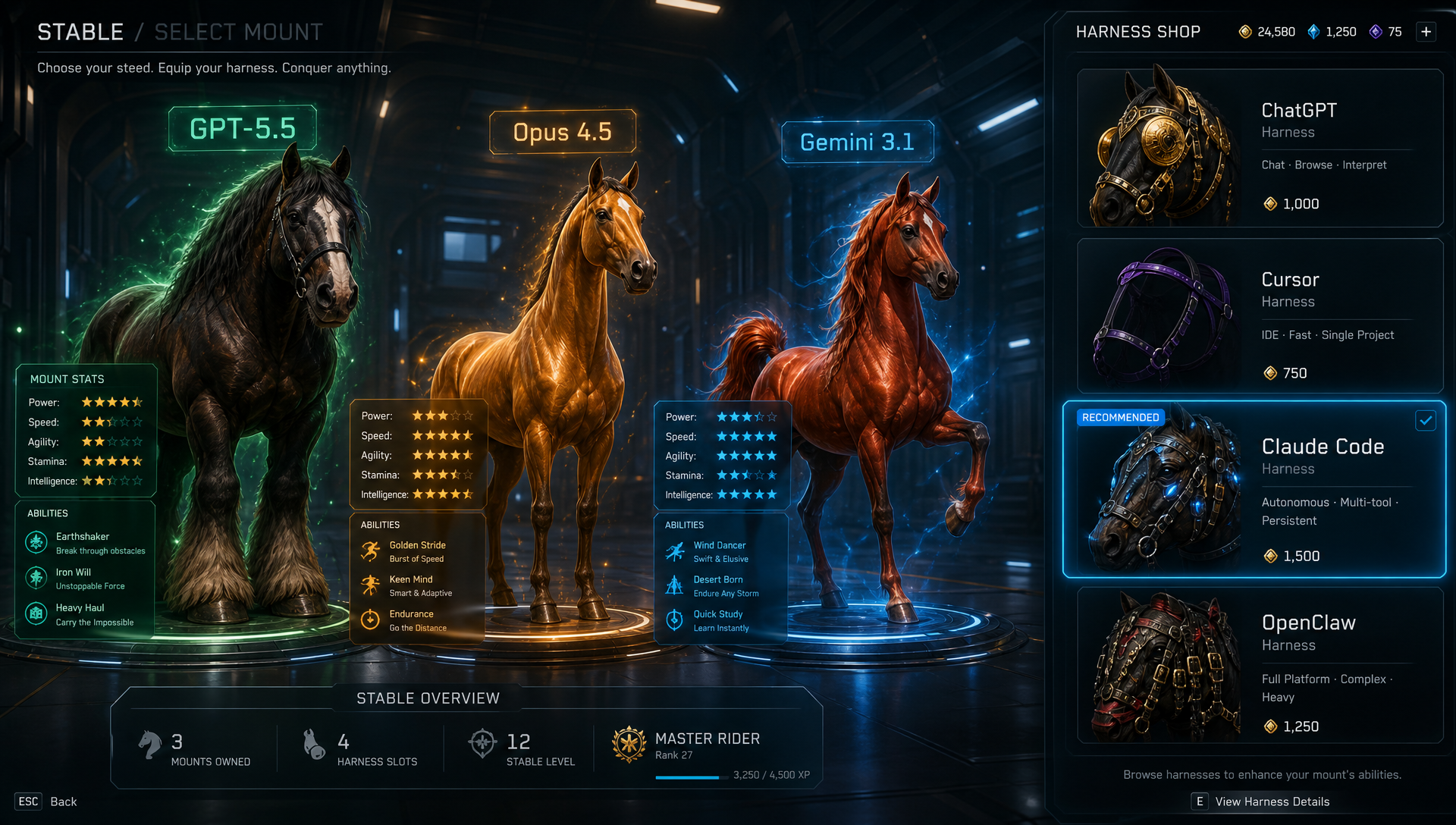
What people loved about OpenClaw—and how Claude Code gets you there
OpenClaw went viral because it made something click. For the first time, a lot of people watched an AI go off and complete a task. The unofficial tagline that emerged across reviews and threads was: AI that actually does things. Those capabilities break down into five categories—and Claude Code has every one...
Become a paid subscriber to Every to unlock this piece and learn about:
- What about OpenClaw’s memory system makes it prone to error
- How Nityesh built an AI assistant for Every’s consulting team and connected it to Slack
- What Claude Code taught us about AI employees
 Create a free account to continue reading
The Only Subscription
You Need to
Stay at the
Edge of AI
The essential toolkit for those shaping the future

"This might be the best value you
can get from an AI subscription."
- Jay S.
 Every Content
 AI&I Podcast
 Monologue
 Every Agent
Join 100,000+ leaders, builders, and innovators

Already have an account? Sign in.
What is included in a subscription?
Daily insights from AI pioneers + early access to powerful AI tools

 Front-row access to the future of AI
 In-depth reviews of new models on release dayPlaybooks and guides for putting AI to workPrompts and use cases for buildersIn-depth reviews of new models on release dayPlaybooks and guides for putting AI to workPrompts and use cases for builders
 Bundle of AI software





 Katie Parrott
 Every Staff
 Kieran Klaassen
Comments