


Dan Shipper is the CEO and cofounder of Every. Every week he explores the frontiers of AI in his column, Chain of Thought, and on his podcast, ‘The Every Podcast’.

We Raised $17.5 Million to Make You and Your Team AI-native
Led by IA Ventures with participation by Nicholas Thompson, Betaworks, and others
Nov 25, 2026 · 7 min read

We raised a $17.5 million Series A at a $110 million post-money valuation.
The round was led by Jesse Beyroutey from IA Ventures with participation from Nicholas Thompson (CEO of the Atlantic), Alex Rattray (CEO of Stainless, acquired by Anthropic), and Betaworks. (Fortune has a full story.)
We are so grateful to so many of you who have helped us get here over the past seven years. As a thank-you, every paid subscriber can now gift a free month of Every to three friends.
Here’s a little more about why we raised and the future we’re building for.
In AI, billions of dollars are being poured into making a single curve go up:
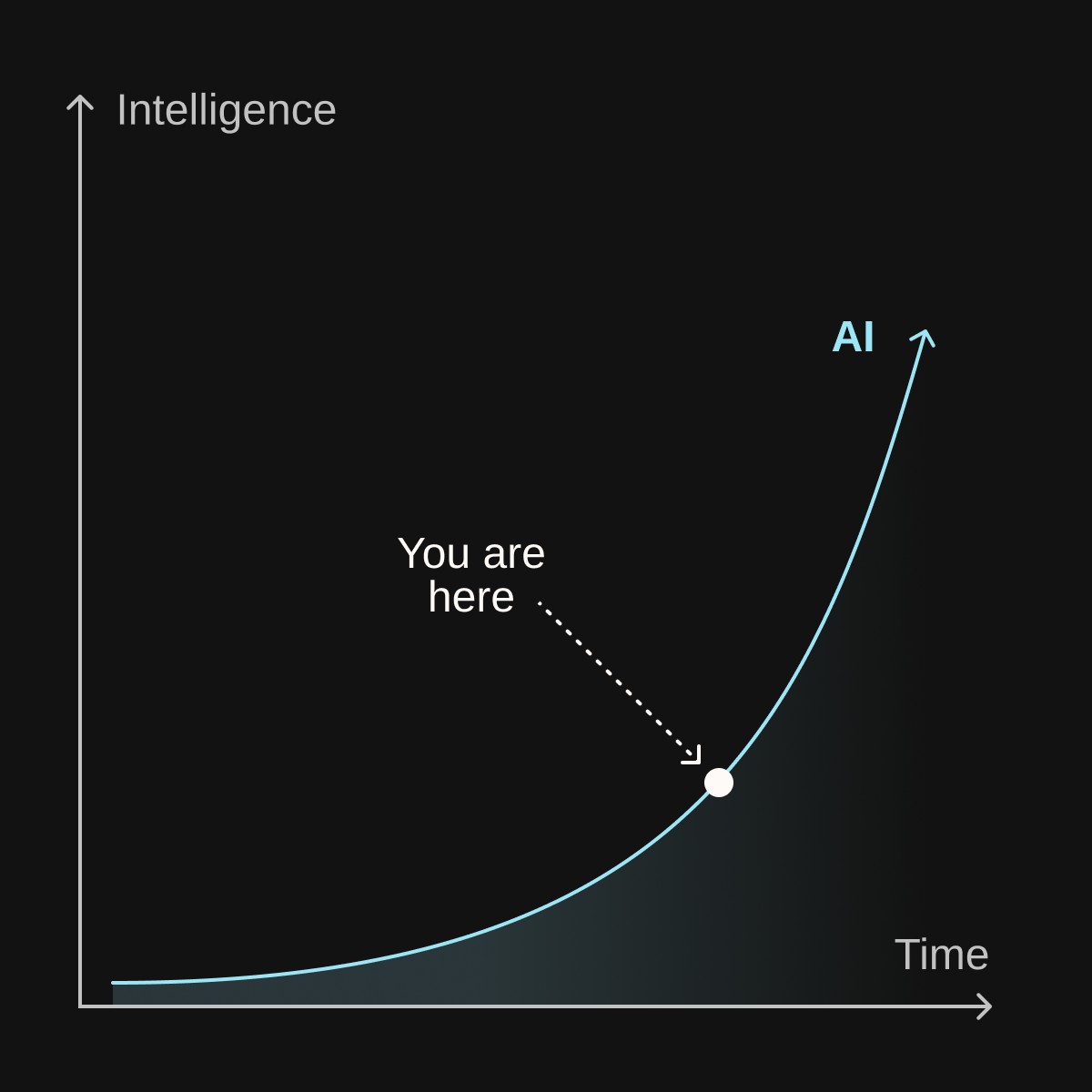
We’ve been focused on AI at Every since before the release of ChatGPT in 2022, and I’ve looked at charts like this for years. Every time I see one, I feel a now-familiar mix of astonishment, foreboding, and grief—and a sense of my own imminent insignificance. I imagine you’ve felt the same.
Those emotions are absolutely warranted. Capability charts accurately predicted the shock that coders, writers, artists, and mathematicians would feel when we watched a model do in seconds what we spent years or lifetimes learning to do on our own. They also predict—also accurately, in my view—that this shock will reach every desk and industry over the coming years.
I’ve also come to see that while the capabilities these charts measure are real, the future of human insignificance they imply is not.
Capability curves were originally built to answer an engineering question: Is the AI getting more intelligent? To measure the machine cleanly, the chart has to freeze every other variable, including you, your tasks, and your tools. In the process, we picture a world where the technology takes center stage and the person disappears.
No wonder the charts are scary!
This charting technique is understandable—indispensable even—within the narrow enclosure of a frontier lab trying to reliably turn investment dollars into compute and model capability. Carried out of the lab and used to predict the fate of humans and the value of human work, it produces nonsense.
Outside the lab, humans are lousy at staying constant. The first thing we do is pick up the new tool, and the moment we do, everything the chart tried to freeze is in motion, with people, tasks, tools, and models all colliding and reshaping each other in real time.
A capability chart can measure how good a model is at the work we used to do. It can’t measure what we’re capable of when we put the model to work for ourselves.
To see that, you have to create a different kind of frontier lab: a living one, built to test not what a new model can do alone, but what humans become capable of when we use it, together.
That is what Every is: a 35-person media and technology company where everyone, in every role, is an AI early adopter, testing new frontier models on real work every day. What we discover becomes stories, education, software, and skills that help our subscribers and their teams put AI to work—long before it becomes mainstream.
Over the past four years, working this way has given us a firsthand view of how AI will reshape work, teams, and companies. It is how we saw in 2022 that AI models would soon allow individuals and small teams to do the work of large organizations; in 2024, that we were entering an allocation economy, where you aren’t judged on how much you know but on how well you can manage AI models; and in 2026, that automation doesn’t mean the end of human work but more work for people with perspective and expertise.
This doesn’t take virtuosic analytical or prophetic abilities. It takes trying these new tools on real work and paying attention to what happens next.
When you do, you stop racing the capability curve and start riding it. We see what that looks like every day inside Every and on the teams of our subscribers and customers.
Each person on our team is doing work that would have taken three, five, or 10 people in 2020. Alongside documents, spreadsheets, and slides, we pitch ideas and review strategy with AI-generated documentaries and playable video games. Marketers are doing data science on customer surveys; designers are building custom thumbnail tools; engineers are producing viral videos and livestreams; writers are designing evals and hill-climbing custom skills; AI researchers are doing three months of work in a week.
Working this way shows you the capability curve has it backward: It isn’t the human who is frozen—it’s the model.
The moment a model ships, it stops changing: a static snapshot of yesterday’s human competence, distilled and distributed cheaply to everyone in the world. Every few weeks, a new model drops, the line jumps to a new level, and another layer of hard-won specialist skill—writing production code, analyzing a messy spreadsheet, editing a video—becomes available to anyone on demand.
Yes, that pace is disorienting and hard to keep up with. Yes, it requires constantly reevaluating your workflows, product offerings, and business models. Yes, we can and we should expect it to get faster as we approach artificial general intelligence (AGI).
But there is an irony in each jump on that curve. A model contains everything humanity already knows in one undifferentiated pool. On its own, it’s inert—paralyzed by its trillions of possibilities, able to inhabit any perspective and therefore possessing none of its own. And because everyone gets access at once, a model’s default output gives you only what everyone else already has.
Seen this way, the rising capability curve is simply the floor: the baseline competence anyone in the world can get from a default prompt. In investing terms, it’s beta—what the whole market gets just for showing up.
Alpha—what makes AI output valuable—is what you and your team bring to it: your responsibility for a real problem in the world and your perspective on which of the model’s trillions of possibilities actually matters. That is where your edge comes from—pushing the model somewhere a default prompt would never go:
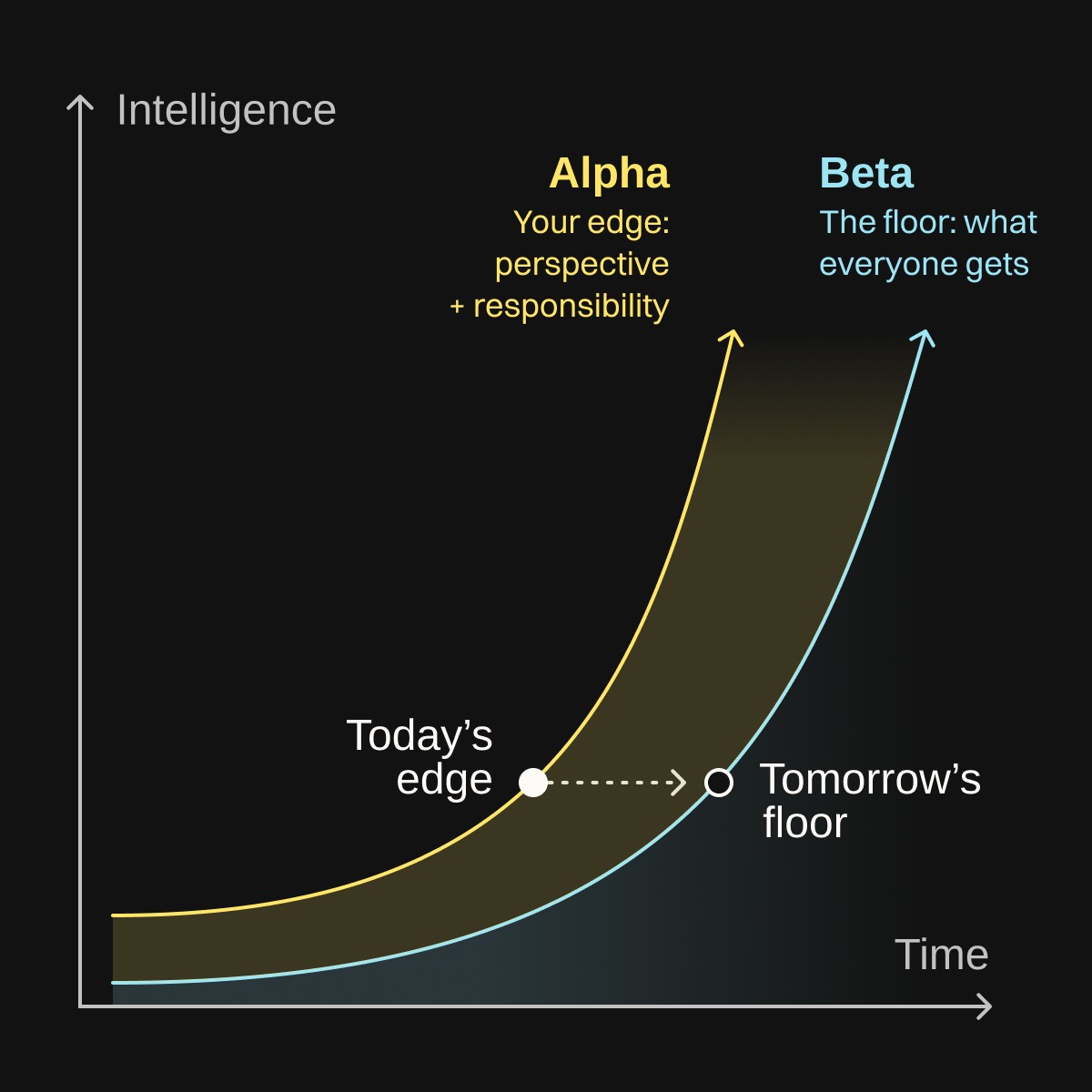
As we approach AGI, that floor will keep rising. What takes real ingenuity to coax out of a model today—today’s edge—becomes tomorrow’s floor.
If you stand still, that rising floor swallows what you used to do. But if you and your team are riding on top of it, every new model lifts you with it, and you get to bring your evolving perspective and responsibility to an even more capable tool.
Where a capability chart asks you to watch the machine grow larger and the human grow smaller, great technology does the opposite: As a tool gets better, it disappears into our hands.
In time, we’ll stop staring at raw model benchmarks in the same way we’ve stopped staring at processor speeds and hard drive capacity and start seeing only the craft of the people wielding the tool. Asking if Claude did something will be like asking if your laptop did it.
As the AI recedes into the floor, the humans riding on top of it will come back into full view—expanded in what we can make, what we can take responsibility for, and what we can be, together.
That is the future Every exists to build.
We raised $17.5 million to build the single subscription you and your team need to keep turning rising model capability into great work: daily writing that tells you what matters on the frontier, software and skills that improve how you work, and training that moves your whole team forward together.
I know the history of media companies that raise venture capital is a grim one. That’s why we raised this round on our terms. Jesse is one of my closest friends, I retain full control, and we’ll use this capital to deepen and expand what makes Every special over the long term.
Most people look at the exponential curve of AI and think: Imagine what it will do in a year.
We say: Imagine what we will do with it.
Dan Shipper is the cofounder and CEO of Every, where he writes the Chain of Thought column and co-hosts The Every Podcast. You can follow him on X at @danshipper and on LinkedIn.
Everyone’s a builder now. Every All Access gets you the full membership plus the Builder Pack—$9,000+ in credits for the tools we build with.
The Only Subscription
You Need to
Stay at the
Edge of AI
The essential toolkit for those shaping the future

"This might be the best value you
can get from an AI subscription."
- Jay S.
 Every Content
 AI&I Podcast
 Monologue
 Every Agent
Join 100,000+ leaders, builders, and innovators

Already have an account? Sign in.
What is included in a subscription?
Daily insights from AI pioneers + early access to powerful AI tools


 Front-row access to the future of AI
 In-depth reviews of new models on release dayPlaybooks and guides for putting AI to workPrompts and use cases for buildersIn-depth reviews of new models on release dayPlaybooks and guides for putting AI to workPrompts and use cases for builders
 Bundle of AI software




 Katie Parrott

 Every Staff

 Kieran Klaassen
Comments