


Evan Armstrong was a lead writer at Every who explored profit and power in technology in Napkin Math.

Profit, Power, and the Vision Pro
Will Apple’s new headset change everything?
Feb 6, 2024 · 13 min readUpdated Jul 15, 2026

I will admit to being biased from the get-go. As I settled down into a stool at the Apple store in Chestnut Hill, Massachusetts, the occupants of the seats around me were already trying the Vision Pro, whispering “Holy shit,” and “Oh my God,” and “Is this shit real?” These folks, united in their use of profanity, were diffuse in demographic. There was an elderly grandpa grasping at invisible screens, a woman with pink hair wearing a denim jacket, a bald man who looked like he had just meandered over from a break at his IT job. All of them, no matter what they looked like, had their jaws open.
If anything, they undersold it.
The Apple Vision Pro (AVP) is the single best tech demo I’ve ever seen. I have tried an obscene number of gadgets and sat in on too many startup pitches too count. Yet nothing has come close to the Vision Pro’s first 20 minutes. During one section I watched Alicia Keys belt music in my face. There was a dinosaur and I played pinball. It was all fairly run-of-the-mill, if still spectacularly rendered, gadget demo stuff.
One moment in particular gave me a glimpse of the future. In the Photos section of the demo, there was a video of children gathered around a birthday cake to blow out the candles. Despite the Apple employee’s insistence that I move on, I replayed the video over and over again. I was there. It was the greatest home movie that humanity has ever made. It was past made present, once again. It was reality made more real.
I couldn’t help but cry. In that video, I caught a glimpse of what virtual reality could be. Devices like the AVP have the potential to be the greatest empathy generator we’ve ever dreamed up. The visual acuity has crossed the tricking-the-brain-rubicon: Some part of me was convinced that what I was viewing was real. Can you imagine what this means at scale? All of humanity can truly feel the suffering, the hope, the joy of our own past experiences, and live in the stories of others. Empathy can be a product, a gadget that people can purchase and carry with them. I think it can create a more peaceful, better world. I’m sold.
This article is not, however, a review of the headset. There are many that will help you decide whether to buy it or not. The device is not perfect: It’s heavy, the field of view is small, and it’s probably not an obvious yes for most people unless you feel the need for more screens in your life.
However, the AVP has shown enough technological ingenuity and generated enough consumer buzz that we can seriously consider the second-order questions: Who is going to make money off this thing? Which companies are going to win? How can hackers build new companies to serve this product? Should they?
These questions about virtual and augmented reality have been circulating for years. But now, with the AVP, we have enough of a foundation to start getting some answers.
A $3,500 teleportation device
You can use the Vision Pro to do three things:
- Big screen everywhere: Surf web pages anywhere, in giant dimensions, while walking around. It could be in your home, it could be on the subway. If you can do it on your phone, you can now do it on a personal IMAX screen wherever you are.
- New media formats: Watch videos that you can’t consume on a normal flat screen—i.e., three-dimensional videos. Apple calls them Immersive Videos (which are professionally made 180-degree, 8K video formats) and Spatial Videos (which are consumer-made videos that, remarkably, you can record with an iPhone 15). The Spatial Video is the demo that made me cry.
- Overlay digital assets onto the real world: In tech parlance, this is augmented reality. Because when you put the AVP on you can still view the world around you, the device can put computer graphics on top of your visual field. Think of Pokemon Go, but instead of peering through your phone screen, the AVP does it for your entire world view.
Combining these elements produces a truly novel device. However, before we merge them, let’s pick apart each of these categories so we can understand the power dynamics.
Big screen everywhere
One otherworldly review came from YouTuber Casey Neistat. Wearing the AVP, he roams around New York City, throwing up screens while at the Times Square Krispy Kreme or riding his skateboard. The most surreal moment happens as he waits for the subway, when he pulls up a movie theater-size screen playing YouTube.
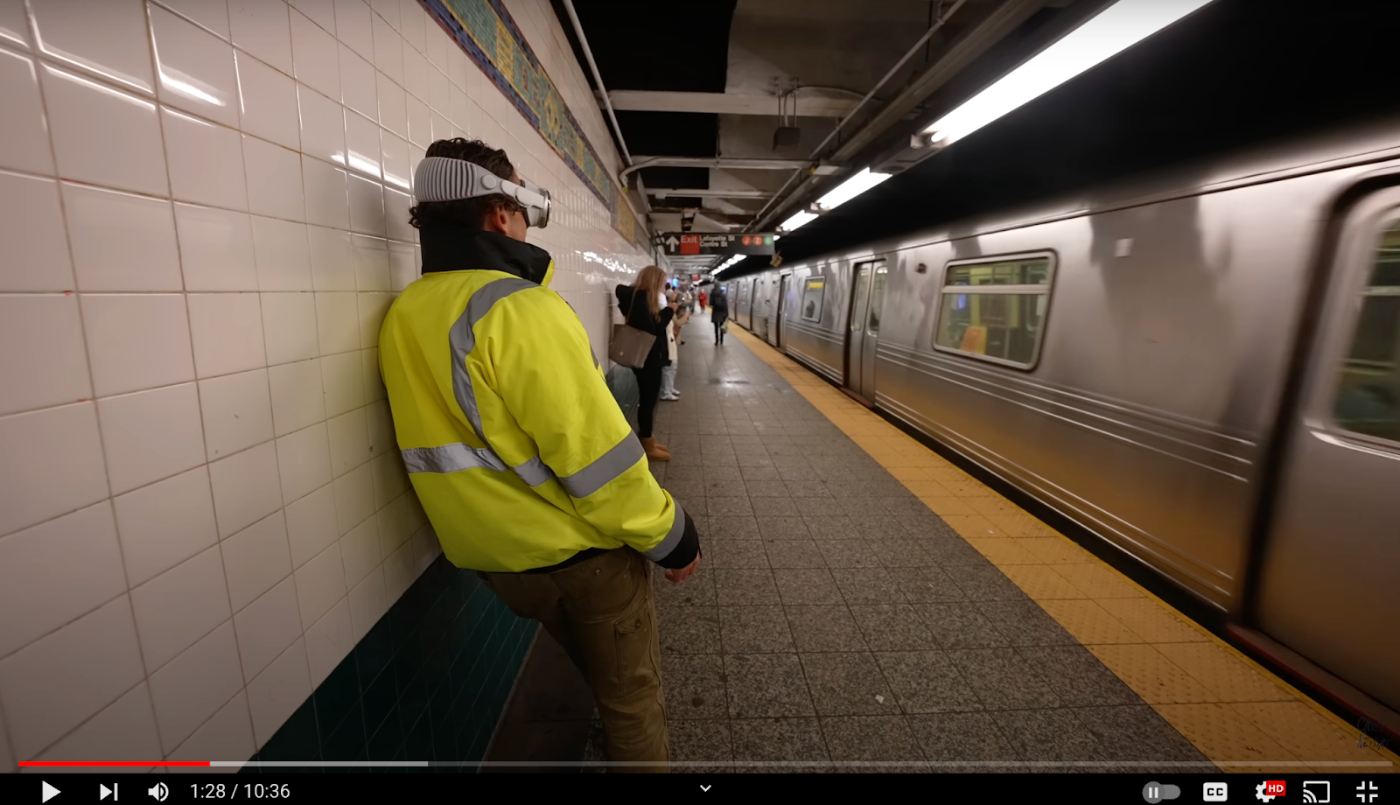
To everyone else, it looks like he’s just wearing ski goggles.
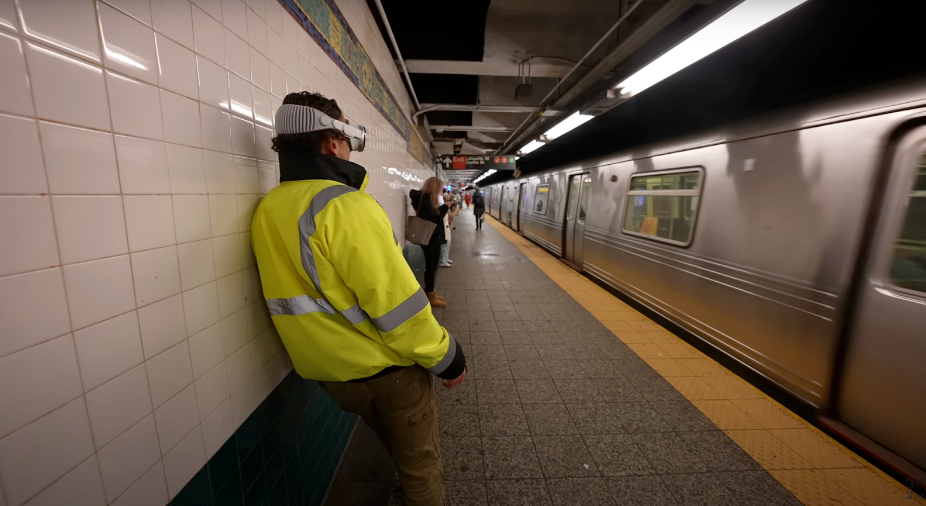
“Standing at [a] subway stop, watching a Mr. Beast video is a pretty special experience,” Neistat says. Not to contradict him, but there is nothing special about this at all! Since it was released two weeks ago, that video of Mr. Beast comparing private islands has been watched 109 million times. Many people watched it at a subway stop—they just did so on their phones. The only thing that has shifted is that your screen is bigger, and no one else can see it.
Still, this is a dramatic improvement in entertainment. It is a miracle of technology that boggles the mind.
It is also the same old internet that can be accessed on your phone. The winners for “big screen everywhere” are the same as those of the internet. Consumer internet companies like Facebook will continue to enjoy network effects. Software companies will benefit from owning a customer’s most important data and workflows.
The “big screen everywhere” disrupts those selling monitors, TVs, and smartphone displays more than it does software companies. In all the places where small screens are inferior or more screens would be beneficial, viola—big screen delivers.
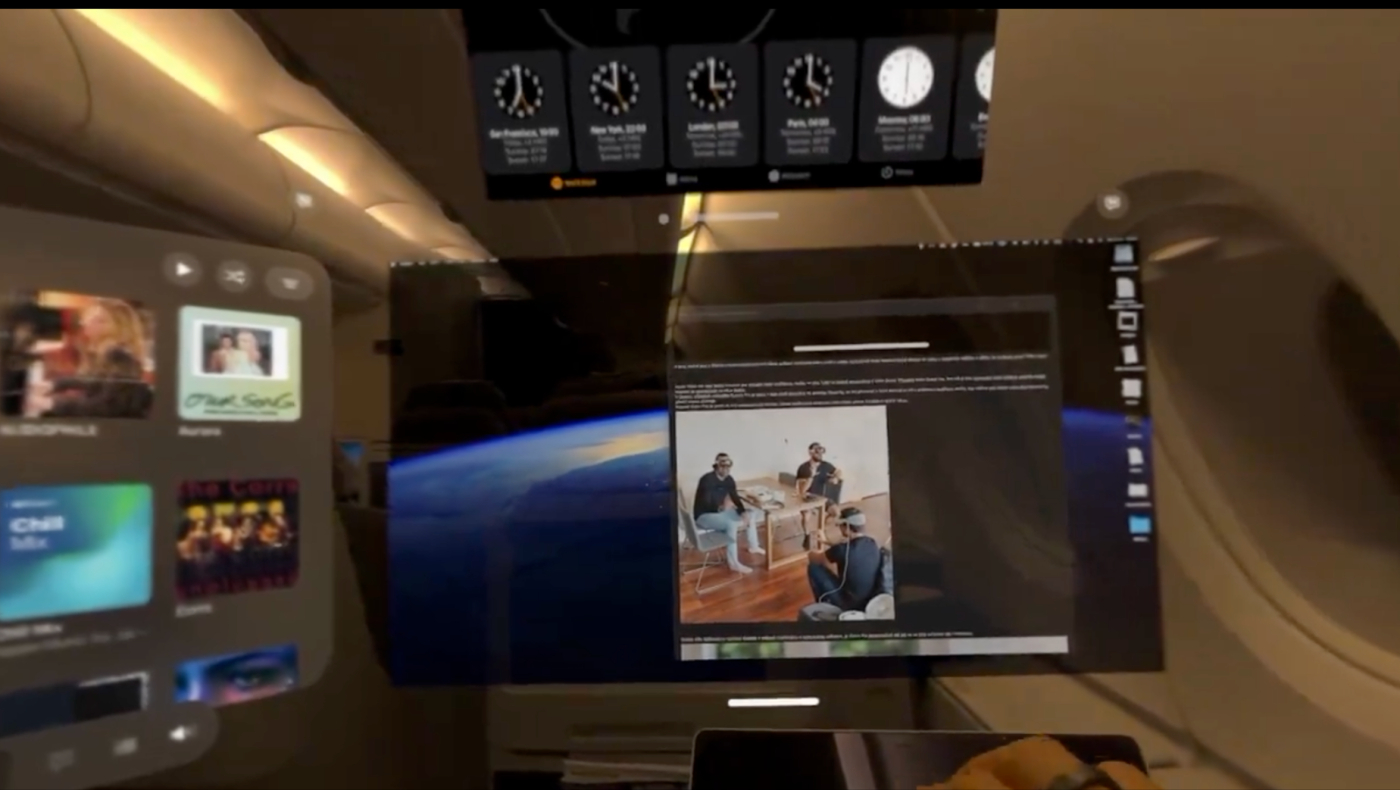
For example, you don’t have to deal with the janky 10-inch display on an airplane anymore.
In the living room and want to watch a movie? Behold.
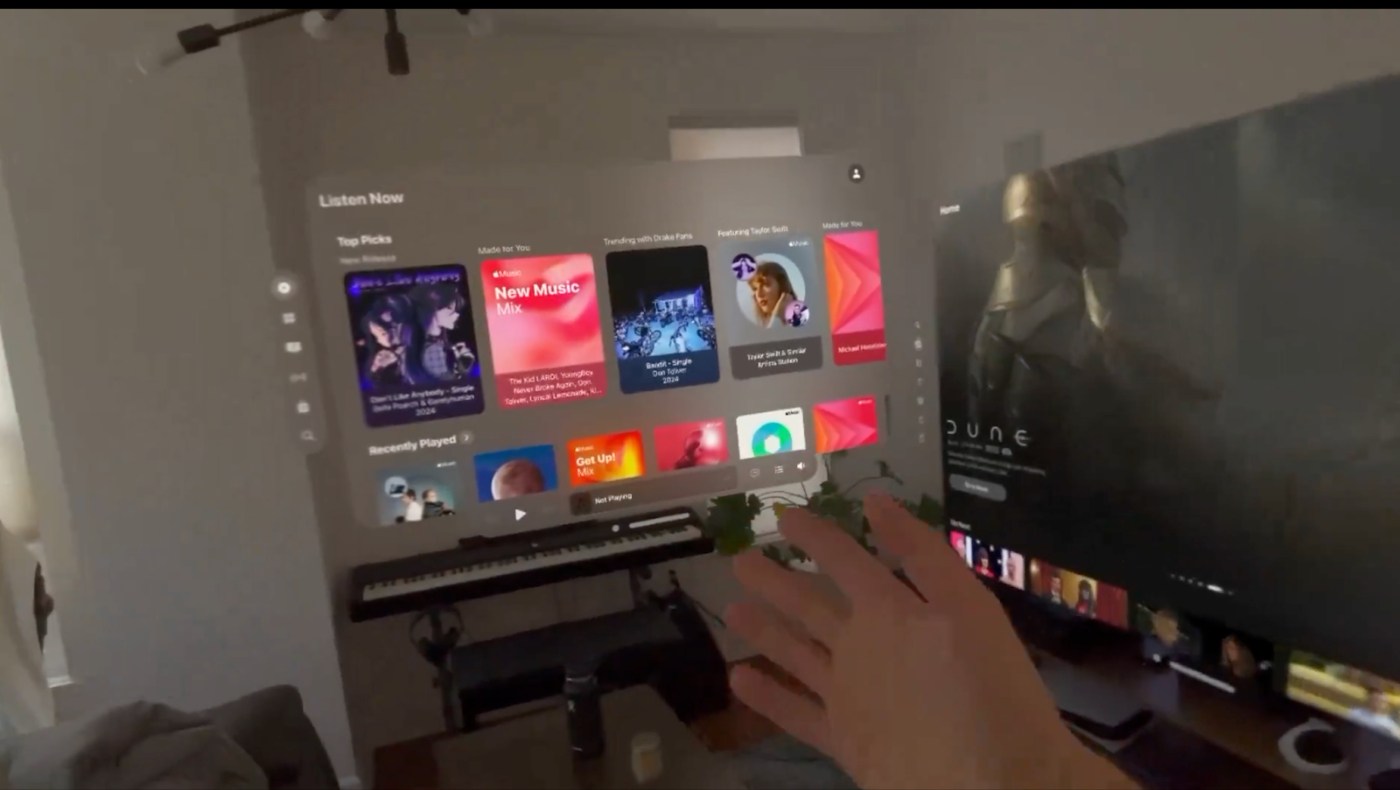
You get the idea.
If anything, the AVP and other AR/VR devices may exaggerate the importance of software: By consolidating multiple forms of hardware into a central display device that you use for nearly everything, the software on the device becomes that much more crucial. Similar to the iPhone demolishing the camera and portable GPS businesses by putting their capabilities into a single device, so too will the AVP affect the sales of any screen you use.
The companies that were the runaway winners of the 2010s era of the internet will continue to dominate because format isn’t the central value proposition. The network of users, creators, and developers that you transport from design paradigm to design paradigm is what makes the companies dominate. YouTube is still going to be a juggernaut. Facebook is still going to keep you scrolling. There will be some design tweaks to better incorporate 3D content and more smoothly operate the hand interface, but, just like in the transition to mobile in the early 2010s, the market is the incumbents to lose.
If anything, this may actually increase the power of cloud-based software ecosystems. Because so much of the computing power on the AVP will be devoted to visual rendering, much of the computing work and data storage will have to be done on the cloud. Gaming will either be streamed or paired with local compute. Movie theaters will continue their slow rot with the AVP beating out most screens.
A large beneficiary will—unsurprisingly—be Apple itself. Many of the most magical parts of being in an Apple ecosystem, such as being able to copy on one device and paste in another, remain true on the AVP. You can extend your Macbook’s display to make it larger, enhancing productivity. You can access your iMessage account between devices. Once Apple sucks you in, they have you for life.
Analysts often break the big screen category into buckets of productivity or entertainment. That isn’t quite right. What we are really talking about is the internet. If you think having the internet on a big screen in front of you wherever you go would be cool, then that’s all that matters. Since the Apple Vision can pair with the accessories you use in your normal workflow (mouse, keyboard, etc.), it isn’t that different from your current productivity stack. It is likely less efficient than your current setup, but that’s OK. It isn’t supposed to be a total Mac replacement (yet). While there are, of course, differences and challenges today—for example the eye tracking isn’t always precise enough—it is hard to imagine a world where Apple and its developer ecosystem don’t improve this over the next five years.
 Create a free account to continue reading
The Only Subscription
You Need to
Stay at the
Edge of AI
The essential toolkit for those shaping the future

"This might be the best value you
can get from an AI subscription."
- Jay S.
 Every Content
 AI&I Podcast
 Monologue
 Every Agent
Join 100,000+ leaders, builders, and innovators

Already have an account? Sign in.
What is included in a subscription?
Daily insights from AI pioneers + early access to powerful AI tools
 Front-row access to the future of AI
 In-depth reviews of new models on release dayPlaybooks and guides for putting AI to workPrompts and use cases for buildersIn-depth reviews of new models on release dayPlaybooks and guides for putting AI to workPrompts and use cases for builders
 Bundle of AI software


 Katie Parrott
 Every Staff
 Kieran Klaassen
Comments