

Katie Parrott is a staff writer. She writes Working Overtime and contributes to Vibe Checks, Source Code, and Context Window.

How to Keep Your Writing Weird in the Age of AI
The 500-year-old secret to making AI your best writing partner
Jun 13, 2025 · 7 min readUpdated Sep 29, 2026

Was this newsletter forwarded to you? Sign up to get it in your inbox.
I was deep in a rabbit hole about textual criticism and the Bible when my ChatGPT tutor pointed me toward a concept that completely changed how I think about writing with AI.
Lectio difficilior potior. The harder reading is stronger.
It's a principle scholars have used for centuries. When faced with two versions of an ancient text and asked which is the original, they choose the one that's more difficult to understand. The thinking is that somewhere along the way, some well-meaning copyist, intentionally or otherwise, tweaked the original to make it clearer or more sensible according to their understanding. I'm going to call this cautious copyist a “timid scribe.”
The moment I read about this concept, I saw AI playing the role of timid scribe everywhere in my own writing. Where I might write "altar-call energy," AI defaults to "enthusiasm." Where I talk about "collecting screenshots like a doomsday prepper," it recommends "documenting examples." I fed this very essay to the AI editor I’ve tailored for my Every writing, and Claude Opus 4 pruned away the spiky edges of my opening sentence in the name of editorial efficiency:
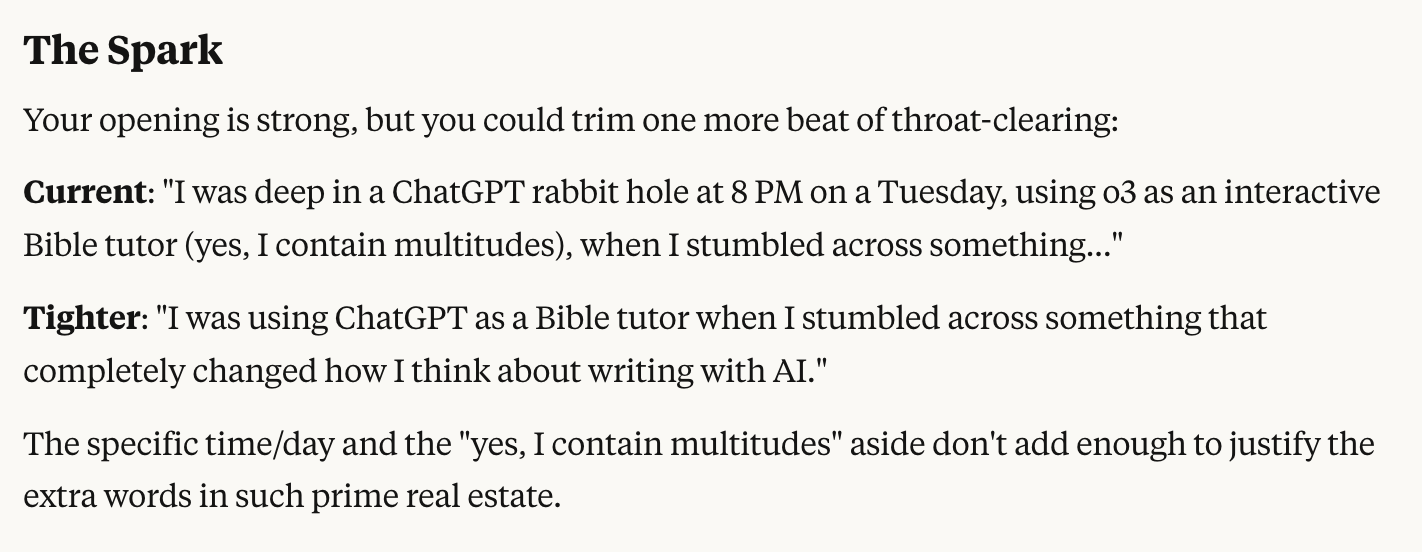
AI takes what's specific and makes it general. It takes what's wrinkly and makes it smooth. The consequences are already visible: Scroll through any business blog, marketing newsletter, or LinkedIn feed, and you'll see the smoothing happening at scale.
AI hasn't created this problem, but it's accelerating it quite a bit. When everyone has access to the same polishing tool, we risk a kind of digital invisibility—millions of pieces of content, all professionally adequate, none memorable.
As I talked to ChatGPT about this classic principle of textual criticism, I gained language for something I'd been noticing but couldn't quite name: AI is our era's timid scribe. It’s a well-meaning assistant that takes your weird original and makes it sound like everything else. And learning to work with it, not against it, might be the most important writing skill of our time.
Thanks to our sponsor: Microsoft

Get more done with less
We’re all busy building—launching startups, side ventures, personal projects. But using multiple tools can complicate things. That’s why we use Microsoft Teams Free, which combines some of our most important collaboration needs—video, chat, file-sharing—in one place, for free. We’re getting more done now with way less.
The smoothing engine at work
Last week, I was writing a social media post about Every's value proposition and started with this:
"Most Every subscribers don't know what they're paying for."
I asked LinkedIn's built-in AI to refine it. The suggestion:
"Most Every subscribers may not be fully aware of what they're paying for."
Look at what happened there. The AI version added hedges ("may not be"), softened the language ("fully aware" versus "don't know"), and became considerably more professional. It also became bland, beige, and forgettable.
This is AI being very good at producing the statistical average of all business writing ever created. It knows that professional communication typically includes qualifiers. It's doing exactly what it was trained to do: Produce text that fits the pattern.
The rough version has a bluntness that might make readers pause: ”Wait, do I know what I'm paying for?” The smooth version slides by without friction. The voice that might lodge in someone's brain gets traded for clarity that evaporates on contact.
Sometimes that trade is worth it! Not every weird metaphor deserves to live. The trick is recognizing when you're smoothing away confusion versus character.
When it’s producing text, AI pulls everything toward the statistical center. Sometimes the center is exactly where you want to be. But sometimes the edges are where the interesting stuff lives.
Learning to work with your timid scribe
Your timid scribe is not your enemy; you just need to learn to work with it. I'm still very much in the process of figuring this out, but here’s what I’ve learned, and how I go about it...
Become a paid subscriber to Every to unlock this piece and learn about
- Katie's exact method for integrating AI when writing her personal newsletter, her Every column, and for brands
- Texture as a strategic choice, not an accident
- Cultivating productive friction in an AI-smoothed world
Thanks to our sponsor: Microsoft

Get more done with less
We’re all busy building—launching startups, side ventures, personal projects. But using multiple tools can complicate things. That’s why we use Microsoft Teams Free, which combines some of our most important collaboration needs—video, chat, file-sharing—in one place, for free. We’re getting more done now with way less.
 Create a free account to continue reading
The Only Subscription
You Need to
Stay at the
Edge of AI
The essential toolkit for those shaping the future

"This might be the best value you
can get from an AI subscription."
- Jay S.
 Every Content
 AI&I Podcast
 Monologue
 Every Agent
Join 100,000+ leaders, builders, and innovators

Already have an account? Sign in.
What is included in a subscription?
Daily insights from AI pioneers + early access to powerful AI tools


 Front-row access to the future of AI
 In-depth reviews of new models on release dayPlaybooks and guides for putting AI to workPrompts and use cases for buildersIn-depth reviews of new models on release dayPlaybooks and guides for putting AI to workPrompts and use cases for builders
 Bundle of AI software





 Katie Parrott
 Every Staff
 Kieran Klaassen
Comments