


The Real AI Bottleneck: Bad UX
Plus: The race to design for agents, and a guide for AI in the workplace
Apr 12, 2025 · 7 min readUpdated Sep 8, 2026

Was this newsletter forwarded to you? Sign up to get it in your inbox.
As Shopify CEO Toby Lütke emphasized this week in his viral company memo, businesses like his already consider AI to be an indispensable tool in the workplace (here's how you can get started using it).
But there are large gaps in adoption, even within narrowly defined groups of people. Anthropic’s education report found that computer science professionals routinely use AI, yet computer science students—who will soon make their way into the professional world—aren’t learning to use AI at anywhere near the same clip. This gap is echoed by a study in Harvard Business Review, which found that while AI is effective at enhancing learning generally, there are persistent fears that it could negatively impact critical thinking. If we fail to bridge the gap between academia and the professional world, we're doing a disservice to an entire generation. Stanford’s AI Index Report underscores how a similar disparity is taking shape not just in education, but in how AI is adopted across disciplines and regions.
One possible solution comes from Nan Yu, the head of product at product management software company Linear. Yu argued compellingly this week that "AI adoption is a UX problem”: The technology’s power is undeniable, but its widespread adoption depends entirely on thoughtful, human-centered interface design. (For some great examples, check out these explorations on X by artist and researcher Kat the Poet Engineer.) To truly harness AI’s potential, we must clearly define the role of the human and, therefore, what we want humans to learn.—Alex Duffy
Knowledge base
“Your CEO Just Said ‘Use AI or Else.’ Here’s What to Do Next.” by Alex Duffy: Shopify CEO Tobi Lütke's viral memo declared this week that "reflexive AI usage is now a baseline expectation" at his company—essentially saying if you're not using AI daily, you're falling behind. If that sounds a little intimidating, fear not: We made a five-step guide to help you get the most out of AI in your work. Read this if you want to make AI feel like a natural extension of your work rather than another task on your to-do list.
"The Race Is On to Redesign Everything for AI Agents" by Tina He: AI agents are already selecting vendors, negotiating deals, and writing code on their own, creating a fundamental shift in how we design products. Coinbase’s Tina He argues we need to focus on three dimensions: agent interpretability, “agentic attention,” and human-agent collaboration. Read this to discover four billion-dollar opportunities in this emerging landscape, from AI-optimized content systems to agent-to-agent negotiation protocols.
"This Master of AI Agents Is Most at Home in the Analog" by Michael Reilly/Thesis: Tina He took us inside how she gets her work done and the tools she needs to succeed. A Japanese gel pen and a perfectly-sized notebook are in the mix, as is her truly impressive reading list. Read this for a glimpse into the analog habits of a digital pioneer, complete with book recommendations that range from Piketty to Munger.
🎧 🖥 "An Inside Look at Every’s Design Philosophy" by Dan Shipper/AI & I: Every's creative lead Lucas Crespo is on a mission to bring that wonder back through what he calls “neoclassical pop art”—think ancient marble statues rocking neon colors and modern symbols. In this episode, Lucas reveals how he creates Every's distinctive visual identity and demonstrates his AI image generation process in real-time. Watch this if you want to see how thoughtful design can make digital experiences feel more human. Available on X, YouTube, Spotify, or Apple Podcasts.
"How to Write Online" by Evan Armstrong/Napkin Math: Evan has spent four years and nearly half a million words (yes, more than the entire Lord of the Rings trilogy) figuring out why some writing online soars while other pieces crash and burn. Read this if you want to transform your writing from forgettable to unforgettable, whether you're just starting out or already have an audience.
From Every Studio
Your briefs, tracked. Your inbox, one step ahead.
Our email management tool Cora got better at keeping up with you, freeing you to focus on communicating, not retracing your steps like an email detective. Here’s what’s new:
Ever open Cora and think, wait…did I already read this brief? Us too. Now you’ll see unread dots on briefs you haven’t read yet—especially handy for getting up to speed on weekend emails.
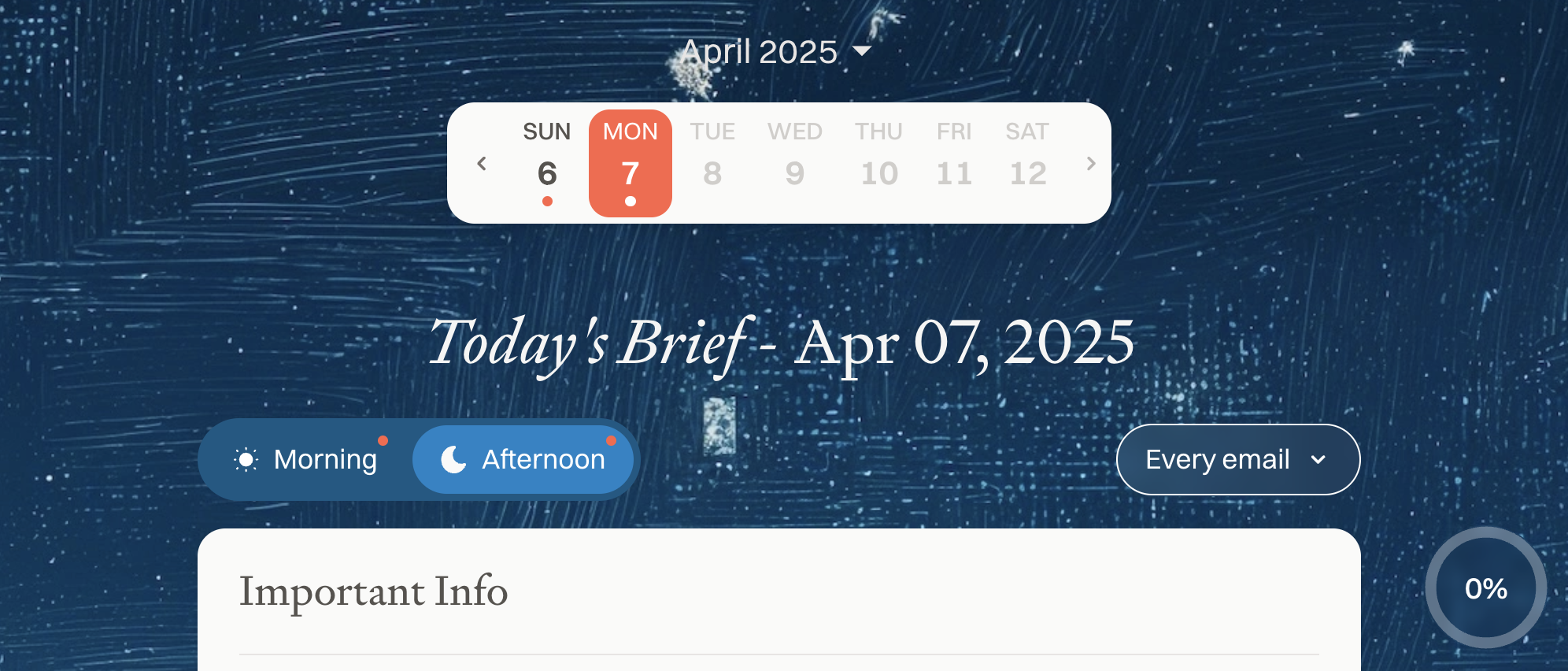
Bonus: When you read a brief from Cora’s site, the matching notification email disappears from your inbox like it was never there.
Mark as (un)read: Need to revisit a brief? Mark it as read or unread with a single click.


From acquaintance to bestie: how we’re thinking about agent relationships
What should it feel like to collaborate with an AI agent? As Every CEO Dan Shipper puts it, “There are two phases to working with an agent: getting to know me, and besties. The first phase requires a lot of back and forth communication. The second [phase], we just give each other a look and it knows what I mean.”
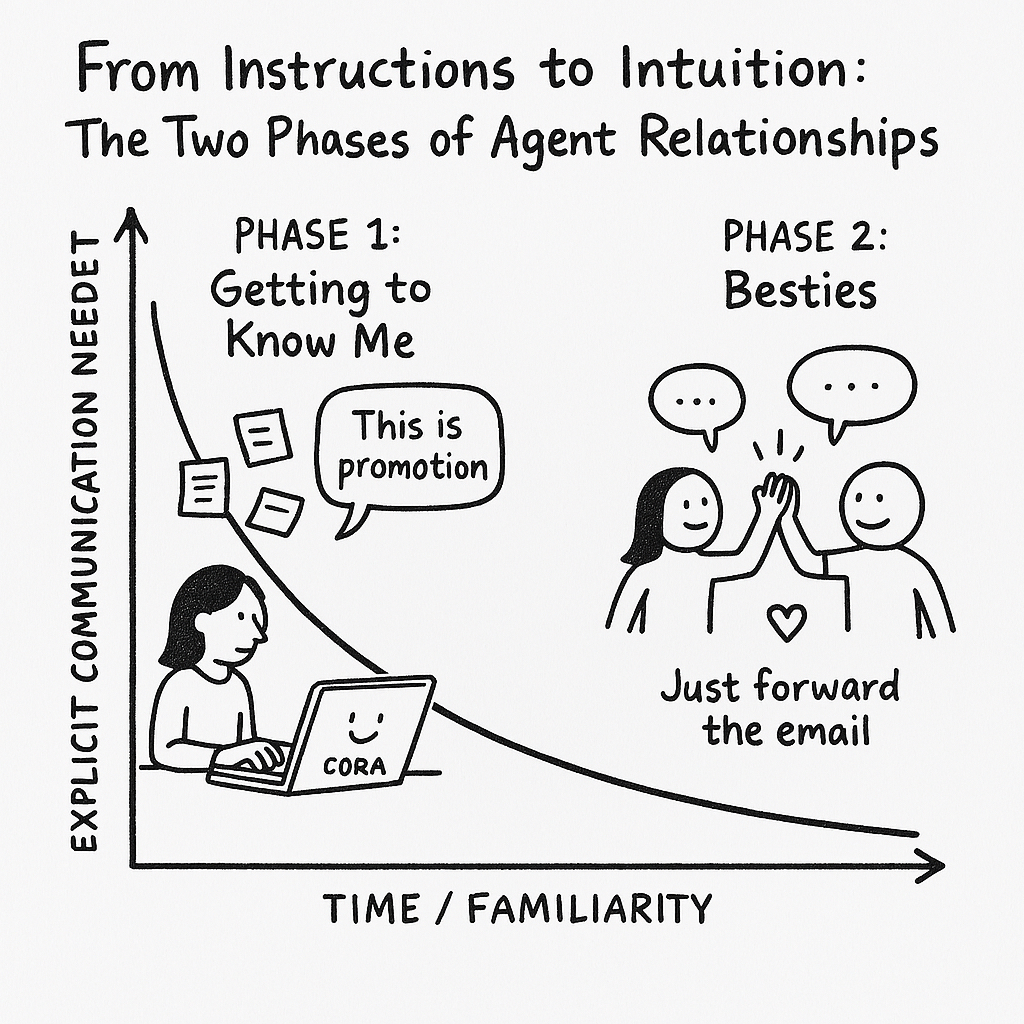
At the Studio, we’re experimenting with ways to build agents into our experiences. Let’s say you want to give Cora guidelines for categorizing a type of email. You’ll get a more tailored experience by interacting with an inbox assistant agent, but you’ll need to give it some guidance on how you want your emails handled. A little “This is a promotion” (file it), “That’s my boss” (always show up in my inbox), or “No, don’t show me this again” (archive it).
Eventually, a good agent relationship feels like magic. You’re able to forward the Cora agent an email without saying anything about what to do—”the equivalent of a meaningful glance to your bestie when someone says something crazy at dinner,” Dan says. Or maybe you don’t even need to forward it—as your inbox “bestie,” Cora‘s already seen it, clocked it, and taken care of it.—Vivian Meng
Alignment
SPOILER ALERT. In the final episode of White Lotus season 3, Piper finally admits that she prefers her luxurious life to “finding herself” in a Buddhist monastery—with its boxed rooms, bland food, and absence of air conditioning—a confession so honest and refreshing that I shouted “YES!” in my living room. The scene dismantles the tired cliché of a wealthy person’s neatly packaged spiritual awakening, a trope we've seen play out thousands of times. By rejecting that familiar narrative, Piper confronts the seductive fantasy of renunciation and realizes that she simply wasn’t ready—or perhaps wasn’t even genuinely willing—to let go. Perhaps you can relate to this yourself. There may be times when living a comfortable, tech-centric life feels somehow empty, and it seems like returning to a simpler way of being would unlock deeper happiness and contentment.
“Not so fast,” Piper seems to tell us. It's easy to romanticize asceticism from the comfort of five-star resorts and Instagram quotes. It’s another thing entirely to accept what true sacrifice entails. Don’t get me wrong. Piper’s refusal is not a failure. Her willingness to accept her contradictions shows genuine maturity: Authentic spiritual practice is admitting you'd rather have air conditioning.—Ashwin Sharma
Collaborative filtering
100-plus students have learned how to write with AI
Our course How to Write With AI just wrapped up with stellar results. More than 100 students—venture capitalists, doctors, teachers, and more—learned to use AI to write tasteful, powerful copy, and 33 of them published their results and saw what these tools make possible. We had a lot of fun reading these. Check out the student essays.
That’s all for this week! Be sure to follow Every on X at @every and on LinkedIn.
We build AI tools for readers like you. Automate repeat writing with Spiral. Organize files automatically with Sparkle. Write something great with Lex. Deliver yourself from email with Cora.
We also do AI training, adoption, and innovation for companies. Work with us to bring AI into your organization.
Get paid for sharing Every with your friends. Join our referral program.
The Only Subscription
You Need to
Stay at the
Edge of AI
The essential toolkit for those shaping the future

"This might be the best value you
can get from an AI subscription."
- Jay S.
 Every Content
 AI&I Podcast
 Monologue
 Every Agent
Join 100,000+ leaders, builders, and innovators

Already have an account? Sign in.
What is included in a subscription?
Daily insights from AI pioneers + early access to powerful AI tools

 Front-row access to the future of AI
 In-depth reviews of new models on release dayPlaybooks and guides for putting AI to workPrompts and use cases for buildersIn-depth reviews of new models on release dayPlaybooks and guides for putting AI to workPrompts and use cases for builders
 Bundle of AI software






 Katie Parrott
 Every Staff
 Kieran Klaassen
Comments