


Katie Parrott is a staff writer. She writes Working Overtime and contributes to Vibe Checks, Source Code, and Context Window.

Taming Opus 5
Plus: How to audit old agent instructions, habits you unlearn when you start working for yourself, a solution for Claude-isms, and the new-model tests we may be neglecting
Jul 28, 2026 · 9 min readUpdated Aug 26, 2026

On Friday, we published our Vibe Check of Claude Opus 5. A small group of us had spent the week testing it, and we found a model that was brilliant in flashes and frustrating in practice. Then the rest of the Every team got their hands on it.
Their experiences over the weekend confirmed the model’s unruliness—and suggested a way to tame it. We also have the second essay in our series in partnership with Maven on “unlearning,” a workflow for checking whether skills built for an older model are getting in the new one’s way, and a theory as to why one-shot AI demos of video games clog your social feeds.
Was this newsletter forwarded to you? Sign up to get it in your inbox.
Pulse check
Getting thrown by Opus 5
Toward the end of Every’s all-team standup on Monday, the conversation turned to Opus 5. More people from the team had tried it by then, and the same quirks kept coming up.
Head of operations Arielle Shipper found that Opus 5 needed too much management and repeated prompting to keep its responses simple—more than Fable or Opus 4.8. Cora general manager Kieran Klaassen advanced a theory that the new Opus is intended to be a subagent to Fable, and communicates as though it were speaking to agents instead of humans.
It was also prickly; during a decluttering project, Opus successfully inventoried head of consulting Natalia Quintero’s belongings and planned donations, but adopted an irritating, judgmental tone, criticizing her for owning 15 water bottles. Senior editor Jack Cheng shared a screenshot of Opus backhandedly calling one of his comments the most interesting thing he had said all session. Software engineer Kai Zau thought Anthropic had dialed up the model’s disagreeableness, while fellow engineer Lee Knowlton joked that Opus 6 might finally tell users they had said something insightful.
Prickliness aside, the team converged toward a specific way of working with the new Opus model. CEO Dan Shipper and Spiral general manager Marcus Moretti had both handed Opus a substantial job with a clear finish line, then left it alone. Jack told it he was about to step away from the computer, and to batch its work and ask any blocking questions. All three got good results. Anthropic’s prompting guide makes the same recommendation: Put the full brief in the first prompt and let Opus run.
Then, when it comes back, evaluate the finished artifact on its own, without getting bogged down in Claude’s narration of how it got there. If the output is good but Opus’s explanations are hard to parse, try this I Have ADHD Skill (12,000 stars and counting). Head of education Micah Rich put the rules from the skill about being concise and action-oriented into Claude’s output styles, so they filter the model’s communications without you having to repeat “I don’t understand what you’re saying” over and over.
I’m still figuring out where that leaves me. I gave Opus materials for a presentation I’m delivering this week on writing with AI, and what it produced was voicey, confrontational, and difficult to follow. It made unsupported claims about my audience and overwrote an earlier file without permission. Whereas from the same inputs, GPT-5.6 Sol gave me a deck I could imagine presenting.
Working with Opus 5 reminds me of trying to tame a high-level horse in The Legend of Zelda. I keep trying because I tend to need longer to learn a new Anthropic model, and the company says we may need to change our prompts and revisit the instructions around our agents. If, with those interventions (and maybe a skill audit—more on that below) Opus is materially better at the kind of work I do, then it might be worth the trouble.
But every time Opus 5 sends me flying into the dirt, I start thinking about the other, tamer horse that right next to it, saddled up and ready to go.
From Every
What you have to unlearn when you work for yourself
Product designer Xinran Ma left his corporate job to start his own business, and solo work forced him to unlearn habits that had delayed action, experimentation, and personal judgment. His essay follows the experiments that helped his move before he felt certain of the direction —and argues why hands-on experiments build a perspective that survives tool churn. It’s the second of three pieces in partnership with Maven, the expert-led course platform, on what we need to unlearn as AI changes how we work.
Steal this workflow
How Flora turns one reference image into a reusable creative system
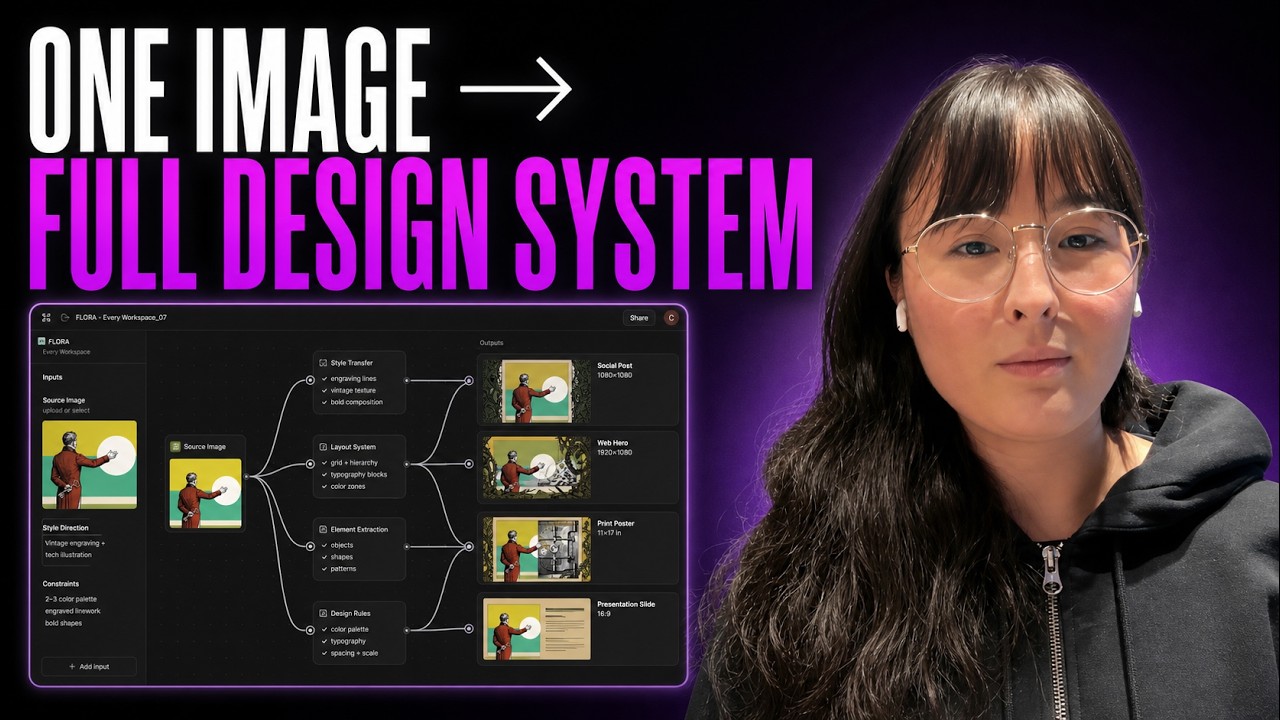
Every’s article headers share a visual language. In this video, Catherine Chung, a forward-deployed creative at Flora, shows how she would turn one finished image into a reusable workflow for the next article.
Catherine walks Dan Shipper through the full process: extract the visual rules from a reference, adapt them to a new topic, generate three distinct directions, and package the workflow so a teammate can run it without touching the node canvas.
- Catherine asks Claude to describe the collage quality, illustration style, composition, and color application of an existing Every header image. That description becomes the template for future prompts.
- She connects new article context to the template, splits three concepts into separate image nodes, then saves the finished canvas as a Flora Technique with one input and three outputs.

Here’s how you can get started:
- Pick a reference image that captures the visual language you want to reuse.
- Ask a model to describe only the qualities you want to preserve: the medium, composition, illustration style, color treatment, and other relevant constraints.
- Give it the new topic or full article and ask for three concepts built from that template, each with a different subject or composition. Render each concept separately.
- Once the workflow produces useful results, save its input, prompts, and outputs as a reusable Technique that teammates can run from FLORA’s app mode.
Ready to try Catherine’s workflow? Upgrade to Every All Access and get one month of Flora Max, worth $200, through the Builder Pack for eligible free accounts. All Access members can redeem more than $7,000 in partner offers.
Steal this workflow
Is it the skill or the model?
During Every’s Opus 5 testing, Kieran found that the model kept stopping between steps in compound engineering. The open-source coding plugin is used by tens of thousands of developers, so he needed to know whether Opus was failing or the plugin was getting in its way...
Become a paid subscriber to Every to unlock this piece and learn about:
- How Kieran Klaassen updates skills that break when new models release
- A Wall Street Journal report that aligns with our “After Automation” thesis
- Why video games are the internet’s favorite AI demo
 Subscribe to read the full article
The Only Subscription
You Need to
Stay at the
Edge of AI
The essential toolkit for those shaping the future

"This might be the best value you
can get from an AI subscription."
- Jay S.
 Every Content
 AI&I Podcast
 Monologue
 Every Agent
Join 100,000+ leaders, builders, and innovators

Already have an account? Sign in.
What is included in a subscription?
Daily insights from AI pioneers + early access to powerful AI tools


 Front-row access to the future of AI
 In-depth reviews of new models on release dayPlaybooks and guides for putting AI to workPrompts and use cases for buildersIn-depth reviews of new models on release dayPlaybooks and guides for putting AI to workPrompts and use cases for builders
 Bundle of AI software





 Katie Parrott
 Every Staff
 Kieran Klaassen