


Mike Taylor is the head of evals at Every and a co-author of "Prompt Engineering for Generative AI" (O’Reilly).

How I Finally Got AI to Write Like Me
Six years of trying, four optimizers, and one blind judge. Here’s the process, step by step.
Nov 16, 2026 · 10 min read

Was this newsletter forwarded to you? Sign up to get it in your inbox.
I’ve been trying to get AI to write like me since 2020, when early AI writing tool Copy.ai was handing out free GPT-3 accounts to everyone who failed to get into Y Combinator. Every time a new model came out, I tried again, and every time it got a little better. By 2023 I had an AI-writing process that was good enough to pass the Turing test: My friends and colleagues couldn’t tell it wasn’t me.
But I could tell. I also didn’t like that when colleagues asked me questions about something I “wrote,” I couldn’t recognize the ideas as my own. I never stopped trying to get AI to write for me but eventually formed better beliefs about how to write ethically with AI—such as writing on topics that aren’t in the training data yet and otherwise wouldn’t be heard. I also developed an AI writing process that included dictating my ideas using voice mode and Lego’ing multiple drafts together until I had something I liked. That got my ideas onto paper faster without losing my authenticity.
But it bothered me that my writing still sounded like AI, and asking Claude to create a writing skill using my past writing didn’t make it much better. So I ran a series of experiments testing how to train AI to write like me. I think I’ve finally cracked it. A recent piece was written with my new /write-like-mike writing skill, as was this one, and I have an eval metric that proves it works.
While I still need to make a handful of edits each time (I rewrote this introduction myself), I can go from having an opinion to writing a piece in about an hour—it used to take me a whole day. There’s a second layer of (human) editing after I submit, and the editors are next on my list to help because I’ve gone from sending them one post a month to one a week. Here’s the process for getting AI to write like you.
Your roadmap needs more than a .md file.
Your agent has a plan. Your team still needs to agree on the priorities.
Which customer problem comes first? What evidence backs it up? What changes when you learn something new?
Jira Product Discovery brings customer insights, prioritization, and living roadmaps into one shared place. Connect ideas to delivery in Jira so people and agents understand what to build and why.
Keep using AI to move faster. Give everyone a shared view of where you’re going and why.
How to build a writing skill that sounds like you
Most people’s writing skill is a description, written by them or by Claude after reading a few posts. That’s a fine place to start, but if you stop there, every rule in the skill is just an informed guess about how you tend to write. The steps turn those guesses into a test of whether the skill produces writing that sounds like you.
Step 1: Gather what you’ve already published
I started with 185 of my posts, which totaled 335,000 words across 13 publications and went all the way back to 2013. I held 54 of them back as a final exam for the methods I was testing. That held-out set is the only way to know a skill has learned a style rather than just memorized some posts.
Volume doesn’t always beat focus, though: I found my writing style had changed over the years, and so when I optimized the writing skill again on just my 30 most recent Every articles, I got better results. My advice: Pick one publication or format and gather 12–25 published pieces from it.
If you don’t have writing samples, take the transcripts from your last 30 meetings instead. I find writing resonates better when you write like you talk. It’s easy to use AI to make something authentic-sounding more formal later if you need to; making something sound more human is much harder.
Don’t use tweets or emails as your source material for emulating your writing style—I tried it, and it sounds terrible. The way you write for social media or email is too specific to the medium and doesn’t translate well to long-form writing.
Step 2: Turn each post into a brief that holds the substance but not the style
For each post, I had a model extract just the core content: the thesis, the outline, every fact, source, anecdote, and exact quote needed to understand the story, but none of the style, phrasing, hooks, or jokes. The model has all the context needed to write the post, but none of the style. That way, if a draft written from the brief sounds like me, I can attribute it to the skill and test new skills that beat it.
Unfortunately, that means you have to supply an actual opinion. If you don’t have anything interesting to say, the best AI writing skill won’t save you. I’ve argued that AI writing is only defensible when your input tokens outnumber your output tokens. Divide what you put in by the length of the final draft, and you get what I call your distillation ratio. The ideas need to be yours, and you should rely on AI only to write them up in the right style.
Step 3: Build a judge you can trust
Scoring style is where my earlier attempts fell short. You can’t optimize your skill or prove it’s working without judging whether AI writing “sounds like you” hundreds of times. What finally worked is something I call the pairwise gold triad eval metric: An AI judge sees my real post and two drafts generated from the same brief and picks the one closer to what I actually wrote.
Because AI judges favor whichever draft they read first, each comparison runs twice with the order swapped, and the judge writes a note on how each draft differs from the real post (one complained about “some punchy asides” that were “slightly more performative than the reference’s understated voice”). Those notes are what the optimizer (explained later) learns from.
Use the most consistent judge you can: Opus 5.5 gave the same answer with the drafts swapped 86 percent of the time, against 70 percent for Sonnet 5.5. Jev changed its mind 50 percent of the time, so it’s not a good judge of a creative task like this that needs more intelligence.
Step 4: Optimize the skill instead of writing it
I compared four ways of building the skill. The first was the normal approach: I asked Claude (Fable 5.1) to read my posts and write a style guide. You might have taken this approach already if you’ve experimented with AI writing. The problem is that you end up with a good-looking set of instructions but no proof they make the model write better.
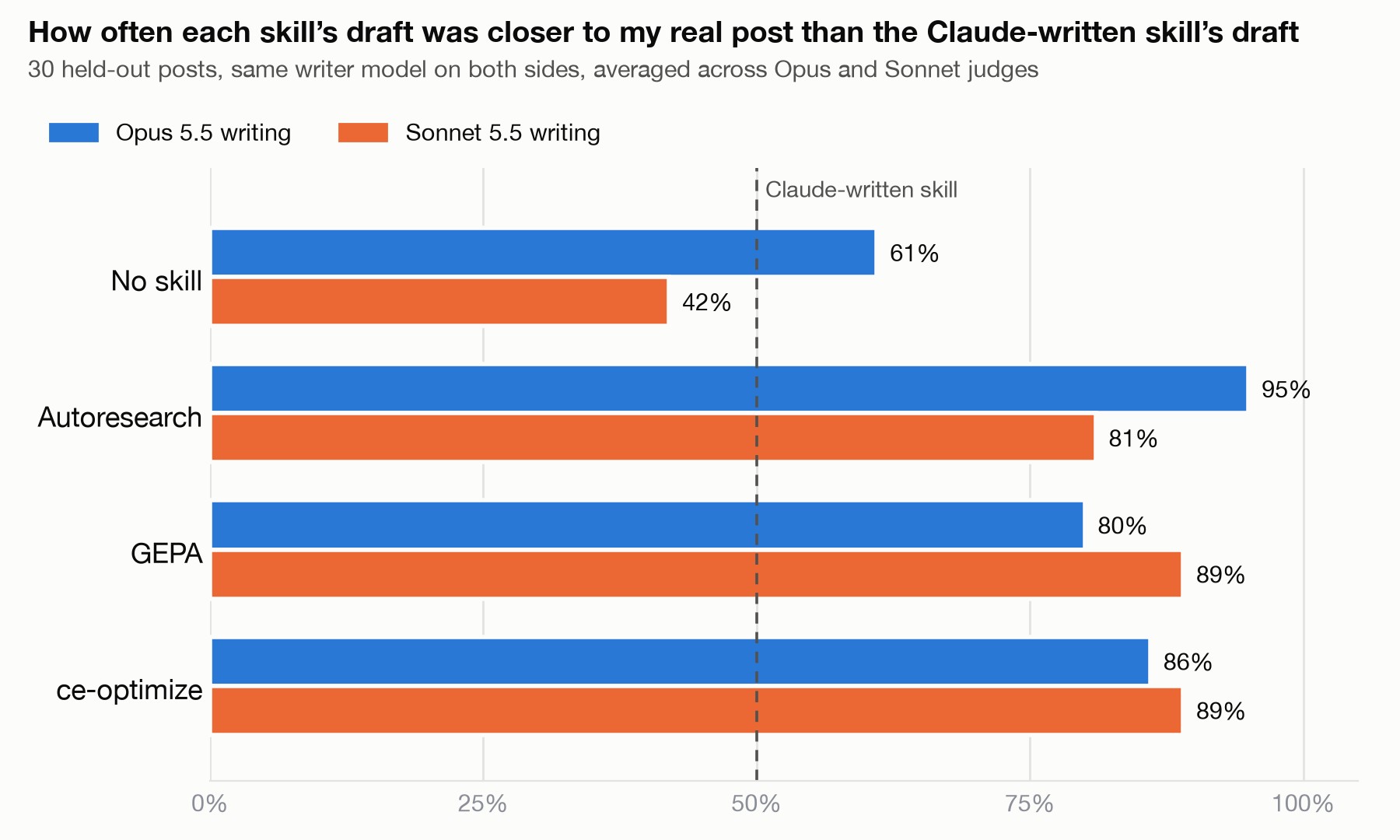
The other three were optimizers, which write drafts, get them judged, and keep a change to the skill only if it scores better: Andrej Karpathy’s autoresearch, DSPy’s GEPA, and ce-optimize from Every’s Compound Engineering plugin. The Claude-written skill lost to all three on 80 to 95 percent of held-out posts. For Opus 5.5, removing the skill improved performance—Claude without the skill beat Claude with the skill 61 percent of the time. I interpret this to mean Opus 5.5 naturally writes like me, and adding the skill was doing more harm than good.
Comparing the skills side by side explains why. The Claude-written skill reads like a list of my greatest hits—self-deprecating humor, one-sentence paragraphs, signposts like “Here’s the thing”—and a model told to use them all the time produces a caricature, not the real me. On one held-out post, it had me “hovering near the coffee station hoping someone interesting would wander over,” which I have never written.
The optimized skills are full of corrections drawn from the judge’s notes instead. For example, the agent noted that earlier failed versions of the skill were producing “tidy edited summaries” and “punchy blog beats.” It also warned against inventing jokes or using the phrase “Here’s the thing.” I use this feedback to rewrite my writing skill, which is then retested on each post to see whether it corrects earlier mistakes. Feedback on what went wrong in each case beats vague descriptions of my preferences, which is also good advice for working with human writers. The optimizer found what replicates my style, rather than overindexing on my quirks.
Optimizing costs more—$27 to $53 per skill at API prices, against $5 for the one-shot version—but all three optimizers made most of their gains within three rounds, so stopping early saves a lot. I ran the second round of experiments on my subsidized Claude Code and Codex subscriptions instead of paying full API prices. GEPA is the one I’d use: On my Every posts it beats autoresearch 77 judgments to 31 and ce-optimize 85 to 15, and it’s built into DSPy, which I already use to optimize prompts.
Step 5: Optimize for the model you’ll actually write with
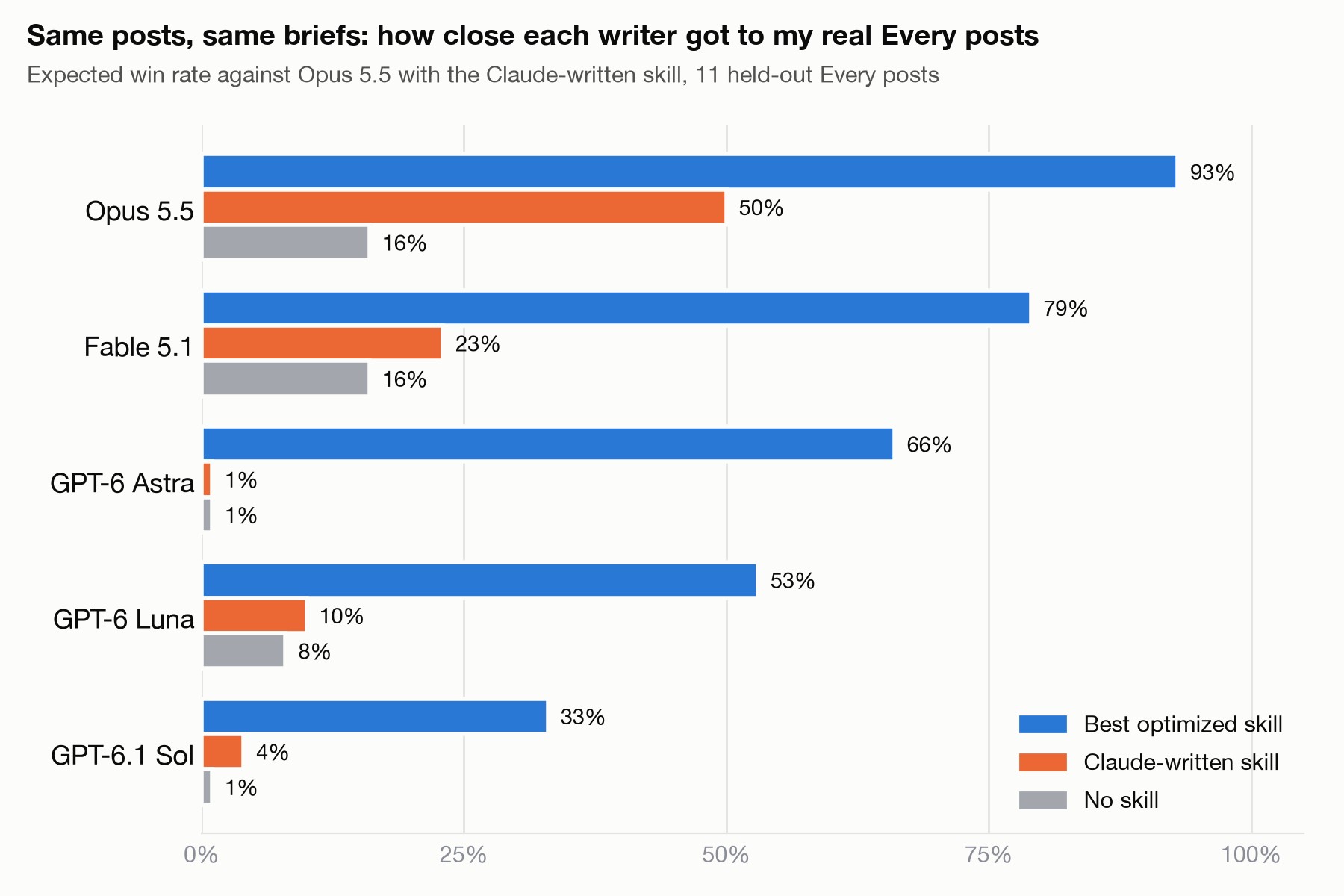
A writing skill belongs to a model as much as to a writer. I optimized skills for six writer models and ranked every combination on one scale, and the spread was enormous: Opus 5.5 went from 16 percent with no skill to 93 percent with its GEPA skill, the best of anything I tested, and GPT-6 Astra went from 1 percent to 66 percent. The skill mattered more than the model, too, since Sonnet 5.5 with its optimized skill beat Opus 5.5 with the Claude-written one on 46 of 60 judgments. Pick the model you’ll draft with, optimize for it, and optimize again if you switch. In this case, I could get Sonnet 5.5 to write better than Opus 5.5 in phase one of the experiment, but I wanted to write with the smarter model in real life, where the context isn’t fixed, and Opus might bring in better ideas than I originally had. So I did another round of optimization and managed to find a skill that pushed Opus to the top.
Step 6: Write from a brief, then feed your edits back
Use the skill the way it was tested: from a brief that holds all your substance. Give it a one-line prompt, and it will fill the gaps with plausible content in a convincing imitation of your voice, which is the worst of both worlds. For my post on cloning colleagues, I gave it a quote, 10 bullet points on what happened, the emails I’d tested, and a dictated transcript. I made 44 edits to the draft, compared with hundreds to AI drafts in my previous experiments. Most made the voice more casual (adding phrases like “I write emails like I write tweets” and “kind of sucks”), and one went directly against the skill: It bolds people’s names, which I don’t do. Those edits are the next round of training data.
One caveat: The judge only rewards resemblance to what you’ve already published, so a skill optimized on your past posts sounds like the writer you were. If your style is changing, hold out your most recent posts for the final exam.
Want to try this on your own writing? Get the skill on GitHub, where you’ll find setup instructions. It will soon be part of Every’s Compound Writing plugin.
How to think about AI writing
Six years after that first Copy.ai experience, writing better descriptions of my style still didn’t help, and even better models didn’t automatically get better at writing like me. What worked was running an actual test on my real posts, with briefs that hold real substance and a judge that compares two generated drafts against ground truth. If you’re struggling to make progress on a task with AI, focus on how you’ll evaluate it before optimizing it.
The next step is to build this into a system, so every time I publish something, it automatically goes into the corpus, and the system retests to see if anything changed. I can concentrate on living an interesting life and forming new ideas and opinions, knowing that AI can write them up for me afterward. We’re entering an era when being organized and diligent as a writer matters less than doing things worth writing about.
The skill still can’t decide what’s worth saying, and you shouldn’t expect AI to do your thinking for you. It can only take what I put into the prompt and say it the way I would. Think of it like a ghostwriter that can write up every good idea you have. You still have to do things that lead to interesting observations and ideas, but it’s now much more feasible to share them with people.
Mike Taylor is the head of evals at Every. To read more essays like this, subscribe to Every, and follow us on X at @every and on LinkedIn.
Everyone’s a builder now. Every All Access gets you the full membership plus the Builder Pack—$9,000+ in credits for the tools we build with.
Thanks to our Sponsor:
Your roadmap needs more than a .md file.
Your agent has a plan. Your team still needs to agree on the priorities.
Which customer problem comes first? What evidence backs it up? What changes when you learn something new?
Jira Product Discovery brings customer insights, prioritization, and living roadmaps into one shared place. Connect ideas to delivery in Jira so people and agents understand what to build and why.
Keep using AI to move faster. Give everyone a shared view of where you’re going and why.



Related Essays

 Katie Parrott

 Every Staff

 Kieran Klaassen

A paid Every subscriber gifted you this article. Every is a bundle of writing and tools for making sense of AI, work, and what comes next.
Subscribe to the Every bundle
Comments