

Katie Parrott is a staff writer. She writes Working Overtime and contributes to Vibe Checks, Source Code, and Context Window.

What Happens When AI Joins the Org Chart?
From assistants to execs, AI is claiming a place in our workplaces
Jan 7, 2025 · 9 min readUpdated Jul 19, 2026

Was this newsletter forwarded to you? Sign up to get it in your inbox.
On the first weekend of the new year, OpenAI CEO Sam Altman published a post on his personal blog. The post, titled “Reflections,” is a sweeping look back at the journey of OpenAI and the potential of artificial intelligence. But the internet (and I) quickly zeroed in on one passage in particular:
“We are now confident we know how to build AGI as we have traditionally understood it. We believe that, in 2025, we may see the first AI agents ‘join the workforce’ and materially change the output of companies.”
It seems the OpenAI team is determined to make AI coworkers happen. And if OpenAI is working on it, we’d better pay attention.
OpenAI isn’t the only org anthropomorphizing AI tools as “workers,” either: From Silicon Valley giants such Google, Microsoft, and IBM to startups like Glean and Lindy, tech companies are racing to develop the “AI coworkers” that will populate our virtual workspaces. In July 2024, the software company Lattice made headlines when it declared on its blog that it would be the first organization to give AI workers official employee records. According to Lattice CEO Sarah Franklin, these AI “employees” would be onboarded, trained, given goals, and managed just like human employees.
Public backlash to the Lattice announcement was swift and fierce. Even other AI execs joined the pile-on: “Treating AI agents as employees disrespects the humanity of your real employees,” one chief of staff at an AI sales platform told The Guardian. “Worse, it implies that you view humans simply as ‘resources’ to be optimized and measured against machines.”
Three days after the initial announcement (and before the company could provide any more details), Lattice quietly walked the idea back.
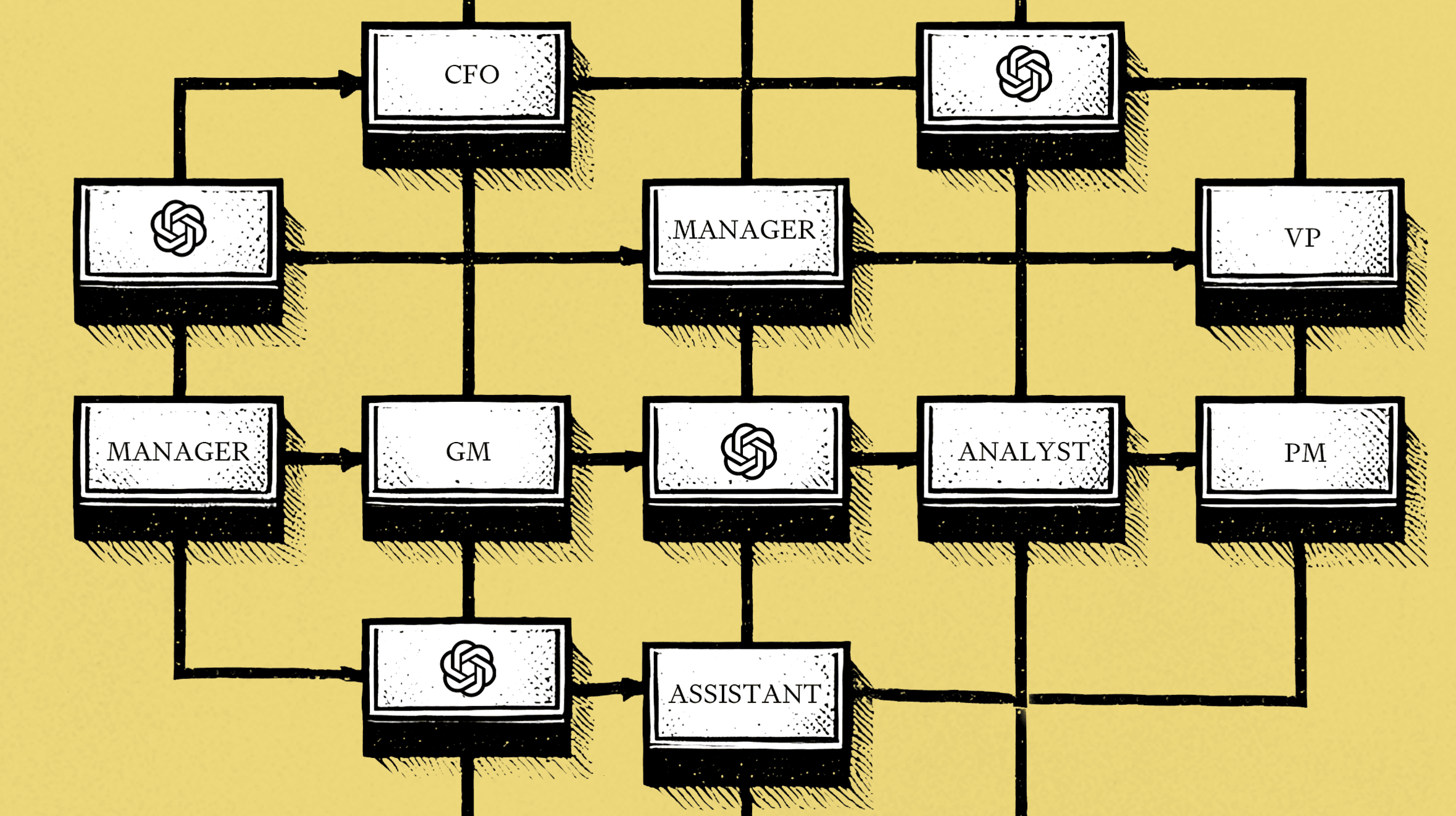
For all the backlash, and all the handwriting about AI “taking our jobs,” many of us have already invited the technology into our workplaces, albeit in ways that feel less prone to lead us into an episode of Black Mirror. AI systems draft emails, brainstorm ideas, analyze data, and even attend meetings. But as these tools evolve from assistants to something more autonomous, we’re confronted with a question that goes beyond utility: What does it mean to work alongside something that isn’t human? And when should we worry that AI is creeping up the org chart?
The implications are enormous. AI promises to free us from drudgery and amplify our potential, but it could also erode trust, distort accountability, and fundamentally reshape how we define work. And that’s before we even get to the idea of AI managers or executives. So, as AI joins us at work, it’s worth asking: Will it be our most valuable coworker—or our most threatening one?
Sponsored by: Every
Tools for a new generation of builders
When you write a lot about AI like we do, it’s hard not to see opportunities. We build tools for our team to become faster and better. When they work well, we bring them to our readers, too. We have a hunch: If you like reading Every, you’ll like what we’ve made.
Meet your ‘model’ employees
 Create a free account to continue reading
The Only Subscription
You Need to
Stay at the
Edge of AI
The essential toolkit for those shaping the future

"This might be the best value you
can get from an AI subscription."
- Jay S.
 Every Content
 AI&I Podcast
 Monologue
 Every Agent
Join 100,000+ leaders, builders, and innovators

Already have an account? Sign in.
What is included in a subscription?
Daily insights from AI pioneers + early access to powerful AI tools
 Front-row access to the future of AI
 In-depth reviews of new models on release dayPlaybooks and guides for putting AI to workPrompts and use cases for buildersIn-depth reviews of new models on release dayPlaybooks and guides for putting AI to workPrompts and use cases for builders
 Bundle of AI software


 Katie Parrott
 Every Staff
 Kieran Klaassen
Comments