
.png&w=3840&q=75)

Rhea Purohit focuses on research-driven storytelling in tech. She writes about the psychology and history of adopting new technologies.
.jpg&w=64&q=90)
Why Your AI Learning Projects Keep Fizzling Out
Founder Nir Zicherman on what general-purpose LLMs can’t do—and what real learning requires
Jan 14, 2026 · 7 min readUpdated Jul 22, 2026

TL;DR: Today, we’re releasing a new episode of our podcast AI & I, where Dan Shipper sits down with Nir Zicherman, the CEO and cofounder of AI learning platform Oboe, to talk about how to use LLMs to teach yourself anything. Watch on X or YouTube, or listen on Spotify or Apple Podcasts.
Was this newsletter forwarded to you? Sign up to get it in your inbox.
LLMs have made it absurdly easy to go deep on almost any topic. So why haven’t we all used ChatGPT to earn college degrees we wished we had majored in or pursued a niche interest, like learning how to name the trees in our neighborhood? I know I’m not the only one to feel guilty for well-intentioned attempts at autodidactism that inevitably peter out.
Entrepreneur Nir Zicherman has a reason for this disconnect: LLMs can answer most of your questions, but they won’t notice when you’re lost or pull you back in when your motivation starts to fade.
As the CEO and cofounder of Oboe, a platform that generates personalized courses about everything from the history of snowboarding to JavaScript fundamentals using AI, Zicherman has thought deeply about why the ability to access information does not automatically lead to understanding a concept. In this episode of AI & I, he talks to Dan Shipper about everything he’s learned about learning with LLMs.
They get into Zicherman’s counterintuitive belief that learning is a more passive process than you’d think, the biggest blocker for most people who want to learn something new, and where AI agents currently fall short in providing a meaningful learning experience.
Previously, Zicherman was the cofounder of Anchor, the world’s largest podcasting platform, and the vice president and global head of audiobooks at Spotify. He’s also contributed to Every.
Here is a link to the episode transcript.
You can check out their full conversation:
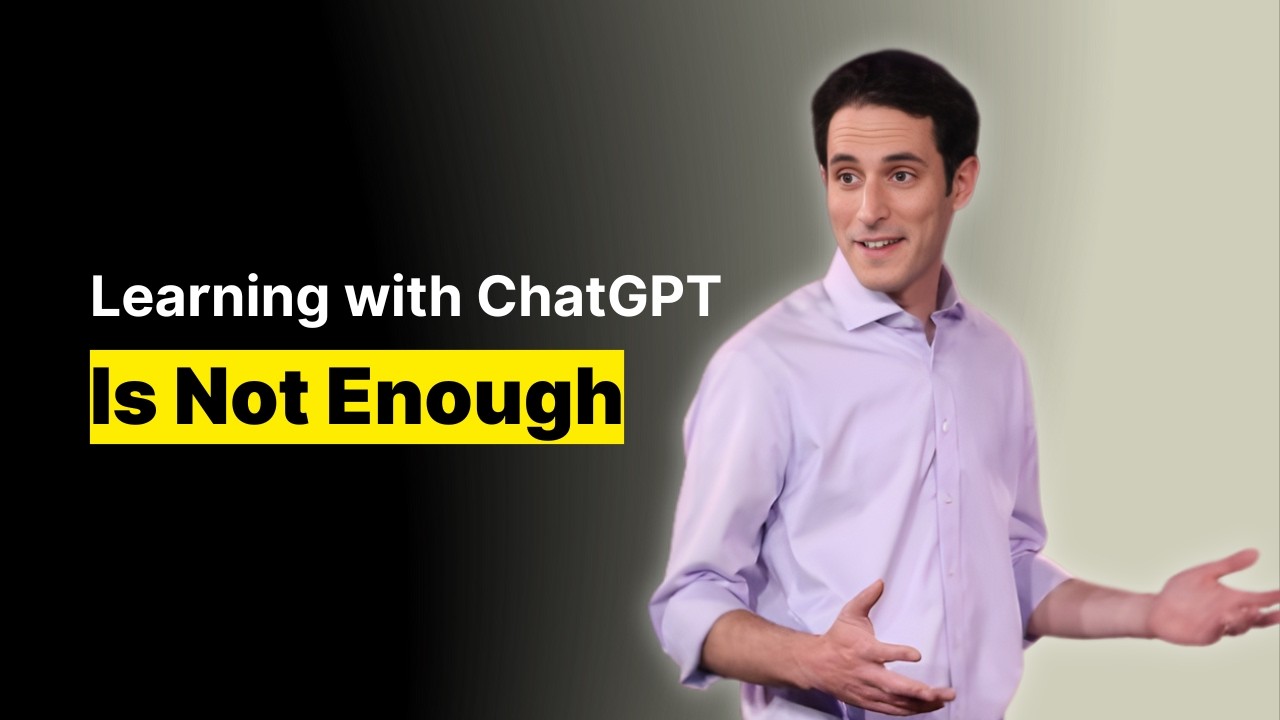

Here are some of the themes they touch on:
What LLMs have taught Zicherman about learning
Zicherman believes that the method—or process—of learning is fundamentally passive, even if someone is proactive about wanting to acquire knowledge. Think back to high school. Broadly speaking, the primary way you mastered new concepts was by listening passively to the instructor deliver material. “The teacher was not asking you questions about how best to structure the course and where to go next,” he says.
In contrast, while LLMs have made it astonishingly easy to access information, they often shift the burden of teaching onto the learner. They require you to be “very explicit around what you want to achieve and how you want to achieve it,” and to provide constant feedback to continue learning meaningfully, he says.
In other words, LLMs are generalists by design. To get useful results, you have to know how to prompt them well—which means the learner ends up doing work that a teacher would normally handle, like making a curriculum and deciding the pace of learning. As he builds Oboe, these are a few principles Zicherman has gleaned about using LLMs to meaningfully understand new concepts.
Keep the learner motivated—without them having to ask for it
Dan shared his own experience of using AI to learn: When o3 gained the ability to set reminders, Dan prompted the model to remind him and provide material to walk him through Andrej Karpathy’s YouTube course about building a language model, section by section. It worked well for a while, until he hit a difficult section and let a few days slip. By then, the friction of getting back into the material was too much, and he stopped trying altogether. The problem was that the model didn’t try to re-engage him when his motivation waned, as any good teacher would have.
Zicherman agrees. “The teacher would be able to read the room,” he says. “[They] would know, ‘Hold on a second, it’s been a week since we last covered this, I need to reinforce certain material.’” The onus can’t be on the student to ask for that. He sees this as a limitation of the early days of agentic AI: Agents still need guardrails to deliver outputs consistently, and to truly “read the room,” an agent would need more autonomy—specifically, the autonomy to reassess its own approach, including changing the guardrails it operates under, without requiring the user to step in and course-correct.
Present information in multiple formats
A big part of Zicherman’s thesis is multimodality. Before AI, when you wanted to learn something, you’d probably read an article or two, skim a subreddit, watch a YouTube video, maybe listen to a podcast. That’s how we actually learn, he argues—and it’s where the bare text output of general-purpose LLMs falls short.
A good learning platform needs to make a pedagogical judgment call for its users: “What is the right thing to show you [and] what is the right format to show you at any given time.” Oboe adapts the format of the course to its subject matter: more graphics for a course on quantum tunneling, fewer for one on Ludwig Wittgenstein (though it did throw in a great photo of the philosopher).
The platform also generates a podcast for every course, but keeps the episodes separate from the main flow. Users click into it when they want that experience because as Zicherman sees it, people usually listen to podcasts when they are in a different state of mind or at a different time of day than when they sit down with a visual course.
Make the experience feel achievable rather than overwhelming
Zicherman believes one of the biggest blockers to learning is people convincing themselves that a topic is too intimidating to tackle. He walks the walk: He didn’t major in math or physics, but he was fascinated by both. It took him years to realize he could just teach himself—and now he has, diving deep into quantum mechanics and the history of early physics experiments.
This shapes how he thinks about course design. The experience needs to feel “very piecemeal and achievable”—lightweight enough that you’re not daunted by it, while still being meaningful in the learning process. One way Oboe does that is through milestones: embedded quizzes that engage the learner and reinforce what they’ve covered, appearing at moments when the program decides it’s time to check understanding.
What do you use AI for? Have you found any interesting or surprising use cases? We want to hear from you—and we might even interview you.
Timestamps
- Introduction: 00:00:36
- Why you need a dedicated AI learning app: 00:01:49
- The process of learning is more passive than you might think: 00:04:32
- Live demo of Oboe to create a course about philosopher Ludwig Wittgenstein: 00:10:21
- Learning works best when it comes in many formats: 00:16:52
- Where AI agents currently fall short in the learning experience: 00:28:21
- The importance of making learning feel accessible: 00:34:10
- How Zicherman uses Oboe to learn quantum physics: 00:35:56
- How embeddings spaces remind Dan of quantum mechanics: 00:40:54
You can check out the episode on X, Spotify, Apple Podcasts, or YouTube. Links are below:
- Watch on X
- Watch on YouTube
- Listen on Spotify (make sure to follow to help us rank!)
- Listen on Apple Podcasts
Miss an episode? Catch up on Dan’s recent conversations with founding executive editor of Wired Kevin Kelly, star podcaster Dwarkesh Patel, LinkedIn cofounder Reid Hoffman, ChatPRD founder Claire Vo, economist Tyler Cowen, writer and entrepreneur David Perell, founder and newsletter operator Ben Tossell, and others, and learn how they use AI to think, create, and relate.
If you’re enjoying the podcast, here are a few things I recommend:
- Subscribe to Every
- Follow Dan on X
- Subscribe to Every’s YouTube channel
Rhea Purohit is a contributing writer for Every focused on research-driven storytelling in tech. You can follow her on X at @RheaPurohit1 and on LinkedIn, and Every on X at @every and on LinkedIn.
We build AI tools for readers like you. Write brilliantly with Spiral. Organize files automatically with Sparkle. Deliver yourself from email with Cora. Dictate effortlessly with Monologue.
We also do AI training, adoption, and innovation for companies. Work with us to bring AI into your organization.
Get paid for sharing Every with your friends. Join our referral program.
For sponsorship opportunities, reach out to [email protected].
Help us scale the only subscription you need to stay at the edge of AI. Explore open roles at Every.
The Only Subscription
You Need to
Stay at the
Edge of AI
The essential toolkit for those shaping the future

"This might be the best value you
can get from an AI subscription."
- Jay S.
 Every Content
 AI&I Podcast
 Monologue
 Every Agent
Join 100,000+ leaders, builders, and innovators

Already have an account? Sign in.
What is included in a subscription?
Daily insights from AI pioneers + early access to powerful AI tools

 Front-row access to the future of AI
 In-depth reviews of new models on release dayPlaybooks and guides for putting AI to workPrompts and use cases for buildersIn-depth reviews of new models on release dayPlaybooks and guides for putting AI to workPrompts and use cases for builders
 Bundle of AI software



 Katie Parrott
 Every Staff
 Kieran Klaassen
Comments