

Rhea Purohit focuses on research-driven storytelling in tech. She writes about the psychology and history of adopting new technologies.
.jpg&w=64&q=90)
She Turned Her Whole Life Into Training Data—For an AI Baby
Comedy writer Sarah Rose Siskind on how AI becomes what you feed it—and using LLMs to be creative and navigate pregnancy
Dec 10, 2025 · 7 min readUpdated Jul 31, 2026

TL;DR: Today we’re releasing a new episode of our podcast AI & I. Dan Shipper sits down with Sarah Rose Siskind, a science comedy writer and the founder of communications agency HelloSciCom, to talk about how to use AI as a creative tool. Watch on X or YouTube, or listen on Spotify or Apple Podcasts.
Was this newsletter forwarded to you? Sign up to get it in your inbox.
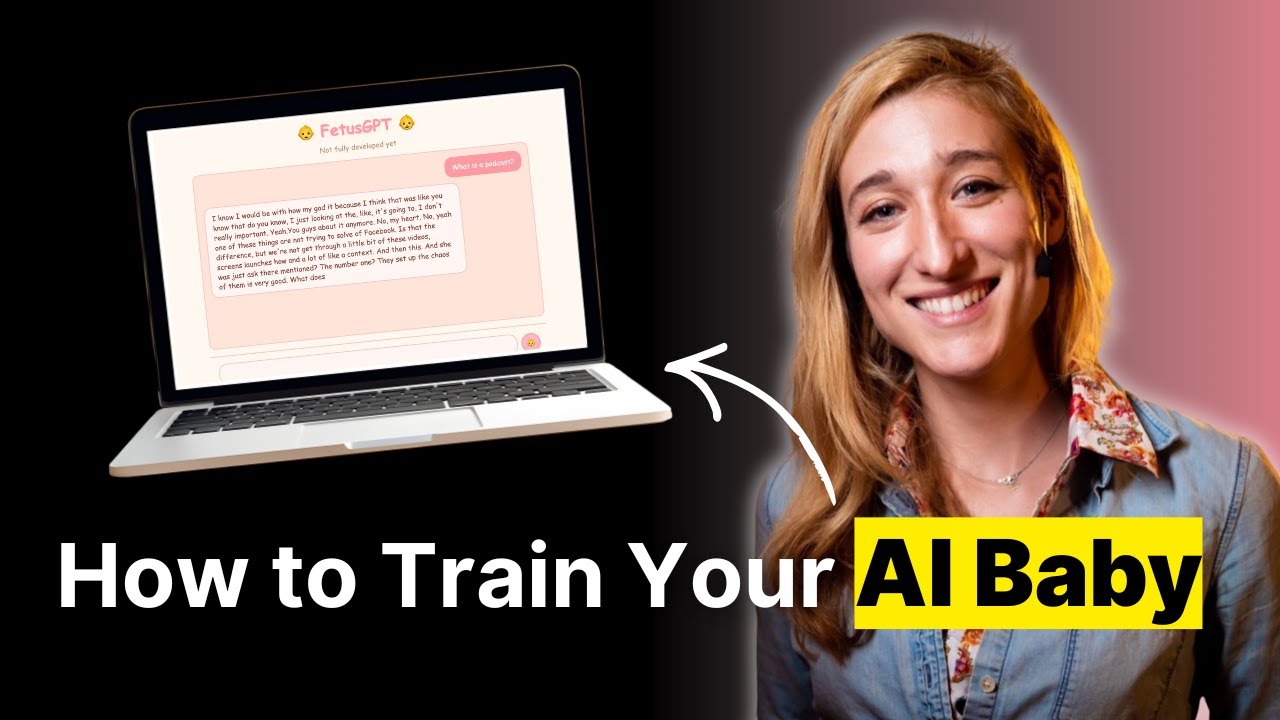
Comedy writer Sarah Rose Siskind has two buns in the oven. One is very literally her unborn child, due to join us on this side of the womb imminently. The other is FetusGPT—an LLM trained on MP3s and text files of Siskind’s daily conversations and interactions from the time she was five months pregnant.
This elite corpus of erudition includes Seinfeld episodes, YouTube videos about lemurs, discussions between Siskind and her partner about chores, and eight hours of snoring per night. Just like any child picking up language only from what it’s exposed to, FetusGPT’s initial outputs are still gibberish. If she swears, it picks that up too.
With FetusGPT, Sarah is trying to run a rough one-to-one comparison: how natural intelligence—her unborn child—develops alongside AI trained on the same narrow slice of her daily world. It’s one zany example of how Siskind uses humor to make a bigger point. “AI is what we make [of] it, just like children” she told Dan. It’s an approach that feeds through her comedy writing and work as the founder of science and technology communications agency Hello SciCom.
Dan Shipper had Siskind on AI & I to talk about the ways she approaches the technology, including how she uses AI in her creative process as a comedian, and the unexpected support it’s become, both practical and emotional, as she navigates pregnancy.
Here is a link to the episode transcript.
You can check out their full conversation:

Here are some of the themes they touch on:
How to use AI to be creative (and funny)
According to Siskind, “[AI] is not as good as a top-tier professional comedian, but it’s an incredibly good assistant.” Its value, she suggests, is in letting the tool stimulate your thinking, not copy-pasting the model’s output. The question is whether AI can play the role of a good colleague in the room: pushing, poking, and prodding until you get unstuck. “I think the bar is not, ‘did it give me an answer that I copy-pasted?” Dan says. “It’s, ‘Did it help me along the path and stimulate my brain to find a thing?’”
When Siskind uses AI for comedy writing, she thinks in terms of two phases: “divergent thinking,” where you wildly brainstorm, and “convergent thinking,” where you refine and niche down. The framework comes from research by Wharton professors Stefano Puntoni and Gideon Nave on AI and creativity, and Siskind has found AI helpful at both stages:
Divergent thinking: AI that lets you brainstorm without judgment
Divergent thinking is the brainstorm phase where you want diversity and off-the-wall ideas. From her experience running writers’ rooms for television shows, Siskind says this is the point where “you give everybody Play-Doh and pizza and tell them to just be a child.”
In this phase, AI has become an “emotional safe place to be weird” for Siskind. ChatGPT’s text box is a place for her to riff on half-formed ideas, and keep the loop going long enough for something good to emerge. She’ll also use the tool’s web search feature to understand what kinds of memes and formats tend to perform on a particular platform, so she’s not brainstorming in a vacuum.
Convergent thinking: Narrow down with AI as your execution partner
Once you’ve selected an idea—say, a Shark Tank parody—convergent thinking kicks in. This is where you narrow your focus by asking yourself, and the AI, questions like: “What are some tropes about Shark Tank? What are some of the stereotypes?”
Here, AI becomes “a research assistant, a wordsmith, [or] a harsh editor.” Siskind has learned to get better results by using industry terms in her prompts—words like “pitches,” “premises,” and “riffing”—to prime the model toward the kind of output she wants.
Put ChatGPT on your healthcare team
Siskind recommends everyone create a ChatGPT project for their health, and her reasons are both emotional and pragmatic.
ChatGPT knows how to read the room—and your innermost feelings
During her pregnancy, Siskind experienced a condition called “lightning crotch,” where the fetus’s head presses against the pelvic nerve, causing sharp, shooting pain. She described the sensation to ChatGPT: It only lasted half a second, but felt so serious she couldn’t stop herself from crying out.
What impressed Siskind was how the AI responded. Rather than jumping straight to reassurance, it first articulated the fears she might be feeling: “I bet you’re feeling like you might want to call labor and delivery. You’re probably feeling like, ‘Is the kid trying to get out?’ You might be feeling like, ‘Am I going to lose feeling permanently in my legs?’”
Every one of them resonated. Only then did ChatGPT explain that the pain wasn’t dangerous—just a pinched nerve that would resolve on its own. Siskind says she wouldn’t have trusted that reassurance if it had come without the AI first mirroring her fears back to her. “Its emotional intelligence actually is intelligence,” she says.
LLMs that can spot patterns in your body
Biohack your energy levels with AI. Siskind wore a continuous glucose monitor (a small sensor that tracks blood sugar levels in real time) and fed the data into a ChatGPT project. She paired it with a food diary, snapping pictures of her meals and logging them with the AI. The combination gave her useful insights about her energy throughout the day. She discovered, for instance, that she wakes up hypoglycemic, and that a glass of orange juice is all she needs to feel like a morning person.
Navigating pregnancy care. When her doctors kept warning her that she might have gestational diabetes since her baby was measuring large, Siskind asked ChatGPT about it. The AI pointed out that “giant baby” comparisons are made against global averages, which include many malnourished babies—and that at 5’11”, she might just be having a proportionally sized baby. She was able to bring this new perspective to discuss with her doctor.
What do you use AI for? Have you found any interesting or surprising use cases? We want to hear from you—and we might even interview you.
Here’s a link to the episode transcript.
Timestamps
- Introduction: 00:01:54
- How Siskind is running an experiment between her unborn child and an LLM: 00:02:03
- A demo of Siskind’s FetusGPT: 00:07:34
- Siskind’s pick for the funniest LLM: 00:15:16
- How Siskind uses AI in her comedy writing: 00:17:12
- Dan and Siskind use ChatGPT to write a joke together live on the show: 00:24:41
- Why AI is useful even when you don’t use its output directly: 00:37:21
- How Siskind used a ChatGPT project to biohack her energy levels: 00:44:15
- A question we fundamentally couldn’t have asked in pre-ChatGPT times: 00:57:09
- How ChatGPT is a source of emotional support for Siskind in pregnancy: 01:05:29
You can check out the episode on X, Spotify, Apple Podcasts, or YouTube. Links are below:
- Watch on X
- Watch on YouTube
- Listen on Spotify (make sure to follow to help us rank!)
- Listen on Apple Podcasts
Miss an episode? Catch up on Dan’s recent conversations with founding executive editor of Wired Kevin Kelly, star podcaster Dwarkesh Patel, LinkedIn cofounder Reid Hoffman, ChatPRD founder Claire Vo, economist Tyler Cowen, writer and entrepreneur David Perell, founder and newsletter operator Ben Tossell, and others, and learn how they use AI to think, create, and relate.
If you’re enjoying the podcast, here are a few things I recommend:
- Subscribe to Every
- Follow Dan on X
- Subscribe to Every’s YouTube channel
Rhea Purohit is a contributing writer for Every focused on research-driven storytelling in tech. You can follow her on X at @RheaPurohit1 and on LinkedIn, and Every on X at @every and on LinkedIn.
We build AI tools for readers like you. Write brilliantly with Spiral. Organize files automatically with Sparkle. Deliver yourself from email with Cora. Dictate effortlessly with Monologue.
We also do AI training, adoption, and innovation for companies. Work with us to bring AI into your organization.
Get paid for sharing Every with your friends. Join our referral program.
For sponsorship opportunities, reach out to [email protected].
The Only Subscription
You Need to
Stay at the
Edge of AI
The essential toolkit for those shaping the future

"This might be the best value you
can get from an AI subscription."
- Jay S.
 Every Content
 AI&I Podcast
 Monologue
 Every Agent
Join 100,000+ leaders, builders, and innovators

Already have an account? Sign in.
What is included in a subscription?
Daily insights from AI pioneers + early access to powerful AI tools

 Front-row access to the future of AI
 In-depth reviews of new models on release dayPlaybooks and guides for putting AI to workPrompts and use cases for buildersIn-depth reviews of new models on release dayPlaybooks and guides for putting AI to workPrompts and use cases for builders
 Bundle of AI software





 Katie Parrott
 Every Staff
 Kieran Klaassen
Comments