



Mining Your Life for Context
Plus, how Every’s head of growth stays focused and some aggressively casual language
May 13, 2026


LLMs make a lot of life searchable, from meeting transcripts to iMessages to half-formed morning thoughts, but all this context only helps if you know what you want to achieve. Today, we’re revisiting how AI entrepreneur Noah Brier uses Claude Code as a second brain to sharpen and expand his own ideas, Every head of growth Austin Tedesco shares how Codex helped him spot the interruptions crowding out deeper work, and we offer a workflow for mining your scattered past insights into a coherent draft.
Was this newsletter forwarded to you? Sign up to get it in your inbox.
Spotlight
Noah Brier, AI entrepreneur and seer
Brier is a true AI early adopter. The cofounder of the AI consultancy Alephic, Brier was all in on using Claude Code as a “second brain” for knowledge work back when most people still viewed the tool as a place to write code.
In September, Brier told Dan Shipper on our podcast, AI & I, how he turned the coding app into a research, thinking, and writing partner by connecting it to thousands of his personal notes. Since then, he’s started thinking beyond his own productivity—how does AI make it easier or harder for an entire organization to stay working toward the same goal? For that, he has a new framework, announced in Every last week, that he calls the “pace layers” of AI engineering, drawn from Stewart Brand’s system for describing how different parts of society change at different speeds.
Just as hooking up Claude Code to an ocean of personal information requires you to determine what is—and isn’t—worth surfacing, running a successful AI company relies on human judgment. Similarly, AI makes code free to produce, but it doesn’t make it easier to identify a product people actually want or orient an entire system of humans and agents around that vision.
Read Brier’s essay on the framework he uses to achieve alignment and then watch his AI & I episode on YouTube, or listen on Spotify or Apple Podcasts. Here’s a link to the episode transcript.


Write at the speed of thought
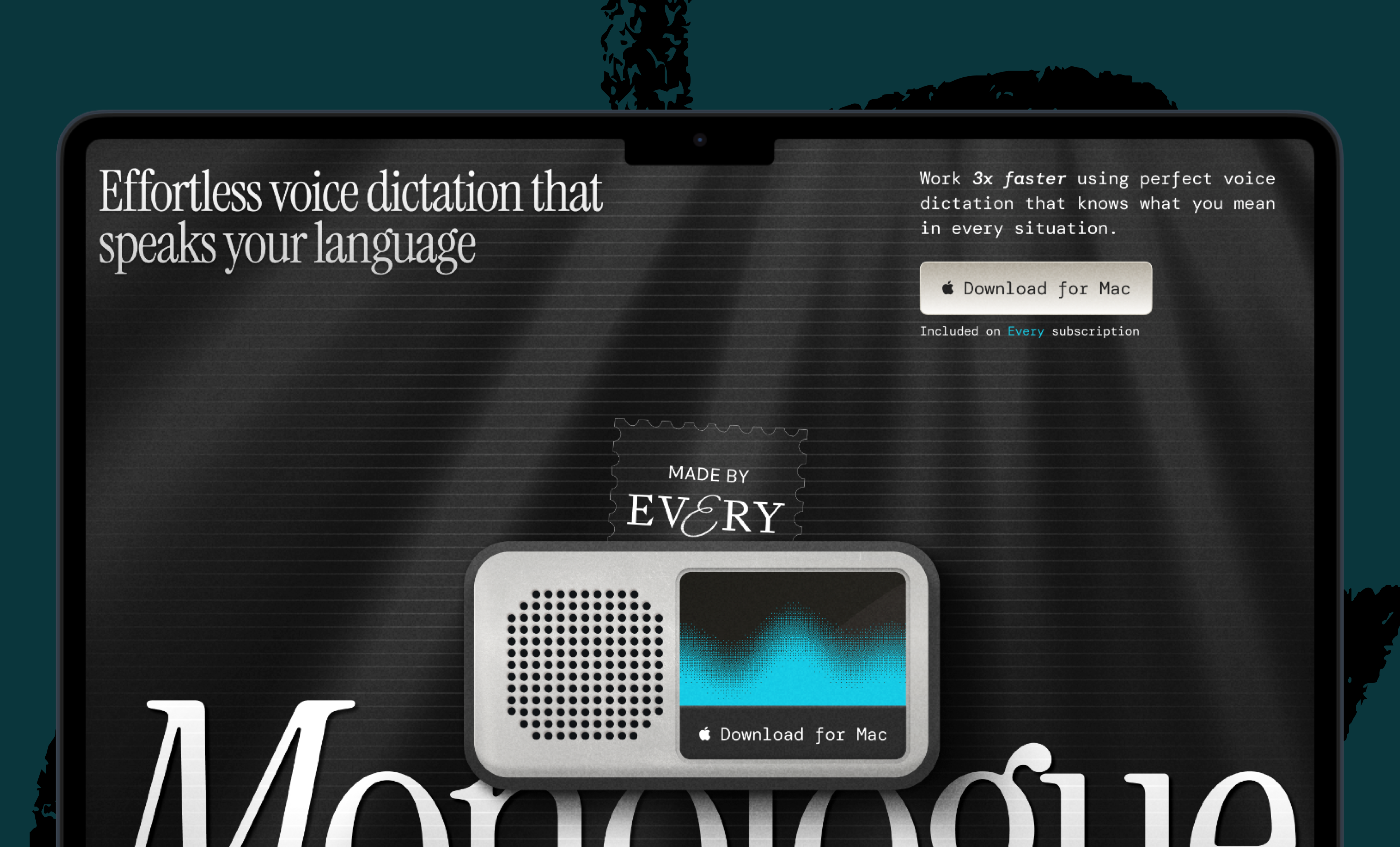
That gap between your brain and your fingers kills momentum. Monologue lets you speak naturally and get perfect text three times faster, and your tone, vocabulary, and style are kept intact. It auto-learns proper nouns, handles multilingual code-switching mid-sentence, and edits for accuracy. Free 1,000 words to start.
Data point
671
That’s the number of times per day iMessage is active on Austin’s screen each day, according to Chronicle, Codex’s screen-context memory feature that uses screenshots to analyze your computer activity. He’d like to get that number down to 150.
Reducing how much he opens and interacts with iMessage is just part of the productivity regimen Codex created when Austin had it use Chronicle to determine how he could use his computer more efficiently. Other directives include slashing interactions across Slack, email, and Chrome.
Austin is game—he’d like to do more focused work, primarily by resisting the urge to bounce between apps and tabs and instead spend as much time as possible in the Codex app, where he can draft and review assets, emails, and Slack messages inside the in-app browser.
“I’m excited by the idea of keeping Codex open and staying focused. Then it can flag, ‘This is your one hour for comms stuff, go’—or even say, ‘Go to respond to this stuff, I’ve already drafted the responses for you,’” he says.
If you want your bad computer habits similarly analyzed, paste the following into Codex:
What have I been doing very inefficiently on my computer (according to Chronicle). Make some recommendations. Be direct. Tell me what I need to hear.
Steal this workflow
Mine your own scattered thinking before you draft
By the time you sit down to write the article, strategy memo, or launch page, you’ve probably already expressed most of what you want to say across Slack threads, Notion documents, voice memos, and meeting transcripts. Here’s how to mine all that content for gold—and avoid the paralysis of the blank page.
The workflow:
Capture by default, sort later. Monologue general manager Naveen Naidu treats the app as a transit point: He hits record on meetings, user calls, conversations with coworkers, and his rambling early-morning thoughts, because he knows he can always come
- back and pull what he needs. The tool matters less than the habit—pick one (Monologue Notes, a voice memo app, whatever) and use it everywhere you do your thinking, not just at your desk.
- Connect every source your agent can read. Give your coding agent access to Slack, Notion, Google Drive, Monologue Notes, and your meeting transcripts. For anything without a connector, export the files into a folder that the agent can search. The goal is one searchable repository across every place your ideas live.
- Name the deliverable and constrain the source. Tell the agent what you’re drafting—article, strategy memo, launch page, go-to-market plan—and specify in your prompt (or project instructions) that it should pull only from things you’ve already said to avoid drafts that blend your thinking with AI-generated concepts.
Try it this week: Connect your agent to the two or three places where most of your thinking lives—Slack and Notion are usually a good start, plus meeting transcripts if you have them. Then paste:
“Find everything I’ve said about [topic] across these sources. Group the strongest threads, cite the source for each, and turn them into a draft outline.”
Discuss
“I’ll use aggressively casual language, like, ‘hey yo, for real,’ or drop a bunch of exclamation points.”—Sarah Suzuki Harvard, copywriter, in the Wall Street Journal
LLMs have flattened how most writing sounds. In response, professional writers are leaning into the colloquial and idiosyncratic, per the Journal, peppering their prose with obscure references, run-on sentences, and intentional typos to prove it wasn’t machine-made. As AI-generated content consumes more of the internet, the split between polished predictability and curated weirdness will only widen.
Laura Entis is a staff writer at Every. You can follow her on LinkedIn.
To read more essays like this, subscribe to Every, and follow us on X at @every and on LinkedIn.
For sponsorship opportunities, reach out to [email protected].
The Only Subscription
You Need to
Stay at the
Edge of AI
The essential toolkit for those shaping the future

"This might be the best value you
can get from an AI subscription."
- Jay S.
 Every Content
 AI&I Podcast
 Monologue
 Cora
Cora
 Sparkle
 Spiral
Join 100,000+ leaders, builders, and innovators

Email address

Already have an account? Sign in
What is included in a subscription?
Daily insights from AI pioneers + early access to powerful AI tools

 Front-row access to the future of AI
 In-depth reviews of new models on release day
Playbooks and guides for putting AI to work
Prompts and use cases for builders
In-depth reviews of new models on release day
Playbooks and guides for putting AI to work
Prompts and use cases for builders
In-depth reviews of new models on release day
Playbooks and guides for putting AI to work
Prompts and use cases for builders
In-depth reviews of new models on release day
Playbooks and guides for putting AI to work
Prompts and use cases for builders
 Bundle of AI software




.png)
 Every Staff

 Alex Duffy
.png)
 Reviews of new AI models on release day
Comments
Don't have an account? Sign up!