





Was this newsletter forwarded to you? Sign up to get it in your inbox.
Whether or not you believe that flawed Anthropic graph or Jack Dorsey’s stated reasons for laying off 40 percent of his staff at Block, the message is the same: AI is doing more of the rote click-work that sustained the laptop class. The knowledge workers who thrive will be the ones who can add something extra—judgment, taste, and expertise.
The problem is that most of us have no good way to prove those things, and we’re not very good at it. For decades, brand names did the heavy lifting. Previous experience at McKinsey or Goldman Sachs were buzzwords that signaled to a hiring manager: This person can build a model and make slides, and someone selective chose them.
But brand names don’t work as a heuristic for expertise anymore. Was that Google alumnus a pixel pusher or a genuine decision maker? The soft skills that matter most in an AI-augmented workplace are invisible on a traditional resume.
One answer is portfolios. Not a portfolio in the sense of a portfolio career—a word that many knowledge workers have embraced as they move away from relying on one employer and pick up advisory roles and solopreneurship. I mean a portfolio as a body of work that proves your value beyond your work history. A collection of artifacts that show how you think, just like creative professionals showcase their design or artistic work.
As a journalist and editor, I write a newsletter about people using writing to build things, and I post on LinkedIn, all of which I consider to be part of my portfolio that helps people evaluate me beyond the names of my previous employers. Whether it is writing on platforms like LinkedIn or building interactive tools on their personal websites, knowledge workers need something similar. AI can make this process fun and creative, and help people experience your expertise without having to meet you.
Wasn’t personal branding supposed to fix this?
Even before anyone was worried about ChatGPT taking their job, we’d been hearing the same advice for years: Build your personal brand. Post on LinkedIn more, put yourself out there—become a thought leader. In theory, a strong personal brand should give you an advantage over someone with the same credentials on their resume but no public presence.
AI maturity in practice: From experimentation to enterprise production
Join us on March 17 at 10 a.m. PDT as Kevin McCurdy (AWS) and Abhishek Gupta (Retool) unpack a practical AI maturity progression that takes you from early experimentation to agent-driven, production-grade workflows. We’ll cover:
- The phases of AI maturity: what it takes to move from experimentation to enterprise-scale outcomes.
- How to tie AI to business outcomes: strategies for measuring real impact across capacity, cost, and throughput
- Scaling AI responsibly on AWS: embedding intelligence into core workflows in a way that’s governed, measured, and built to last.
Retool is trusted by 10,000+ companies, like Ramp, which saved $8M and increased efficiency 20%.
In practice, almost nobody does this well. LinkedIn has more than 1 billion registered users, but only a tiny fraction of those share content. Much of what gets shared is self-congratulatory announcements, not proof of expertise. And more and more of what is shared is obviously AI-written. Readers’ eyes gloss over the drivel as they move to the next rocketship emoji on their timeline.
The people who do want to share real insights—writing-first practitioners, as I’ve been calling them—are fed up with the platform. You can’t format text in posts. The algorithm surfaces two-week-old content like it’s breaking news, and anything older gets buried. That’s why wealth manager Jan Voss moved to a newsletter to share his most important thoughts. He wanted a place where, as he told me earlier this year, “posts have staying power.”
The platform’s functionality is only part of the problem. Thinking more deeply, LinkedIn rewards a specific kind of extroversion. Many people feel uncomfortable with building their brand there because they feel pressure to have a “hot take” or, more simply, to brag.
The age of the portfolio is coming
We’re entering a period where knowledge workers build portfolios the way creative professionals have for years—not on Dribbble or Behance, but through a growing ecosystem of formats that let you show how you think.
Substack and similar platforms are making a play here, letting individuals share deep thinking that endures and build a following around their expertise. Substack even wants to let users express themselves beyond writing, as last week’s launch of a video recording and publishing feature shows. But if the hurdle to writing frequently on LinkedIn is high, the hurdle to maintaining a regular newsletter or recording a regular podcast is enormous. You need to have information or opinions to share with your readers each week, even if you are simply curating links.
One Substack writer who committed himself to one post a week for a year wrote 62,773 words, or the equivalent of a short novel. Most people don’t have the stamina or the discipline to achieve that level of prolificness. Hence, Substack as a reputation-building tool will remain limited to the small minority of people willing to write consistently in public.
Other formats are emerging. Platforms like Andreessen Horowitz-backed Maven offer cohort-based courses where you can teach what you know to a room full of people who’ve paid to learn it, and given that teachers must apply, being featured on the platform carries credibility. Intro, also backed by Andreessen, does something similar with one-on-one calls.
And then there’s a newer category: knowledge workers building interactive tools on their personal websites that give potential employers or clients a taste of what they can do.
Strategist Loris Colantuono has a section called “Resources” on his website with guides about storytelling and manifesto writing—a link at the end prompts visitors to set up a call. Julius Bachmann, a Berlin-based executive coach, did something similar with his annual review document at the end of last year. He released the guide as a PDF and a custom GPT so you can either fill it out on paper or by chatting with AI.
Both examples are interactive proof of how these individuals think. Even if you never pay either of them, you’ve seen what they have to offer. It’s also scalable. A thousand people can experience Loris’s strategic thinking or Julius’s coaching style without them having to take an equal number of coffee meetings.
Building these kinds of tools and portfolios can be less stressful for people who are uncomfortable with LinkedIn’s self-promotional tone. You don’t need to perform or humble-brag. You can create something on your own terms that looks and feels like you.
Building your portfolio with AI
The same technology that’s threatening knowledge work is also lowering the barrier to building these kinds of portfolios. A year ago, creating an interactive tool on your personal site required hiring a developer. Now you can spin one up in an afternoon.
Katie Parrott, a staff writer at Every and AI editorial lead, redid her personal website in early 2025 after a colleague encouraged her to try out Loveable. Though the process was clunky, “it was the first time the site felt like mine,” she says.
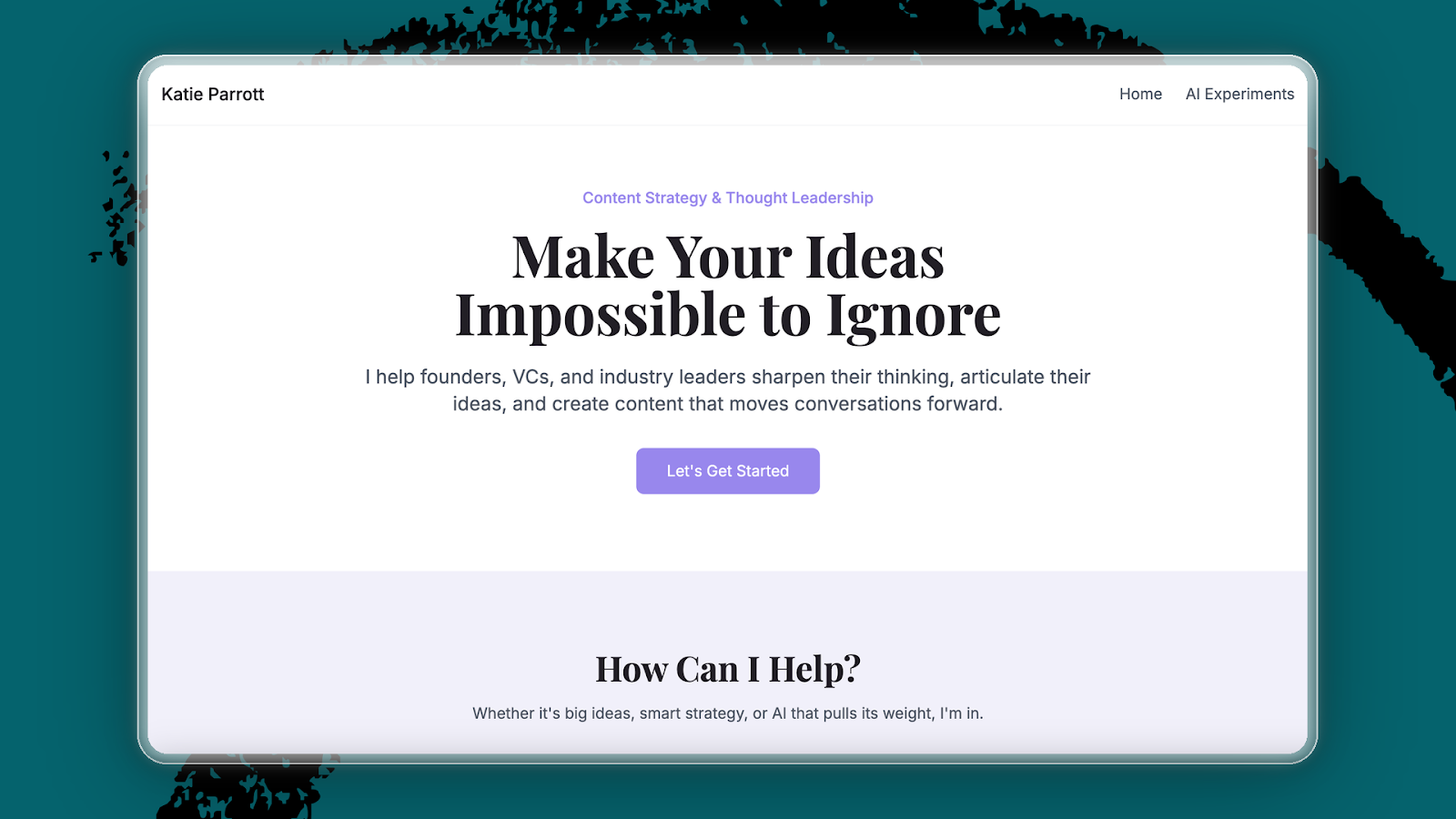
She rebuilt the site again in February 2026 as a way to test the capabilities of her new personal AI agent, Margot. “I pointed her at a folder containing my entire ChatGPT and Claude conversation histories and said: ‘Based on everything you know about me, come up with an updated concept for my website.’” Margot came up with a design that highlighted how Katie made things with words—typing animations, blinking cursors in unexpected places.
Her website brings together all her projects (Every writing, Substack, an AI writing tool she’s building) and explains clearly who she is as a professional, with panache—“Writer. Builder. Chronic overthinker.” Her favorite feature, one she came up with, also provides a glimpse at what’s important to her: a changelog. It’s a running, curated inventory of things she has published, built, and learned that don’t necessarily warrant their own post but that she wants to capture. “For a long time, a personal website was a static credential. Now, it’s more like a living document of momentum,” she says.

There’s at least one obstacle, though: A lot of the best expertise lives behind NDAs and confidentiality walls. If your most impressive work is a strategy you built for a client you can’t name, using data you can’t share, you have no proof of work when the world asks. Perhaps this shift toward portfolio-building will create pressure on NDAs to allow at least anonymized sharing of real work.
The trust problem
You are probably thinking: Portfolios are great, but how do you prove the judgment was yours? Or prove that you didn’t ask Andrey Galko, who manages Every’s website, to create something impressive for you?
To this end, I think that a rise in portfolios will be accompanied by more paid work trials. Not the unpaid case study interviews (do a presentation about our strategy, the output of which we will promptly steal once we tell you you don’t have the job) that have rightly been criticized, but short, compensated engagements where you work alongside a team for a week or two before anyone commits. The trial proves those skills in your portfolio are real.
I used to put a hold in my calendar to update my resume every few months. Now, I’ve put a hold to create a personal website and portfolio.
Eleanor Warnock is the managing editor at Every. She has been a business journalist and editor at the Wall Street Journal and the Financial Times-backed Sifted, and is an advisor to Bek Ventures. Follow her on LinkedIn and Substack.
To read more essays like this, subscribe to Every, and follow us on X at @every and on LinkedIn.
We do AI training, adoption, and innovation for companies. Work with us to bring AI into your organization. Discover Every’s upcoming workshops and camps, and access recordings from past events.
For sponsorship opportunities, reach out to [email protected].
The Only Subscription
You Need to
Stay at the
Edge of AI
The essential toolkit for those shaping the future

"This might be the best value you
can get from an AI subscription."
- Jay S.
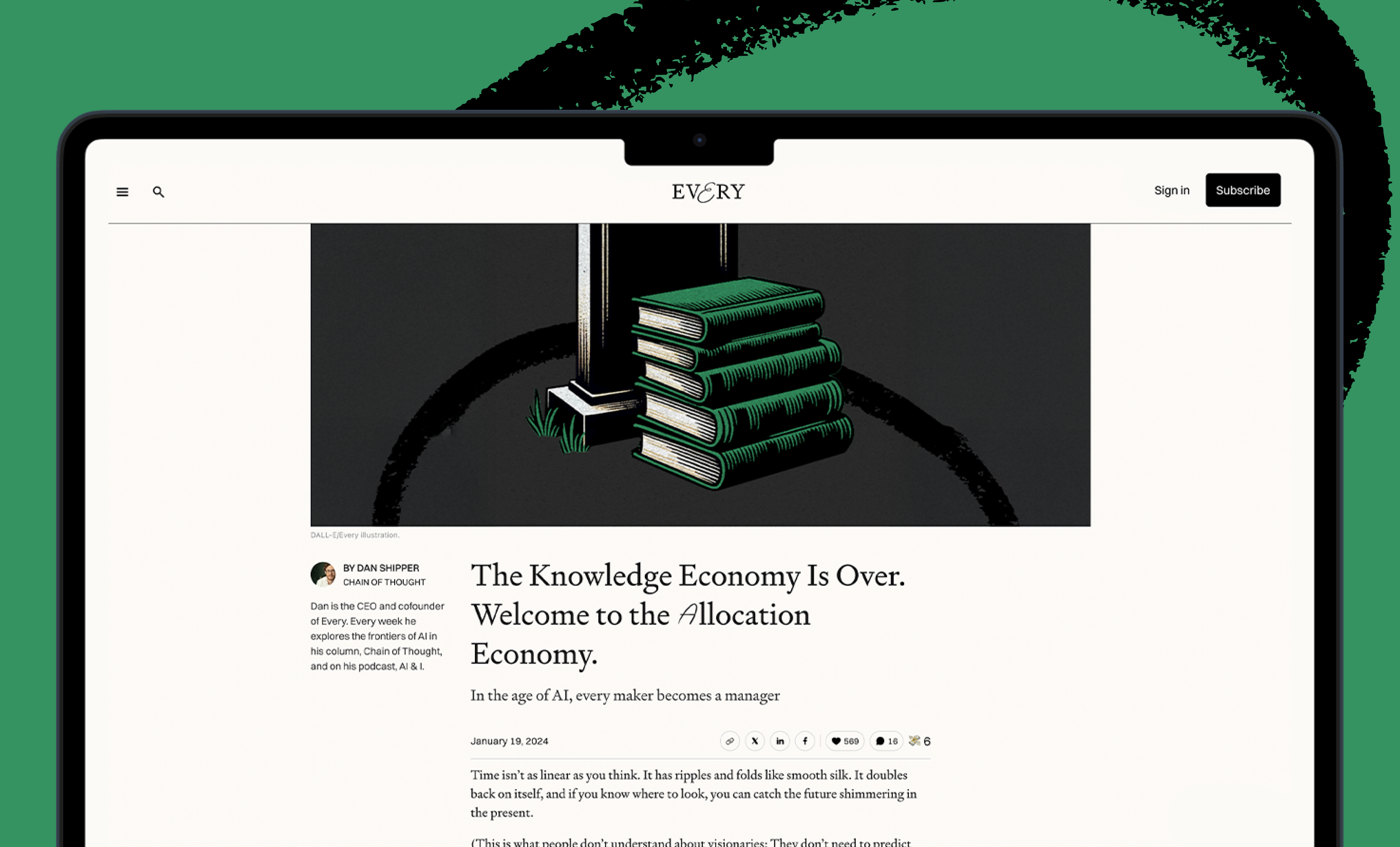
 Every Content
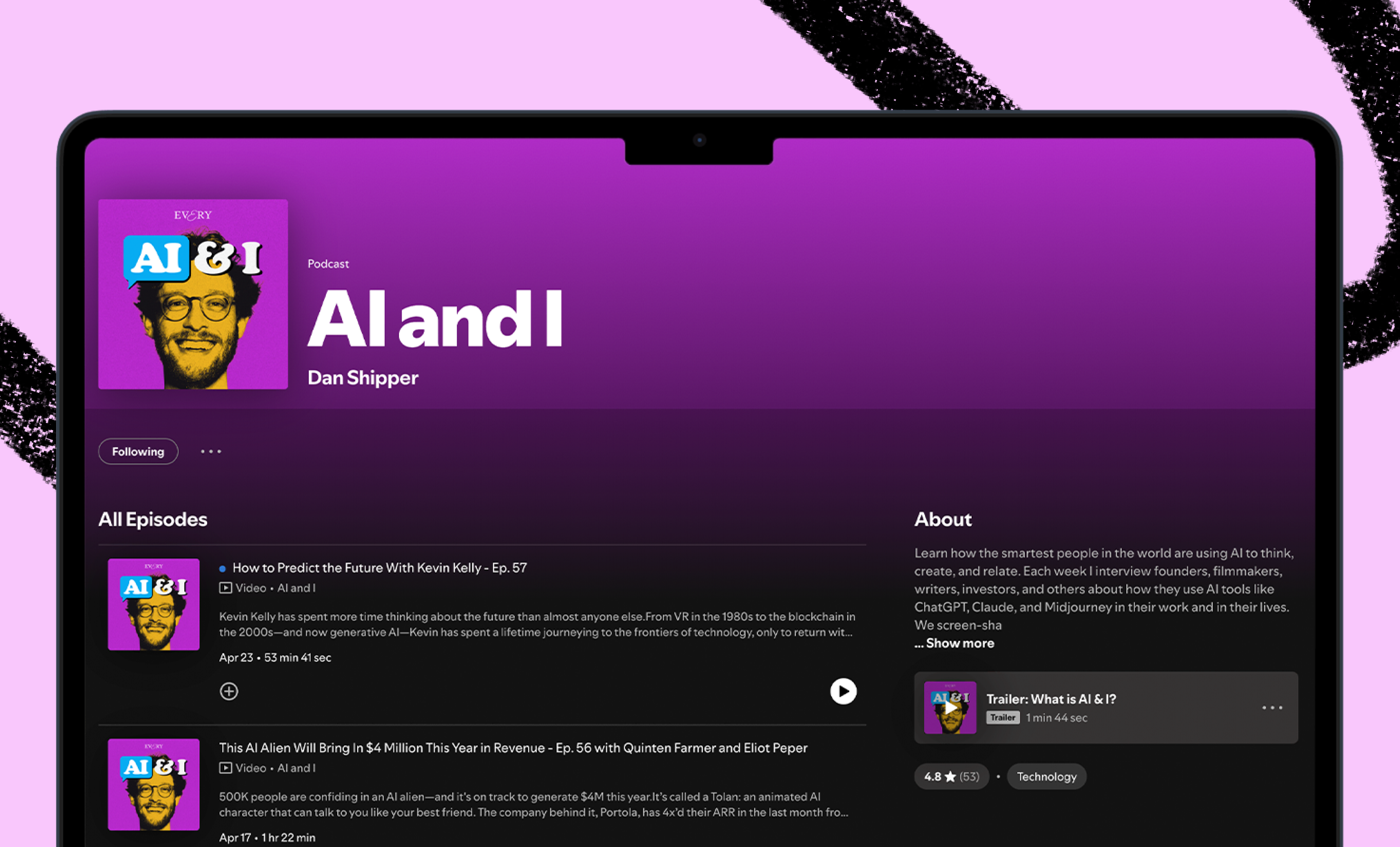
 AI&I Podcast
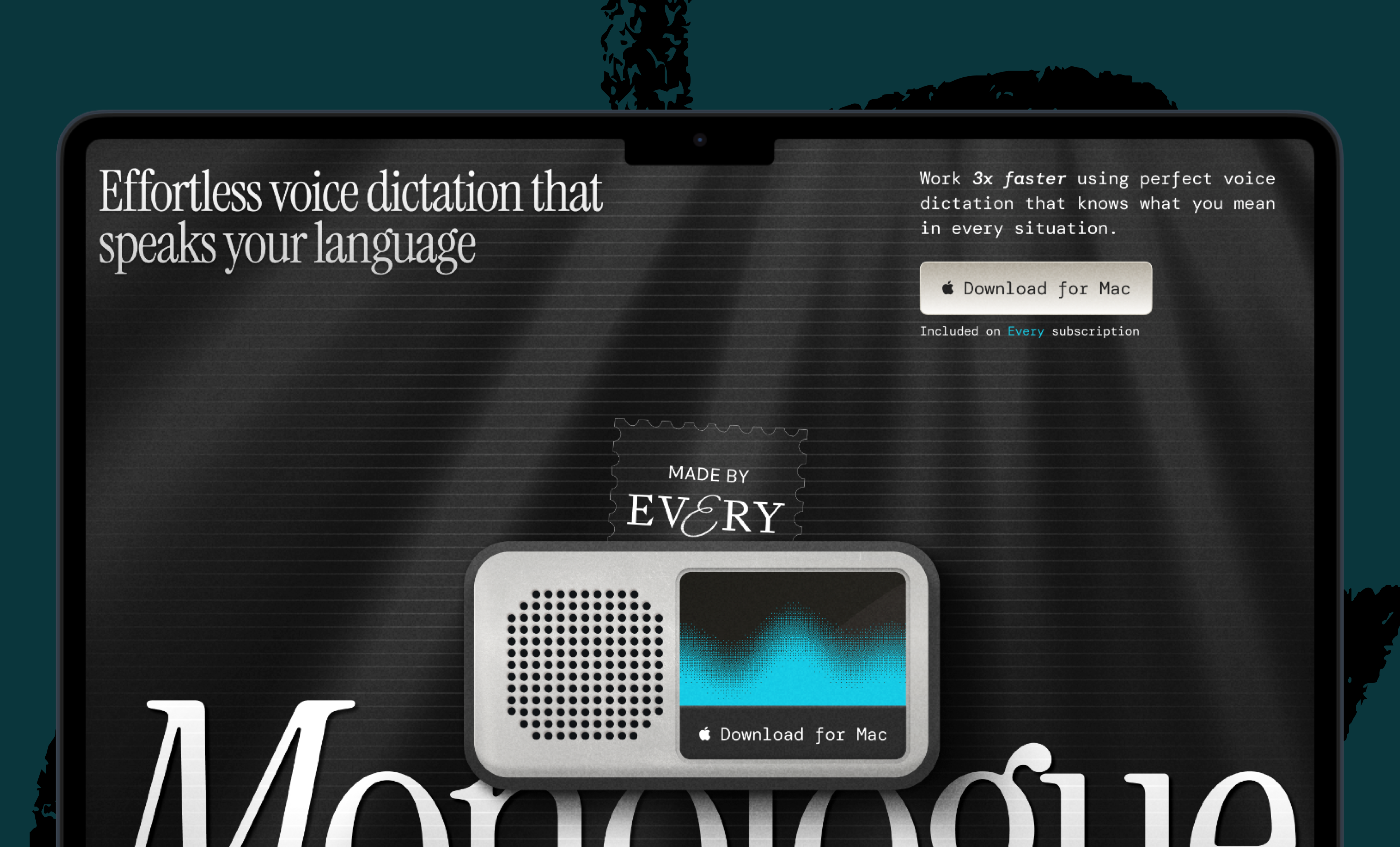
 Monologue
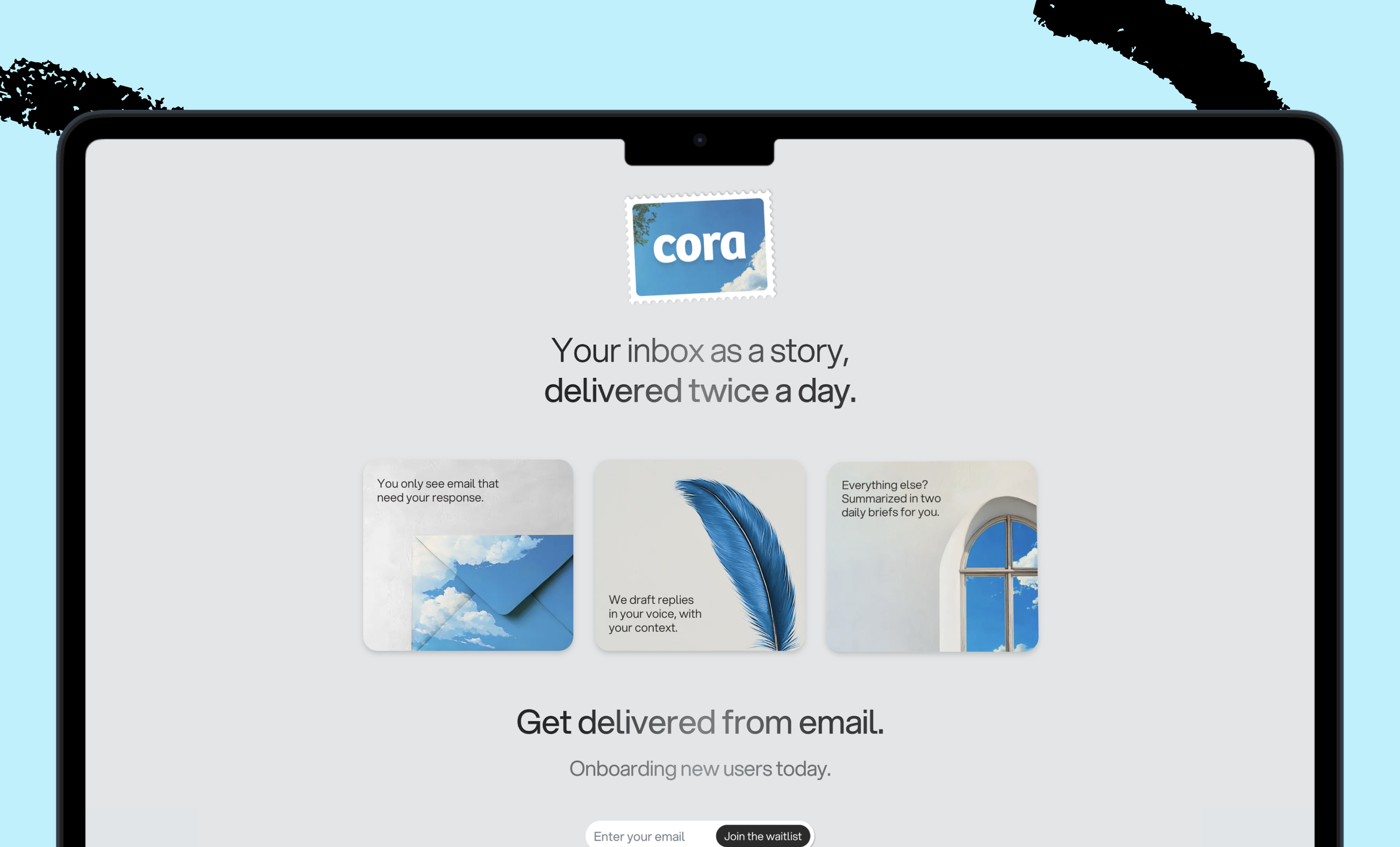
 Cora
Cora
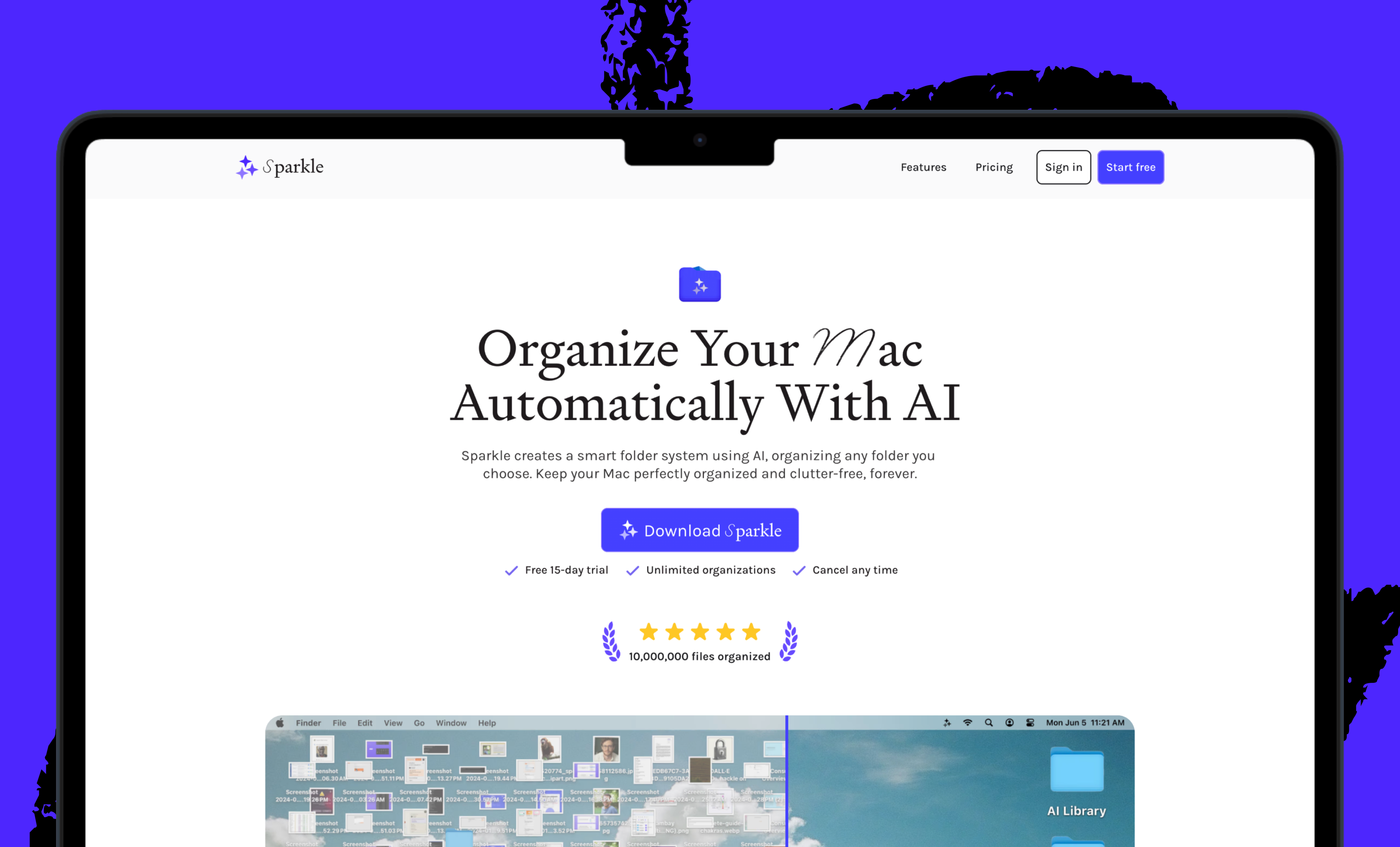
 Sparkle
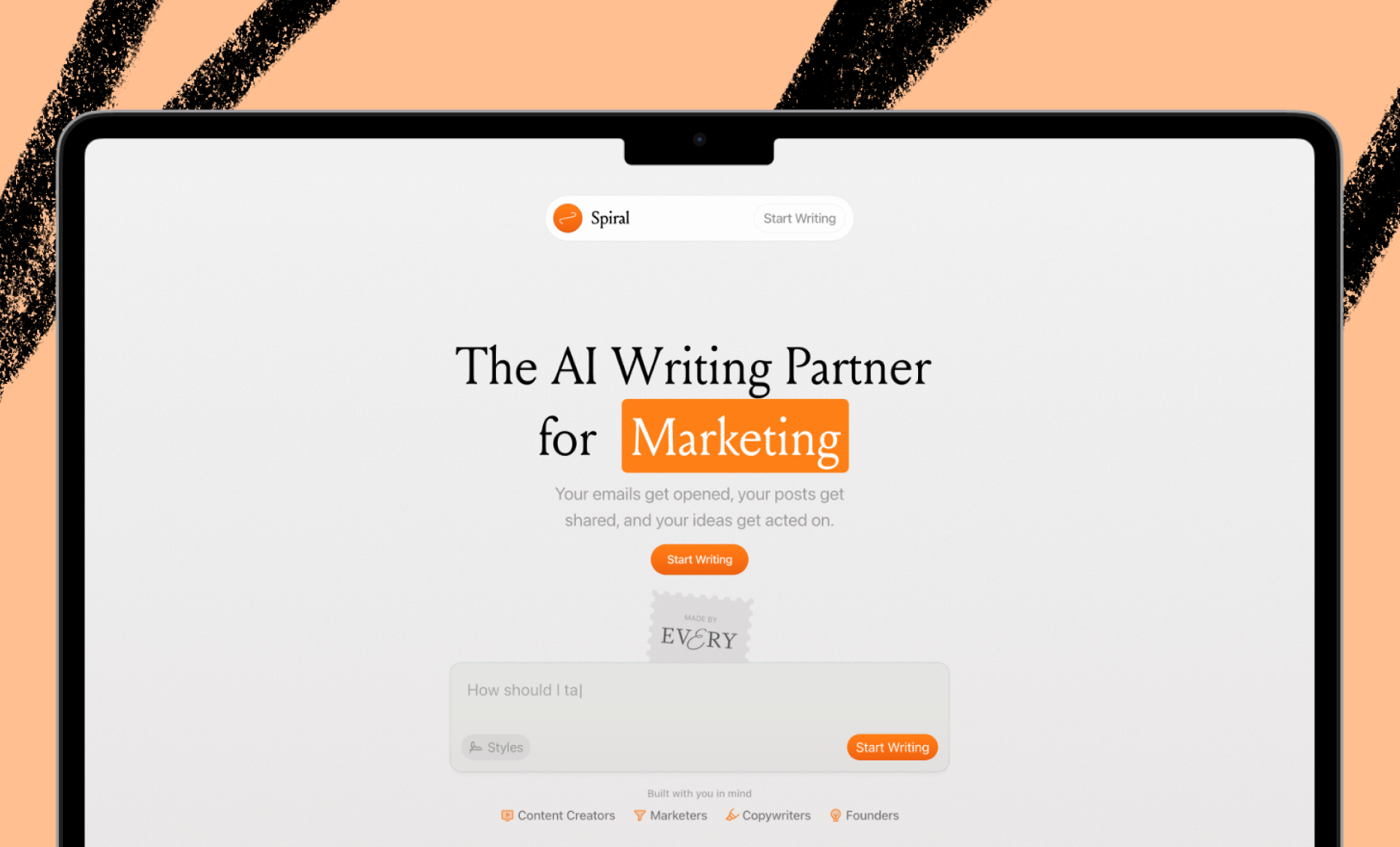
 Spiral
Join 100,000+ leaders, builders, and innovators

Email address

Already have an account? Sign in
What is included in a subscription?
Daily insights from AI pioneers + early access to powerful AI tools
 Front-row access to the future of AI
 In-depth reviews of new models on release day
Playbooks and guides for putting AI to work
Prompts and use cases for builders
In-depth reviews of new models on release day
Playbooks and guides for putting AI to work
Prompts and use cases for builders
In-depth reviews of new models on release day
Playbooks and guides for putting AI to work
Prompts and use cases for builders
In-depth reviews of new models on release day
Playbooks and guides for putting AI to work
Prompts and use cases for builders
 Bundle of AI software



 Reviews of new AI models on release day
Comments
Don't have an account? Sign up!