


Katie Parrott is a staff writer. She writes Working Overtime and contributes to Vibe Checks, Source Code, and Context Window.

The Urge to Merge (ChatGPT and Codex)
Power users revolt at OpenAI’s tool combination. Plus: The battle for knowledge-work OS, managing agents with Fable, and a 53 percent error-rate drop
Jul 14, 2026 · 8 min readUpdated Sep 8, 2026

After OpenAI released GPT-5.6 Sol on Thursday, Anthropic reset Claude’s five-hour and weekly usage allowances for all users, presumably to give people more time to use Fable before it leaves Claude plans and moves to the API. Some saw the move as a bid to keep users from defecting to OpenAI’s hot new model. Thibault “Tibo” Sottiaux of the Codex and ChatGPT team quote-posted Anthropic’s announcement with three words: “I smell fear.”
OpenAI and Anthropic are fighting to become the home for agentic knowledge work. OpenAI is merging Codex into ChatGPT. Anthropic is adding a browser to Claude Code and extending Fable access. Power users mix labs anyway. Today we bring you the merge drama, a workflow that puts Fable in charge of cheaper models, and the upside of our model parents fighting: Christmas in July
While we have you: Today we’re launching Every All Access, a new $625 annual membership that sits above the current Member tier and bundles unlimited access to all five Every products with the Goodie Bag—curated partner discounts from Cursor, Notion, Framer, Anthropic, PostHog, and others.
If you’re already a Member, you can upgrade now at every.to/subscribe.
Was this newsletter forwarded to you? Sign up to get it in your inbox.
Signal
Codex is dead. Long live Codex.
OpenAI found out how much people loved Codex by renaming it ChatGPT.
Five months after releasing Codex as a standalone app, OpenAI folded it into the new ChatGPT desktop app last week and relabeled the previous ChatGPT app “ChatGPT Classic.” The new app has three modes: Chat for questions, Work for longer assignments across tools, and Codex for developer workflows.
We’re on the record as loving Codex. We wrote a whole guide about it and rebuilt many of our workflows around it. But since the merge, we’ve barely noticed. Coders are still coding in Codex. I toggled into Work during a meeting, kept drafting, searching files, and pulling from Slack, and didn’t realize until later that I’d switched.
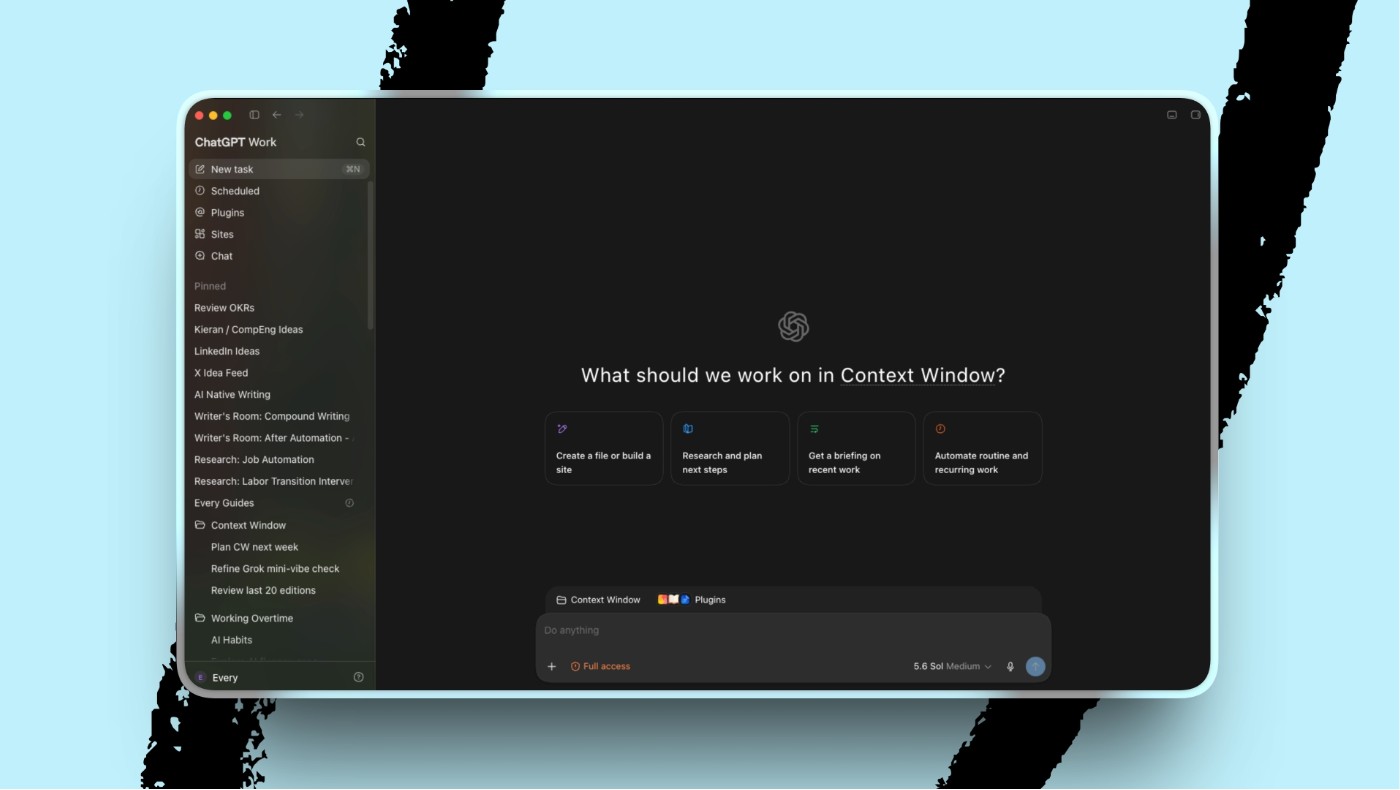
You wouldn’t know that if you were on X that day. Backlash to the move among Codex lovers was immediate and vocal. Developer and YouTuber Theo Browne called the merge a “generational fumble.” Redditors complained of duplicate apps, buried chats and projects, broken plugins, and unclear limits. One thread called the release and the communication about what was happening with Codex “mayhem.” The company appears to have decided that alienating some power users is worth potentially gaining a larger audience for Codex: ChatGPT has more than 800 million weekly users—orders of magnitude larger than Codex’s 5 million weekly users. The merge is a bet that the features that made Codex so compelling for its fans, like file access, tool use, and the ability to carry out tasks across long time horizons and multiple turns, will reach more people inside a product they already know.
OpenAI isn’t the only frontier lab experimenting with how it packages its products. After launching Cowork on Claude Code’s agentic architecture to win over more knowledge workers in January, Anthropic has now put Chat and Cowork in one “home” tab. Both moves aim to introduce chat interface users to the possibilities of AI agents.
Underlying these changes is a shared bet that agentic work is where the technology is moving. Both labs want their flagship assistant to become the place where any knowledge-work task begins: Give the model files, tools, and a sustained assignment, then let it act. Whether OpenAI or Anthropic succeeds will depend on how well their general-purpose apps serve newcomers while preserving the control, context, and reliability power users expect.
What to do this week: For Codex lovers, switch to ChatGPT Codex and carry on as usual. But if you’re agent-curious and haven’t made the leap to agent-driven interfaces, here’s how to get started in Codex: Give it one defined assignment using your files and a concrete deliverable. Require approval before Codex sends messages or changes anything outside the app. You can test agentic work without first learning how to use a coding agent.
Steal this workflow
Put fancy models in charge of affordable ones
During our GPT-5.6 launch livestream, ChatPRD founder Claire Vo described her relationship with Fable 5: “What Fable does is none of my business.” She can say that because she treats Anthropic’s most expensive model as a senior consultant instead of a daily driver. Fable plans the job, delegates bounded tasks to cheaper models, and reviews what comes back.
Claire is part of a broader trend among power users who use the smartest, priciest model as the boss and let cheaper models do the grunt work. Every CEO Dan Shipper takes the pattern one step further by crossing model labs, which requires Claude and Codex to share the same brief and project files. Fable leads. GPT-5.6 Sol executes.
Here’s how to set it up...
Become a paid subscriber to Every to unlock this piece and learn about:
- How to keep Claude as the planner while Codex does the implementation work
- The habit that cut an AI agent’s error rate by more than half
- Why the AI model wars are a gift to users
 Create a free account to continue reading
The Only Subscription
You Need to
Stay at the
Edge of AI
The essential toolkit for those shaping the future

"This might be the best value you
can get from an AI subscription."
- Jay S.
 Every Content
 AI&I Podcast
 Monologue
 Every Agent
Join 100,000+ leaders, builders, and innovators

Already have an account? Sign in.
What is included in a subscription?
Daily insights from AI pioneers + early access to powerful AI tools


 Front-row access to the future of AI
 In-depth reviews of new models on release dayPlaybooks and guides for putting AI to workPrompts and use cases for buildersIn-depth reviews of new models on release dayPlaybooks and guides for putting AI to workPrompts and use cases for builders
 Bundle of AI software





 Katie Parrott
 Every Staff
 Kieran Klaassen
Comments