

Hello, and happy Sunday! This week, Every’s head of platform Willie Williams kicks off a new section—Jagged Frontier—where he goes further out on the AI frontier than we usually venture, returning to a few big ideas from fresh angles each time. First, though, a mini-Vibe Check on OpenAI’s warp-speed Codex-Spark. New models are coming out so quickly that sometimes it’s hard even for us to keep pace. We’re off on Monday for Presidents’ Day in the U.S.—we’ll be back in your inbox on Tuesday.—Kate Lee
Was this newsletter forwarded to you? Sign up to get it in your inbox.
Mini-Vibe Check: OpenAI’s Codex-Spark is so fast it’ll blow your hair back
GPT-5.3-Codex-Spark was slinging code so fast on our livestream on Thursday, Cora general manager Kieran Klaassen and Every CEO Dan Shipper couldn’t get a word in edgewise.
OpenAI’s new model generates ~1,000 tokens per second. For context, Anthropic’s latest heavy-duty model Opus 4.6 runs at about 95.
The AI industry has spent the last year optimizing for intelligence—smarter models, deeper reasoning, longer thinking chains. Spark goes in the other direction. It’s not as sharp as Opus 4.6 or GPT-5.3 Codex on reasoning, so it’s not as reliable on complex tasks. But then again, how smart does a model need to be if it gets you what you need before you lose your train of thought?
What it is
Spark is a smaller, speed-optimized version of OpenAI’s GPT-5.3 Codex, built to run on hardware from Cerebras, a chipmaker that designed its processors specifically for AI inference. It’s OpenAI’s first model running on non-Nvidia hardware, which is partly why it’s so fast: Cerebras designed its hardware specifically for speed at AI inference, not for general purpose (as Nvidia does).
The tradeoff is that Spark is less capable than both GPT-5.3 Codex and Opus 4.6 on complex reasoning. Think of it as a fast junior developer who can knock out simple tasks instantly, rather than a senior engineer who takes longer but catches edge cases. It’s currently available only to Pro subscribers ($200 per month) in the Codex app and command line interface, with API access limited to design partners.
What’s working
Dan has been testing Spark on knowledge work queries where he needs an answer in 30 seconds and staying in flow is more important than getting every detail correct. On the stream, he pulled a YouTube performance report in about 30 seconds that would have taken Opus or 5.3 Codex closer to 90. Dan pointed out that 90 seconds is enough to make him leave the task, check Discord, and lose the thread. Thirty seconds keeps him in his chair.
Kieran found Spark best for brainstorming and rapid iteration. He ran it through his compound engineering workflow—triaging GitHub issues, planning features, iterating on Cora’s user interface—and the speed made exploratory work feel frictionless. He ran about 10 design iterations in the time a heavier model would have finished two or three.
The stream’s most interesting finding came from another Kieran experiment. He gave Spark a routine code review task two ways: one where Spark did all the work itself, and one where it delegated pieces to helper agents—the way most developers speed up complex tasks. Spark alone finished in 1.5 minutes. With helpers, it took four minutes, because the helpers had to pass information back and forth.
Kieran thinks this points to a broader change in how developers will approach code. Until now, developers have been building increasingly complex systems where multiple AI agents divide up work and run in parallel—it’s faster than waiting for one model to handle everything. But if the model itself is fast enough, that complexity becomes unnecessary. One well-written prompt that gets an answer in a second can beat a five-agent system that takes four minutes to coordinate.
What needs work
The code itself isn’t as good. GPT-5.3 Codex and Opus 4.6 both produce more comprehensive and reliable output on serious tasks. Spark is a tier below on reasoning, and for anything production-critical, you’d still reach for a model with heavier reasoning capabilities.
The speed also creates its own problem. Spark can spit out 10 pages of code and work summaries in about 30 seconds, which is overwhelming. Dan flagged this as a UI problem, not a model problem—coding interfaces aren’t built for reviewing output at this pace. Until tools develop affordances for that volume of work, the raw speed can create friction instead of eliminating it.
Dan framed both limitations as part of a larger pattern: Every three to six months, capabilities change so radically that your entire approach has to change. UI overwhelm didn’t used to be a problem. Progress can be energizing but also, as Dan admitted, “a little tiring.”
Who should try it
It’s worth trying if you have:
- Fast, lightweight tasks that don’t need deep reasoning: brainstorming, triage, analytics queries, UI iteration
- Workflows where staying in flow matters more than perfection: changelogs, quick data pulls, exploratory prototyping
- Curiosity about how speed changes your process: if iteration is part of what you value about AI, this model could be for you,
For anything that needs precision or judgment, stick with Opus 4.6 or 5.3 Codex. For the team’s full first impression of Spark, check out the livestream. —Katie Parrott
Knowledge base
“Compound Engineering: The Definitive Guide” by Kieran Klaassen/Source Code: Most codebases get harder to work with over time—each feature adding complexity until teams spend more time fighting the system than building on it. Compound engineering flips this: Each unit of work makes the next one easier. Bug fixes eliminate entire categories of future bugs. Patterns become reusable tools. Read this for Kieran’s full systematic approach, plus a GitHub plugin to start using compound engineering today. 🧑💻 Paid subscribers can learn Kieran’s approach at our first Compound Engineering Camp on February 20. Reserve your spot.
🎧 🖥 “Inside OpenAI’s Agentic Browser, Atlas” by Rhea Purohit/AI & I: Ben Goodger and Darin Fisher have spent decades building browsers together—Netscape, Firefox, Chrome—and now they’re building Atlas, OpenAI’s agentic browser designed to handle your digital errands. In this conversation with Dan, they explain why the web won’t become obsolete and how Atlas balances being an invisible doorway with being a helpful guide. 🎧 🖥 Listen on Spotify or Apple Podcasts, or watch on X or YouTube.
“How Claude Code Is Transforming Finance—Without Turning You Into a Coder” by Brooker Belcourt: Finance should be AI’s sweet spot—structured workflows, repeatable research, defined processes—yet most firms try AI for a few weeks, hit a snag, and quietly revert to their old ways. Brooker Belcourt, Every’s head of financial services consulting, shares what he’s learned from six months working with firms managing over $100 billion in assets. No coding required—just a clear view of the task. Read this for his full playbook. 💹 If you work in finance and want to learn more, join us on March 13 for a day-long Claude Code for Finance course. Reserve your spot.
“The Two-slice Team” by Dan Shipper/Chain of Thought: Amazon’s “two-pizza rule” kept teams under 10 people for two decades. Now, Dan argues it’s time for a new standard: the two-slice team—two slices, one person. Every now runs four software products each led by a single person, with 99 percent of code written by AI agents. Read this to understand his philosophy, and test Proof, an agent-native markdown editor that Dan alone built in his spare time.
“Introducing Every Events” by Natalia Quintero/On Every: After a year of coding camps, vibe coding marathons, and enterprise training for companies like the New York Times and Walleye Capital, we’re pulling it all together with Every Events—your new hub for training resources. Camps are free and hands-on for paid subscribers. Courses go deeper for a separate fee. Demo Days showcase what Every’s builders are making in real time. Read this for the full calendar and how to sign up.
Jagged frontier
In the beginning, there was the command line. Then came Windows, and we stopped writing instructions and started clicking icons. Next our phone, where we forgot the mouse and used our fat fingers to scroll the web. Now, I don’t even use my hands.
I talk.
I whisper to my code. I yell at my email. I murmur incantations that make my computer dance as if I’m casting spells. Productivity at 200 words per minute while I watch the clouds float by.
Each shift in computing stripped away a layer of abstraction. The cursor was more natural than a terminal. Fingers were more natural than the mouse. Voice is the interface we were born knowing how to use. It’s why talking feels so right, like something we’re returning to rather than adopting for the first time.
It may not be a coincidence that voice is having its moment at the same time that AI is making us feel like beginners again. Every week there is a new tool and a new interface to learn.
When things are moving so fast, voice might be the key to getting our heads around all of it. Because you don’t have to learn voice—you just say what you want. The interface that supported the emergence of human civilization hundreds of thousands of years ago turns out to be the best way to keep up with the most complex technology we’ve ever built.
Not despite being ancient, but because of it.—Willie Williams
From Every Studio
Cora gets a model upgrade
This week Kieran upgraded the inference model powering Cora’s email classification and summarization from Gemini Flash 2.0 to Flash 2.5. The result is better classification accuracy, cleaner summaries, and improved reliability under high demand. The changes are live for all users—you don’t need to do anything, just notice that Cora’s getting a bit better at reading the room.
Alignment
Dead at dawn. For the past few weeks I’ve been struggling with my sleep. I wake up at 4 a.m. and instinctively reach for my phone so I can open emails or X. I know that’s an issue, because within five minutes I absorb three predictions about mass job losses, two threads about tools I’ve never heard of, and a viral essay comparing AI to Covid. Given that I worked in medicine through COVID, my chest, as you can imagine, gets pretty tight. I put the phone down but don’t fall back asleep.
One of the issues is that the AI timeline only ever seems to serve you two emotions: terror that you’re about to be replaced, or panic that you’re falling behind. And you can’t dismiss either, because some of these takes have merit. So instead of ignoring the content, I realized I had to create some kind of filter that stops it from overwhelming me.
What broke the cycle was a technique I borrowed from writer Cedric Chin. Before you consume anything, ask yourself one question: What is the outcome I’m trying to achieve?
When I started answering honestly, I realized most of my scrolling was hoarding and stockpiling information that wouldn’t change a single decision I’d make that week. I came across an impressive new AI video editor, but it was nowhere near my top five priorities. So I bookmarked it as interesting and forgot about it. The mass layoffs thread that went megaviral is possibly directionally true, but it doesn’t change what I’m doing right now, at this moment.
This is not ignorance by any stretch of the imagination. I’m choosing what enters my sphere of attention and filtering it through my goals and objectives.
I know this sounds like Life Advice 101—you know, just have priorities. But I didn’t actively apply the ones that I had for the first 30 years of my life, and I’d bet most people scrolling at 4 a.m. don’t either. Once you have even a rough plan of what you’re trying to do this week, this month, this year, everything on your timeline becomes filterable through that lens. It either serves your goals or it doesn’t, and the stuff that doesn’t can be de-prioritized.
That’s what intentionality gives you: equanimity and a good night’s sleep.—Ashwin Sharma
That’s all for this week! Be sure to follow Every on X at @every and on LinkedIn.
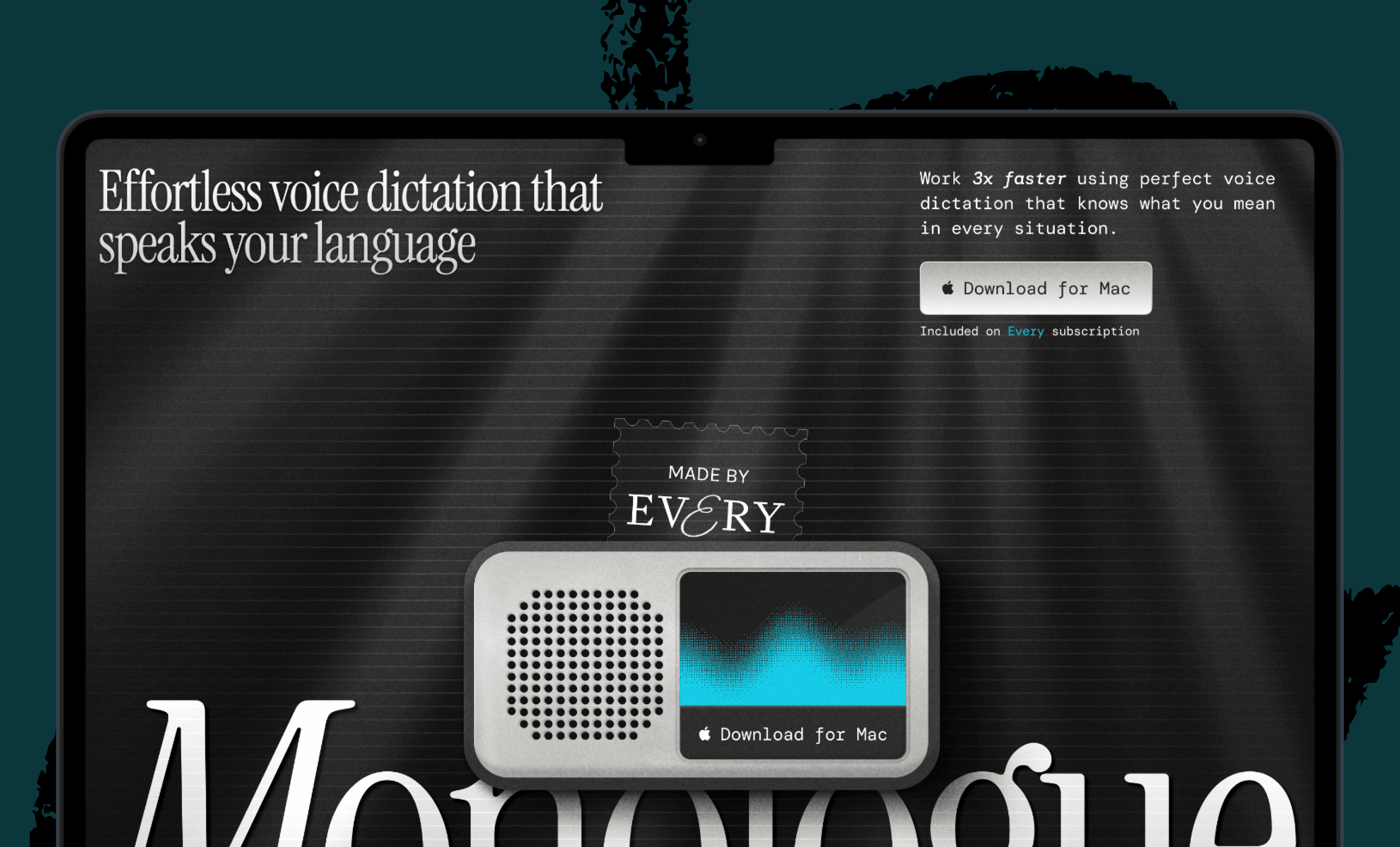
We build AI tools for readers like you. Write brilliantly with Spiral. Organize files automatically with Sparkle. Deliver yourself from email with Cora. Dictate effortlessly with Monologue.
We also do AI training, adoption, and innovation for companies. Work with us to bring AI into your organization.
Get paid for sharing Every with your friends. Join our referral program.
For sponsorship opportunities, reach out to [email protected].
Help us scale the only subscription you need to stay at the edge of AI. Explore open roles at Every.
The Only Subscription
You Need to
Stay at the
Edge of AI
The essential toolkit for those shaping the future
"This might be the best value you
can get from an AI subscription."
- Jay S.

Join 100,000+ leaders, builders, and innovators

Email address
Already have an account? Sign in
What is included in a subscription?
Daily insights from AI pioneers + early access to powerful AI tools

Comments
Don't have an account? Sign up!