


Dan Shipper is the CEO and cofounder of Every. Every week he explores the frontiers of AI in his column, Chain of Thought, and on his podcast, ‘The Every Podcast’.

Marcus Moretti is the general manager of Spiral.

Katie Parrott is a staff writer. She writes Working Overtime and contributes to Vibe Checks, Source Code, and Context Window.

Inside Anthropic’s 2026 Developer Conference
What it was like in the room, plus what the new Managed Agents features look like in production
May 7, 2026 · 9 min readUpdated Oct 9, 2026

Was this newsletter forwarded to you? Sign up to get it in your inbox.
To our surprise, the biggest launch from Anthropic’s developer conference in San Francisco yesterday wasn’t a model or a feature. Instead, it was the company’s announcement of a deal with SpaceX to allocate all of the capacity in the latter’s Colossus supercluster to Claude.
Anthropic has been riding a historic demand surge over the last year as Claude Code opened up a new wave of agentic coding for engineers and non-engineers alike. But compute constraints have caused friction even amongst its most die-hard fans—we’ve written previously about being frustrated with its OpenClaw restrictions and the speed of its latest models like Opus 4.7.
The deal with SpaceX changes that equation. Anthropic has already doubled rate limits for subscription plans, removed peak-hour limits on Pro and Max accounts, and raised API rate limits by as much as almost 17 times for certain tiers.
Other than that, the big story is Claude Managed Agents, Anthropic’s hosted agent product. The company released three new features:
- Multi-agent orchestration: a coordinator agent that spins up subagents in parallel baked into the platform
- Dreaming: Anthropic’s general-purpose version of compound engineering, a feature that allows agents to learn from past sessions to improve between runs
- Outcomes: Anthropic’s answer to Codex’s /goals command, allowing developers to specify an outcome and run an agent in a loop until the outcome is achieved
By themselves, these features are nice but not groundbreaking. What’s more important is that what an AI platform is has changed. In the GPT-3 days, the platform was a text completion end-point: Send text in, get text out. Now, with Claude Managed Agents, the platform is an AI model with a harness and host computer—all provided with unlimited scaling by the model companies.
Cora general manager Kieran Klaassen and I reported live from conference with our biggest takeaways, including the xAI compute deal, doubled Claude usage limits, Claude Managed Agents, and why the battle lines between OpenAI and Anthropic are starting to become clearer. Watch now:


We also recorded a conversation with Angela Jiang, head of product for the Claude platform, and Katelyn Lesse, head of platform engineering. The full episode drops tomorrow on AI & I—highlights below.—Dan Shipper

Building blocks that help your agents compose elegant backends
Agents right now often write code that needs to be cleaned up because they need three things most infrastructure wasn’t built to provide: immediate feedback, local reasoning, and a thin meta layer. Convex provides immediate feedback, enables local reasoning, and minimizes the meta layer, giving agents a surface layer that’s actually small enough to work with. Scale without breaking or spending a fortune.
Vibe Check: Claude Managed Agents
Spiral general manager Marcus Moretti uses the platform’s new features
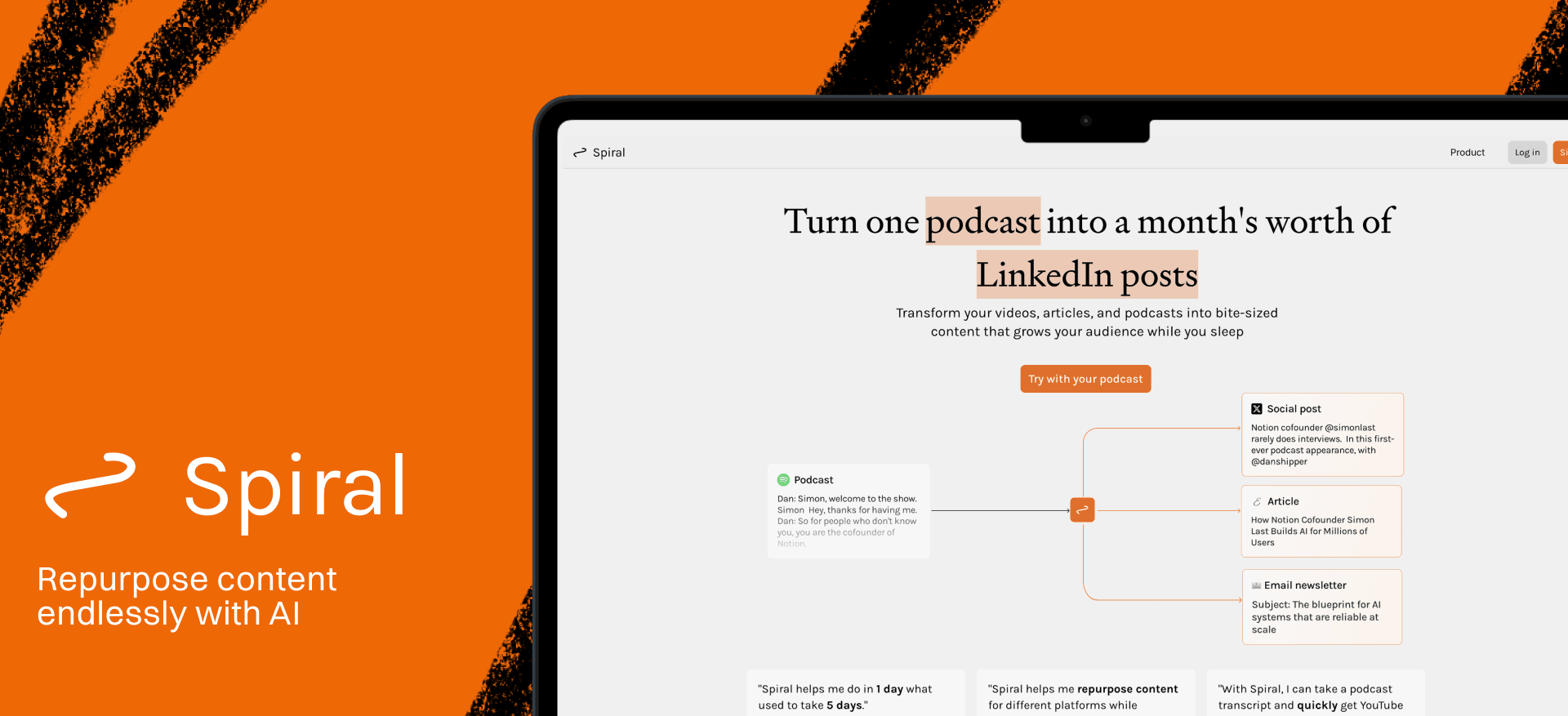
Anthropic launched Claude Managed Agents in April, and since then, Every’s AI writing tool Spiral has used the platform to power its API and command line interface (CLI), which lets developers and other agents talk to Spiral outside the web app. Claude Managed Agents run on Anthropic’s servers, instead of us having to run them on our own.
We set up a new Managed Agent in an afternoon and deployed it to power our API the next day. We’ve incorporated two of the new features Anthropic announced yesterday (memory and multi-agent orchestration) and are deploying the third (outcomes) soon.
Memory: Every’s editorial and social expertise—how to write a good X post, for example—lives in...
Become a paid subscriber to Every to unlock this piece and learn about:
- How Spiral is already using the new features announced this week
- How Claude’s new “Dreaming” feature takes a page out of compound engineering
- Why Anthropic says building a model-agnostic harness is a losing strategy
Thanks to our Sponsor: Convex
Building blocks that help your agents compose elegant backends
Agents right now often write code that needs to be cleaned up because they need three things most infrastructure wasn’t built to provide: immediate feedback, local reasoning, and a thin meta layer. Convex provides immediate feedback, enables local reasoning, and minimizes the meta layer, giving agents a surface layer that’s actually small enough to work with. Scale without breaking or spending a fortune.
 Create a free account to continue reading
The Only Subscription
You Need to
Stay at the
Edge of AI
The essential toolkit for those shaping the future

"This might be the best value you
can get from an AI subscription."
- Jay S.
 Every Content
 AI&I Podcast
 Monologue
 Every Agent
Join 100,000+ leaders, builders, and innovators

Already have an account? Sign in.
What is included in a subscription?
Daily insights from AI pioneers + early access to powerful AI tools


 Front-row access to the future of AI
 In-depth reviews of new models on release dayPlaybooks and guides for putting AI to workPrompts and use cases for buildersIn-depth reviews of new models on release dayPlaybooks and guides for putting AI to workPrompts and use cases for builders
 Bundle of AI software






 Katie Parrott
 Every Staff
 Kieran Klaassen
Comments