
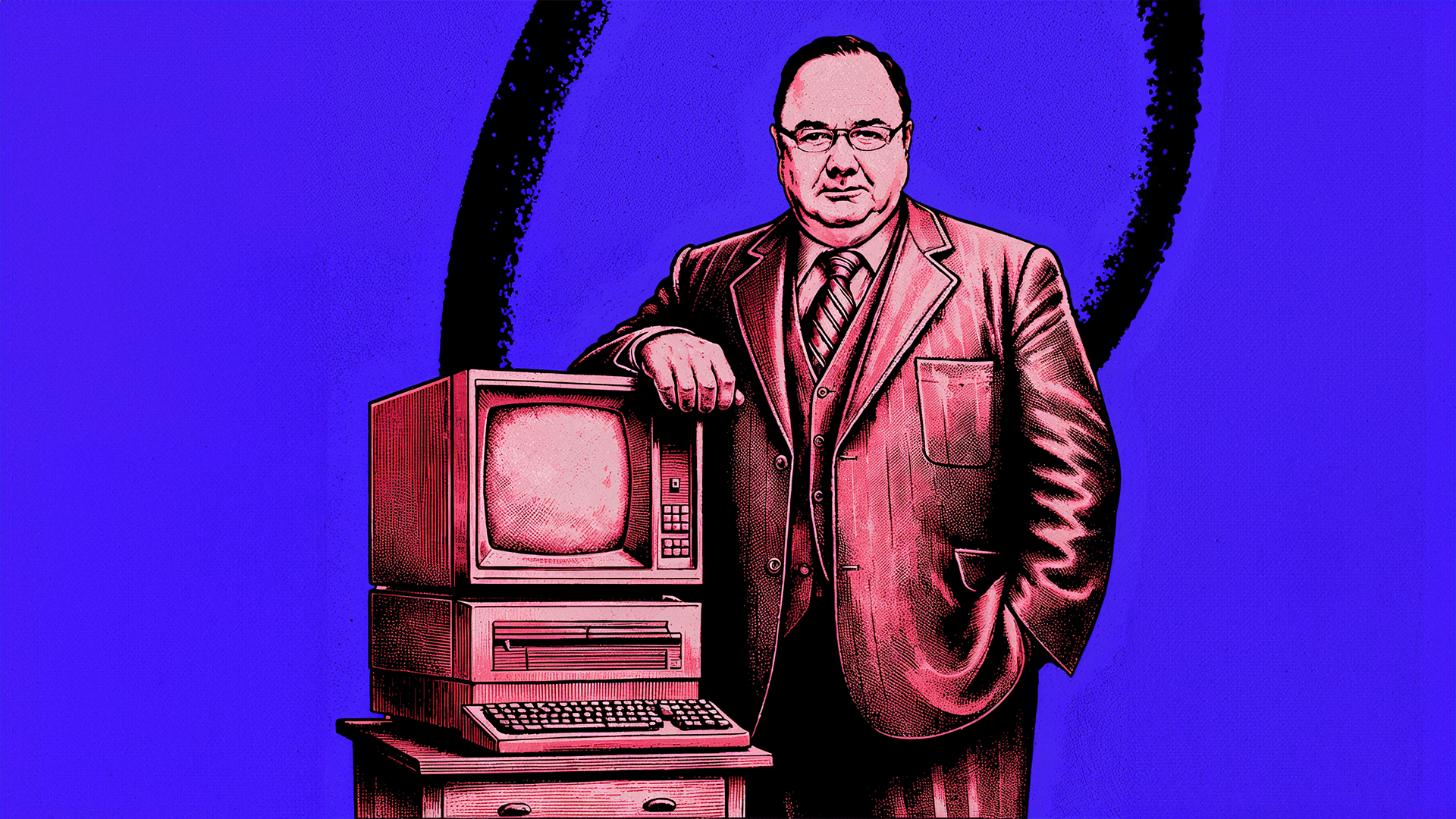

Gareth Edwards is a digital strategist, writer, and historian. He unearths Silicon Valley’s tech history in his monthly column, The Crazy Ones.

The Secret Father of Modern Computing
How Ed Roberts created the personal computer industry—and then walked away
Dec 15, 2023 · 23 min readUpdated Mar 9, 2026

We’re in the midst of the biggest paradigm shift in technology since the internet and the personal computer. If you want to understand what’s going to happen with AI, you have to understand how previous technology shifts played out—because history repeats itself. That’s why we’re publishing this original essay by digital strategist and historian Gareth Edwards on the secret history of the first PC revolution. It's a long read with which to settle into the weekend. We hope it sheds light on the past—and on the future. We’d like to publish more of these pieces by Gareth, so if you like it, please let us know. —Dan
In September 1974, Ed Roberts was sitting at the bank in a foreclosure meeting. His once-profitable calculator company, Micro Instrument and Telemetry Systems (MITS), had exhausted its $250,000 overdraft and was on the verge of bankruptcy. But Roberts wasn’t getting ready to shut down. Instead, he was soliciting a $65,000 loan. Not to spend on calculators, he explained to the bank, but for something completely different. Something nobody had done before. He planned to build an affordable personal computer.The bankers were dubious. Everyone knew that computers were large and expensive, the domain of big business. “The banker asked me, ‘Well, how many of these do you think you'll sell?'” Roberts remembered later.
It was a question that he’d hoped they wouldn’t ask because Roberts had no answer. He had decided to pivot his entire company on a personal hunch: that he could sell a large number of low-cost computers in a market where most companies expected to sell four or five expensive ones every year. “I said, ‘I think we'll sell seven or 800 of them over the next year.’ [The banker] laughed at me, accused me of being a wide-eyed optimist and all that."
For a second, Roberts thought that this was the end of MITS. Instead, the banker sighed and signed off on the loan. He explained that he saw little value in foreclosing now. If, somehow, Roberts managed to sell even 200 of these machines, it would yield the bank some return.
Roberts went away surprised, but happy. This didn’t mean he wasn’t worried. His business depended on him being right about two things everyone insisted were wrong: that you could create a useful computer for less than $400, and that there were people who would buy it.
But Robert had conviction. "Here’s the thing that’s so hard for people to understand now,” he said. “Those of us who wanted computers lusted after computers. That's the only way to describe it. The idea of possessing your own computer... I mean... wow. There were only one or two things more exciting about that. And I'm not even sure about them!"
We often picture tech disruptors as brash, dynamic figures who are keen to be both seen and heard. Yet the personal computing industry was largely sparked by a straight-talking ex-Air Force officer—one more Ron Swanson than Elon Musk. He ignored claims by IBM and others that people didn’t want a computer at home, and risked his whole company on a hunch that they were wrong. His approach to business was different from the “move fast and break things” model we’ve come to expect from tech entrepreneurs, yet he succeeded beyond all expectations because of it.
This is the story of Ed Roberts, the man who created the personal computer, launched the careers of Bill Gates and Steve Wozniak, and decided—at the height of his success—to walk away. It is based on archival video interviews with Roberts, Gates, Steve Wozniak, and many of the other key figures involved. I also draw on written accounts by Forrest Mims, Paul Allen, and others who were there; contemporary publications, such as Dr. Dobbs Journal and Popular Electronics; and books like Fire in the Valley and Endless Loop: A History of Basic.
Dreams of selling a computer
Roberts had started to act on his hunch about personal computers long before meeting with the bank. As early as 1972, as the power of microprocessor chips was increasing and their prices were dropping, he sensed that there was an opportunity to produce a mass-market computer. He also understood that the electronic calculator market in which MITS had enjoyed great success was about to implode.
Like most of the firms that had ridden the calculator boom, MITS made very few parts itself. The company designed the boards, selected the chips, sourced the parts, and (for an additional fee) would even assemble your calculator for you. However, as demand grew, chip manufacturers started entering the market, and companies like Texas Instruments began to sell directly to customers. They could offer cheaper products than third-party assemblers like MITS. Almost overnight, Roberts’s profit margins disappeared.
Roberts wanted to exit the calculator market entirely—and he had experience making bold decisions. Initially, MITS made electronic telemetry systems for model rockets—hence, its full name, Micro Instrument and Telemetry System, which was cleverly selected to create a mental association with MIT, the university. After several years catering to rocket enthusiasts, Roberts had sensed that the market for electronic calculators was about to explode. When his founding partners in MITS proved reluctant to pivot, Roberts offered to buy them out. After they accepted, he took the company successfully into the calculator market. As far as he was concerned, pivoting to affordable computers was a natural progression from pivoting to affordable calculators.
"I know now that I'm onto something good when everyone else thinks it’s a bad idea,” he said. “I just didn't figure that out until later."
Roberts’s interest in computers was different from most of the customers who would eventually buy his machine. He was a realist—fascinated by what they could do now, rather than the future they represented. In fact, he had always wanted to become a doctor, but he grew up in a relatively low-income family, so he had to find a way to pay for college. He chose to study electrical engineering and committed to a period of service afterward with the U.S. Air Force (USAAF), which ensured that his tuition would be covered. After graduation, he joined the USAAF Weapons Lab at Kirkland Air Force Base near Albuquerque. Some years later, he created MITs along with other Air Force personnel.
At college and Kirkland, Roberts had encountered some of the most powerful computers then available. He was fascinated by computers—how they could democratize power, and who they could offer that power to.
“To some extent, your worth has always been measured by the number of people you control—the number of people you ‘own,’ so to speak,” Roberts explained. “In the case of the computer, one person can do the work of thousands. So by any historical definition, if you have a computer, you’re wealthy. I mean, wealthy beyond all imagination. That’s always intrigued me about computers. The enormous amount of power it gives us regular folks.”
 Create a free account to continue reading
The Only Subscription
You Need to
Stay at the
Edge of AI
The essential toolkit for those shaping the future

"This might be the best value you
can get from an AI subscription."
- Jay S.
 Every Content
 AI&I Podcast
 Monologue
 Every Agent
Join 100,000+ leaders, builders, and innovators

Already have an account? Sign in.
What is included in a subscription?
Daily insights from AI pioneers + early access to powerful AI tools
 Front-row access to the future of AI
 In-depth reviews of new models on release dayPlaybooks and guides for putting AI to workPrompts and use cases for buildersIn-depth reviews of new models on release dayPlaybooks and guides for putting AI to workPrompts and use cases for builders
 Bundle of AI software



 Katie Parrott
 Every Staff
 Kieran Klaassen
Comments