


AI Is Ready. Organizations Aren’t.
Plus: Spiral 4.0 writes in your voice, and why the next blockbuster drug may come from China
Jun 6, 2026 · 7 min readUpdated Aug 12, 2026

Hello, and happy Sunday! This week the consulting team published two practical guides. Mike Taylor built on engineer Steve Yegge’s viral post to map the eight levels of AI adoption—with sample prompts and signals for when to move up—and Natalia Quintero (who’s talked to leadership teams at hundreds of organizations) laid out a foolproof five-step process for executives rolling out AI across their companies. Covering Microsoft Build, Mike argued that enterprise adoption lags the news cycle—a gap he sees up close with the enterprise clients he advises. He also made a counterargument to Dan Shipper’s essay about the future of work, “After Automation.”
Spiral 4.0 shipped this week: Every’s writing tool can now draft in your voice from inside any agent, with a price cut to match. Elsewhere, Figma’s Matt Colyer makes the case that the SaaSpocalypse is overblown, designer Daniel Rodrigues shares a two-tool image generators workflow, Monologue general manager Naveen Naidu has a system for making coding agents more efficient with custom local skills, and the team names its most annoying model output.—Kate Lee
Was this newsletter forwarded to you? Sign up to get it in your inbox.
Knowledge base
“The Eight Levels of AI Adoption” by Mike Taylor and Laura Entis/Guides: A framework mapping every stage of AI adoption, from Level 1 (a chatbot you ask and it answers) to Level 8 (an orchestrator agent that runs a team of sub-agents), with example prompts and guidance on when to move up. A higher level isn’t automatically better—the right level for a task depends on how much you trust the AI to run without intervention and how costly a mistake would be. A companion essay lets you figure out which level you’re on. Read this for where you stand today and what it takes to move up a level.
“An Executive’s Guide to Implementing AI” by Natalia Quintero/Guides: AI adoption isn’t being held back by the models—it’s the organization. Natalia Quintero, head of Every Consulting, gives executives who’ve bought the tools but aren’t seeing returns a five-step framework, laid out as a 60-day plan—with a companion essay that previews it. Read this for the five steps and how to run them.
“How Microsoft Is Building for a World of Metered Intelligence” by Mike Taylor/Also True for Humans: Reporting from Microsoft Build, Mike Taylor argues that Microsoft is the first big company to design for a world where intelligence is metered and the era of subsidized AI subscriptions is ending. Its response includes automatic model routing, a laptop that runs AI locally, and cheaper, smaller models. Read this for a ground-level look at AI’s post-subsidy era.
“Why We’ll Still Be Employed When AI Can Do Everything” by Laura Entis/Context Window: In a counterpoint to Dan’s “After Automation” essay, Mike argues that even after AI can outwork people at well-run companies, running it will cost so much energy and compute that hiring a person is often cheaper. Read this for a grounded take on the AI-employment debate.
“Opus 4.8 Is Smart Enough to Get in Your Way” by Laura Entis/Context Window: A week after our Opus 4.8 Vibe Check, we check back in—now that the public has reacted and more of the Every team is using it daily—and our initial read holds: It’s strong on dense, long-running work but quick to get in its own way. Read this for how the verdict looks a week on.
🖥 “Codex Runs My Inbox Now” by Dan Shipper/Every: Dan shows the workflow that’s kept him at inbox zero for 13 weeks straight—a Codex-native app that pulls his emails, Slack messages, meetings, and company context into review cards, drafts the next action on each, and learns from every decision. It shows Codex working as an operating system for knowledge work and ends with the full prompt to build the app yourself. Read this for the inbox-sweep workflow and the prompt to copy.
“Figma Exec on Why the SaaSpocalypse Is a Goldmine” by Dan Shipper/AI & I: Matt Colyer, Figma’s director of product management for developers, argues that the “SaaSpocalypse”—the fear that vibe coding will kill software by letting anyone build their own tools—has the economics backward: AI expanded the developer base, so more software gets built and software becomes more valuable, not less. Watch or listen to this for the clearest reframe of the vibe-coding-kills-SaaS panic. 🎧 🖥 Listen on Spotify or Apple Podcasts, watch on YouTube, or follow the discussion on X.
Log on
Get hands-on with how Every uses AI. These are the live camps, workshops, and meetups where team members teach the workflows behind our work.
Upcoming camp
- Codex Camp: Our Power User Guide: On June 12, Dan and the Every team host a two-hour live walkthrough of the Codex power-user guide—setup, workflows, and Codex-native app development. RSVP.
Recordings you may have missed
- Compound Engineering Camp: Kieran Klaassen and contributor Trevin Chow walk through compound engineering, Every’s AI-native development workflow. Watch the recording.
- Executive AI Sessions: Natalia introduces Every Consulting’s new offering for leadership teams navigating AI adoption. Watch the recording.
From Every Studio
Spiral 4.0 ships agent-native access and a price cut
Spiral, Every’s AI writing tool, shipped version 4.0 this week: a new style engine, agent-native access through MCP, CLI, and API, and expanded team workspaces for writing in a shared voice. Pricing moves from sessions to tokens, dropping the personal plan to $15 a month (from $25) and team plans to $25 per user (from $35).
Alignment
The great wall gets greater. Drug companies do not create billion-dollar assets by having ideas. They need human trials to prove the idea works, and China has become exceptionally good at running them. Because the government has made biotechnology innovation a strategic innovation, policy makers have cleared the bureaucracy and regulation obstacles that have long slowed drug development in the U.S. and Europe. As a result, last year Bloomberg reported that China had more than 1,250 novel drugs entering development, close to the U.S. count of about 1,440. A decade ago, Chinese biotech was synonymous with copycat drugs—which makes this a Sputnik moment for the industry.
One key reason for China’s ascendency is that hundreds of millions of patients are concentrated in large urban hospitals, so companies can recruit quickly from a smaller number of high-volume sites. Chinese biotech firms can reportedly complete patient enrollment for a phase 1 or phase 2 trial in nearly half the time a U.S. firm needs. In North America—and even more so in Europe—patients are scattered across fragmented health systems, where every trial site has its own contracts and ethic approvals, each one slow and cumbersome.
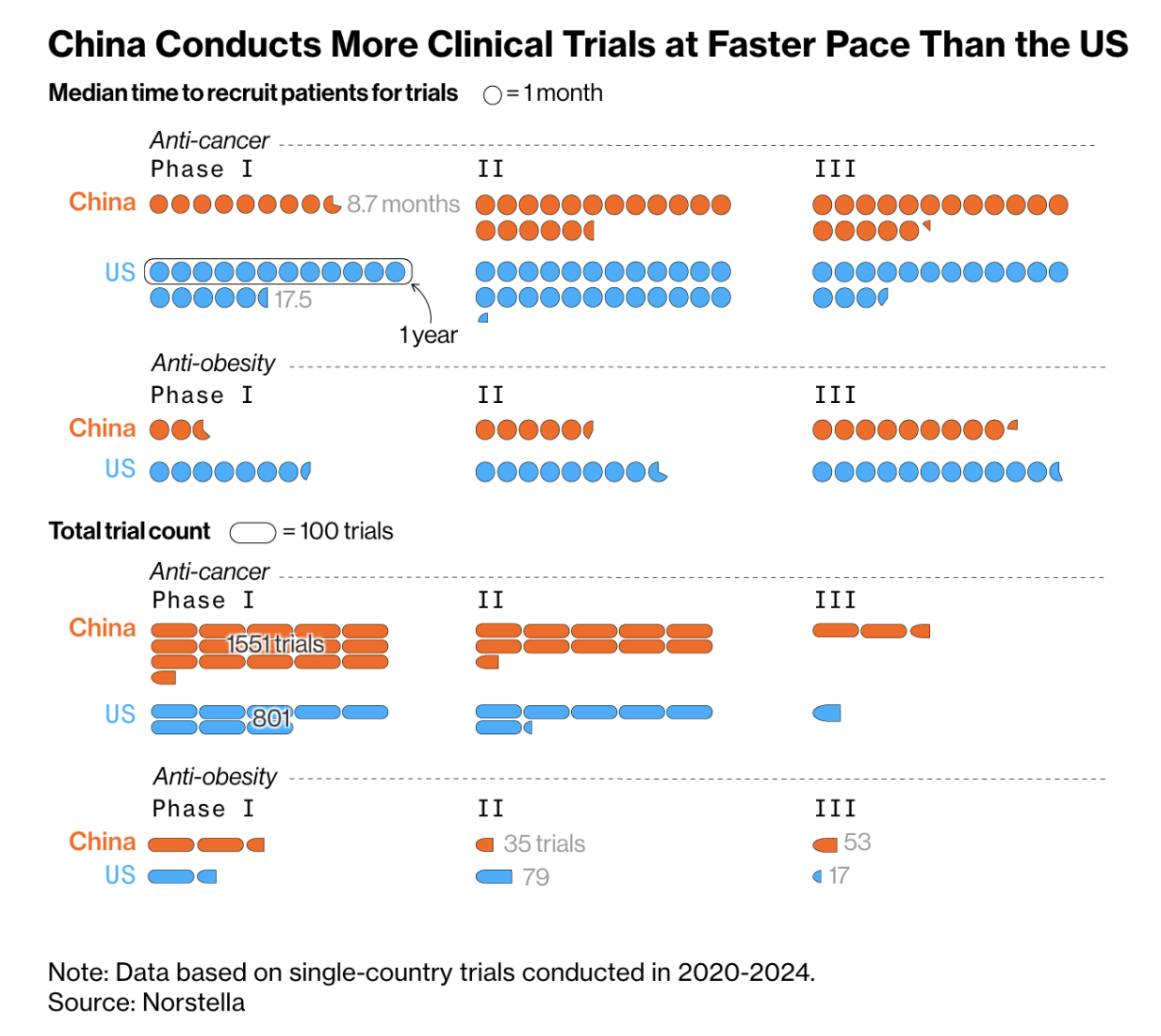
China’s advantage is that it can turn a large population into clinical data much faster—and iterate on feedback loops of drug development to produce assets that are more effective, and thus more valuable to investors and big pharma. Recently, Legend, a Chinese biotech, developed its own version of a largely American drug innovation that treats multiple myeloma, a type of aggressive blood cancer. Chinese drug developers moved quickly into human trials and produced data strong enough for Johnson & Johnson to sign a global licensing and codevelopment deal with Legend worth $350 million upfront.
A second- and third-order consequence of this new landscape is that even U.S. biotech firms may start asking whether it makes sense to take their drugs to China first, at least to complete phase 1 and phase 2 trials.
For now, any drug seeking approval in the U.S. still needs evidence that regulators believe applies to American patients—and in many cases that means later-stage global or Western trials. But it may be inevitable that a Chinese biotech develops a China-originated drug that was licensed into the west without such a step.
If this change happens—and many believe it will—the next major obesity, oncology, or immunology drug may come from China, marking the same pattern of ascendancy already visible in solar, batteries, and electric vehicles. Biotech may be next.—Ashwin Sharma
That’s all for this week! Be sure to follow Every on X at @every and on LinkedIn.
We build AI tools for readers like you. Write brilliantly with Spiral. Organize files automatically with Sparkle. Deliver yourself from email with Cora. Dictate effortlessly with Monologue. Work on documents with AI agents using Proof.
For sponsorship opportunities, reach out to [email protected].
The Only Subscription
You Need to
Stay at the
Edge of AI
The essential toolkit for those shaping the future

"This might be the best value you
can get from an AI subscription."
- Jay S.
 Every Content
 AI&I Podcast
 Monologue
 Every Agent
Join 100,000+ leaders, builders, and innovators

Already have an account? Sign in.
What is included in a subscription?
Daily insights from AI pioneers + early access to powerful AI tools



 Front-row access to the future of AI
 In-depth reviews of new models on release dayPlaybooks and guides for putting AI to workPrompts and use cases for buildersIn-depth reviews of new models on release dayPlaybooks and guides for putting AI to workPrompts and use cases for builders
 Bundle of AI software






 Katie Parrott
 Every Staff
 Kieran Klaassen
Comments