


Laura Entis is a staff writer at Every.

Opus 4.7 Reels Us Back In
Plus: The ‘Mini Shai-Hulud’ breach, a small step to eliminating AI-isms, and how we define ‘agent’
May 14, 2026 · 5 min readUpdated Jun 27, 2026

Was this newsletter forwarded to you? Sign up to get it in your inbox.
Vibe shift
Did Opus 4.7 get better?
If you’ve been following Dan Shipper’s posts lately, you know that a large portion of the Every team has been Codex-pilled. When GPT-5.5 arrived, Codex got so much faster and steadier at coding and knowledge work that many of us made the switch from Claude Code.
Recently, however, we’ve observed that Opus 4.7 seems sharper than our initial tests last month. It proactively suggested that Every engineer Paridhi Agarwal use multiple terminals to parallelize her work. “I’ve never seen it think about my setup like that!” she says.
When head of growth and known Codex convert Austin Tedesco fired up Opus 4.7 over the weekend for a creative writing project, he was surprised by how good the results were. Compared to Codex, which Austin says operates like an “AP fact checker,” Opus 4.7 was closer to a senior magazine editor. Dan agrees: “Codex feels fast but thin in terms of thinking.”
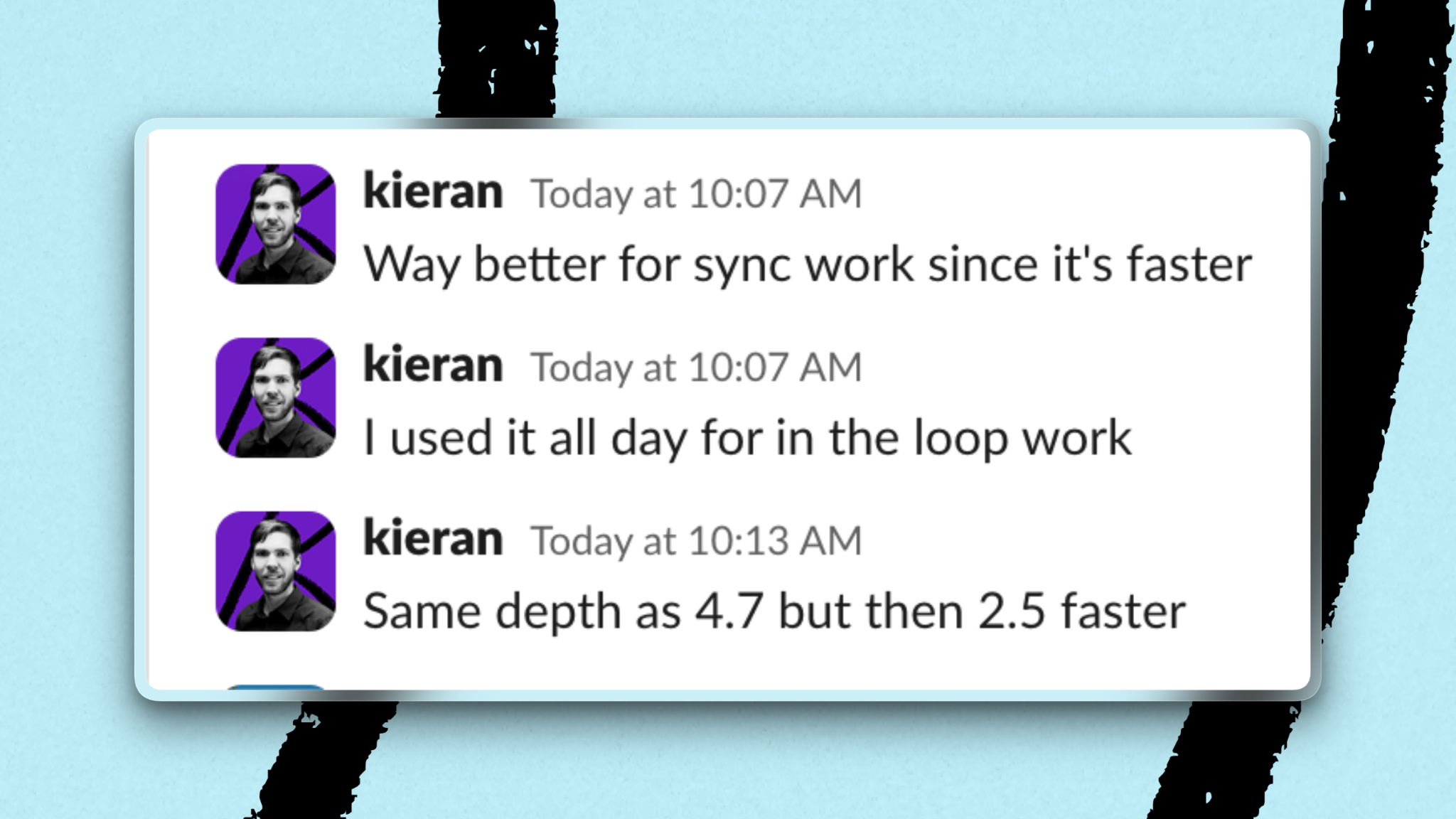
On Tuesday, Anthropic released fast mode for Opus 4.7, which makes the model 2.5 times faster at a higher token cost. Combined with the model’s edge at planning, multitasking, and creative projects, fast mode is now Cora general manager Kieran Klaassen’s default model for synchronous work.
Counterpoint
Online chatter about Opus 4.7’s apparent glow-up has been mixed. Does it feel smarter because of improvements to the harness? Patched bugs? Or are we getting better at using the model?
All fair hypotheses, but we found this one the most amusing: Opus 4.7 realizes that it’s the end of the school year.
When speaking last year on The Ezra Klein Show, Wharton professor and AI researcher Ethan Mollick explained that models have been shown to perform worse in December than in May, and the going theory is that the models internalize the idea of winter break.
Maybe Opus 4.7 just knows that it’s time to grind if it wants to pass AP English.
Signal
The pull request as a credential theft
Earlier this week, attackers published malicious versions of 42 official TanStack packages (a popular JavaScript toolkit used by web developers) on npm, the main public registry for such packages...
Become a paid subscriber to Every to unlock this piece and learn about:
- How attackers hijacked a popular JavaScript package without stealing a single password
- The workflow addition to Spiral that cut complaints of AI-sounding writing by 30 percent
- Why nearly everything is an agent now—and a better question to ask instead
 Create a free account to continue reading
The Only Subscription
You Need to
Stay at the
Edge of AI
The essential toolkit for those shaping the future

"This might be the best value you
can get from an AI subscription."
- Jay S.
 Every Content
 AI&I Podcast
 Monologue
 Every Agent
Join 100,000+ leaders, builders, and innovators

Already have an account? Sign in.
What is included in a subscription?
Daily insights from AI pioneers + early access to powerful AI tools


 Front-row access to the future of AI
 In-depth reviews of new models on release dayPlaybooks and guides for putting AI to workPrompts and use cases for buildersIn-depth reviews of new models on release dayPlaybooks and guides for putting AI to workPrompts and use cases for builders
 Bundle of AI software







 Katie Parrott
 Every Staff
 Kieran Klaassen
Comments