



From Doing to Tending
Plus: A mini-Vibe Check of Grok 4.5, and why AI scribes could dull doctors' judgment
Jul 12, 2026 · 7 min readUpdated Sep 7, 2026

Was this newsletter forwarded to you? Sign up to get it in your inbox.
Mini-Vibe Check: Grok 4.5 is fast, cheap, and finally useful
Almost a year ago, we vibe-checked Grok 4 and found a model that performed well on benchmarks but was not useful enough for our engineers to use every day. Our April Vibe Check of Cursor 3.0 found a promising but unfinished agent-orchestration product, but that verdict aged quickly: Kieran Klaassen was using Cursor daily by the end of the month, and by June Composer 2.5 was his main model for final polish. Then, in June, SpaceX signed an agreement to acquire Cursor, and a new candidate for the AI frontier space race was born.
Grok 4.5 is the first result of that collaboration. Cursor says it jointly trained the model with SpaceXAI using data from interactions with codebases and software tools.
When our team ran Grok 4.5 through the evals we use internally, the consensus was that it is an Opus-level model. Mike Taylor’s latest benchmark put it slightly above Claude Opus 4.8: Grok followed every step and returned a complete, polished result, while Opus stopped early or skipped parts of the assignment.
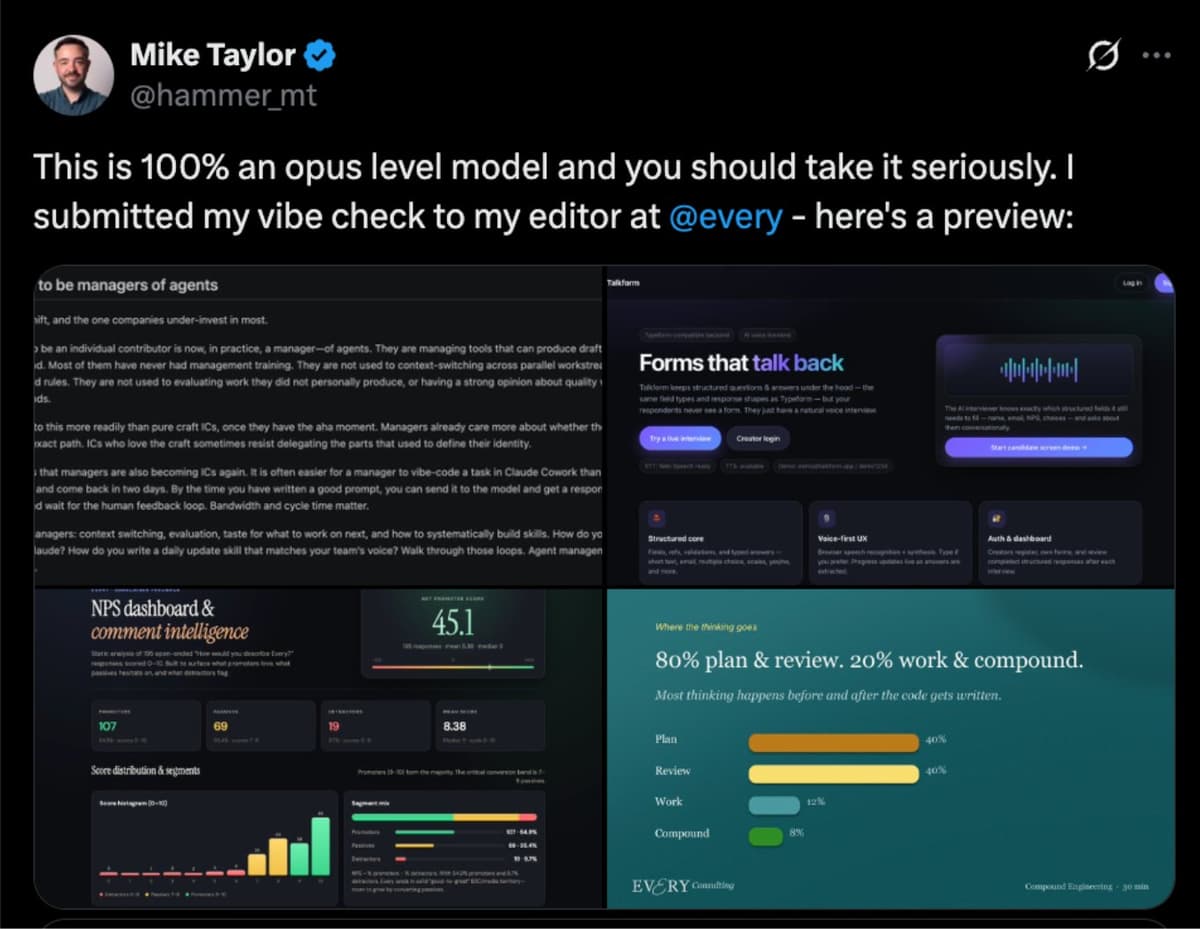
Kieran ran Grok 4.5 through /LFG, Every’s compound-engineering workflow for planning, building, reviewing, and improving a project. He put it around Claude’s Opus 4.5-to-4.6 range, calling it “not state of the art, but pretty good for a lot of things, and very fast.”
Grok’s biggest competitive advantage may be its impact on the bottom line: xAI says Grok 4.5 runs at roughly 80 tokens per second and about twice the token efficiency of leading models. At $2 per million input tokens and $6 per million output, it is also much cheaper than the frontier models Every compared it with: Claude Opus 4.8 costs $5 and $25, while GPT-5.6 Sol costs $5 and $30.
In our other tests, Grok held its own at vibe coding and generative user interaction, spinning up a working voice-interview form, a neighborhood map app, and a convincing clone of Mike’s writing style. Mike rated its PowerPoint-style slides around the level of Opus 4.6 or 4.7 and called the copy quality “pretty great,” singling out one headline Grok wrote on its own: “Forms that talk back.” The map app was not quite as sharp as work from the latest frontier models, and Mike still prefers Sol for writing. Grok avoids some of Claude’s familiar AI writing tics but has its own habit of producing short, sharp sentences.
You probably do not need to swap out your daily driver. But if you already work in Cursor, Grok 4.5 is right there, and it has earned a slot for long, multi-step assignments where speed, price, and follow-through count more than the last few points of quality.—Katie Parrott
Knowledge base
“GPT-5.6 Sol Is Our Favorite Model to Collaborate With” by Katie Parrott/Vibe Check: Tested across coding, writing, research, spreadsheets, and agents, Open AI’s GPT-5.6 Sol is the model most of the Every team wants open all day—fast, resourceful, easy to steer, quick to find files, hold context, and turn out another pass while the decision is still fresh. Fable still gets the biggest, loosest assignments, but Sol runs everything else. Read this for the clearest guidance yet on which model should get which job.
“How GPT-5.6 Changes Knowledge Work” by Dan Shipper/Chain of Thought: We open-sourced Tend, a free, open-source prompt and repository for building loops that run your knowledge work; it gathers information, proposes decisions, and carries out the ones you approve while you make the key calls. Tend is a direct reflection of Dan’s argument that GPT-5.6 is the first model able to run a whole loop of knowledge work on its own—so you tend the loop instead of doing the work yourself. Grab the prompt and build your own loop at every.to/tend.
“Use Fable Before You Know What to Ask” by Katie Parrott/Context Window: Fable earns its premium on the jobs where you don’t yet know the right question, where the goal or standard itself is still unsettled. Mike handed it his finished book manuscript to catch what he’d missed, and Dan Shipper spent five weeks on copy-editing experiments before Fable told him the goal he’d been chasing was wrong all along. Also inside: Head of social media Becky Isjwara has Fable write a reusable manual so a cheaper model can clip her livestreams, and product leader Trevin Chow’s /ce-pov skill makes an AI weigh a new tool against your own codebase instead of judging it in the abstract.
“Welcome to Efficiencymaxxing” by Laura Entis/Context Window: AI’s cheap-novelty era is over: As models grow token-hungry and the labs pull back subsidies, people are done bragging about how many tokens they burn (tokenmaxxing) and starting to compete on what they get for them (efficiencymaxxing). Also inside: Monologue general manager Naveen Naidu on “revenue per million tokens,” the metric making the rounds at Apple’s WWDC as a successor to revenue per employee, and Spiral general manager Marcus Moretti on using OpenRouter to run a stack of cheaper models for the jobs that don’t need a frontier one.
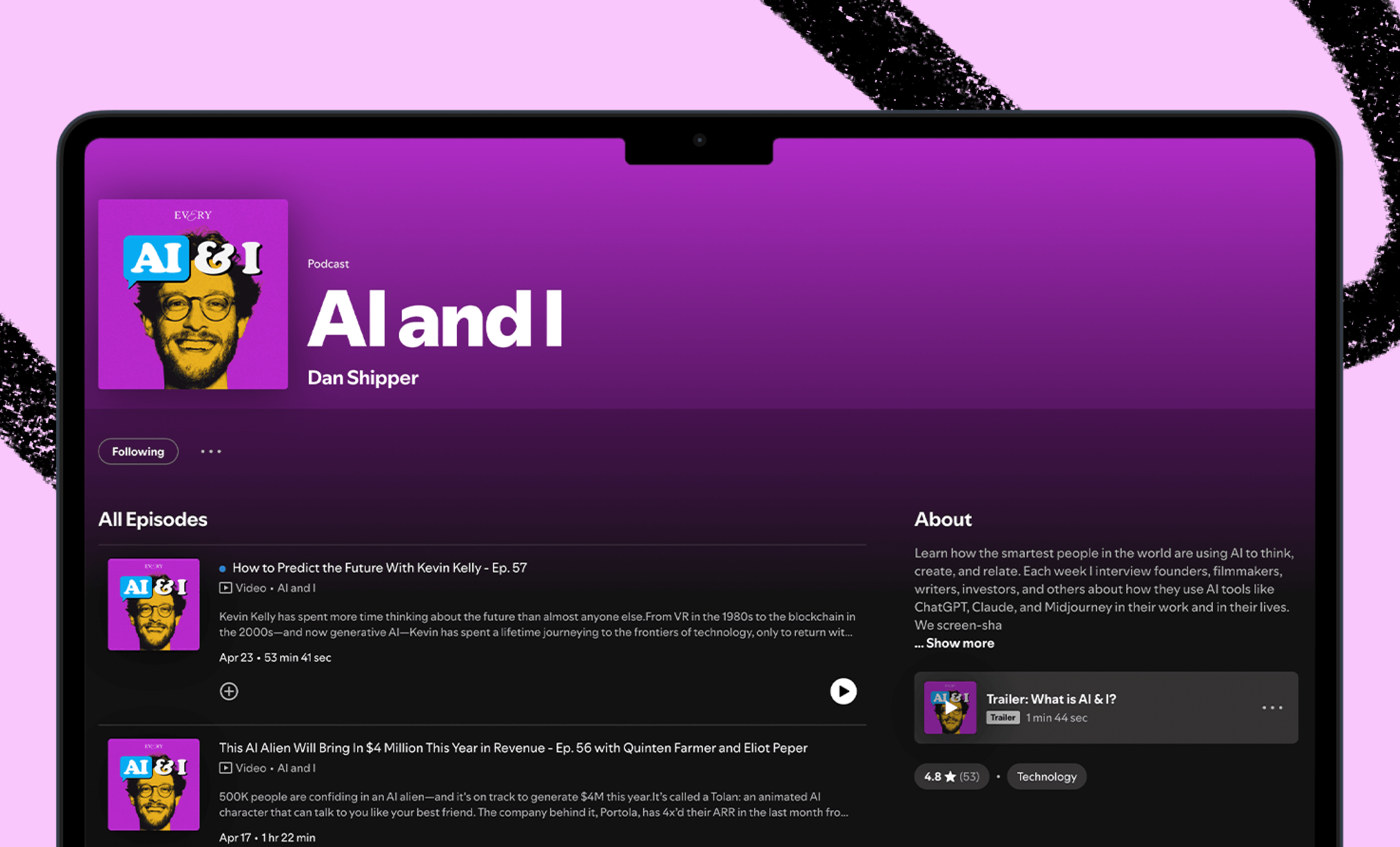
🎧 🖥 “How a Writer Uses AI Without Losing His Voice” by Dan Shipper/AI & I: Writer and technologist Craig Mod joined Dan to explain why cheap software creation has made him more protective of his writing: He says it “puts a higher premium on intent.” He vibe codes replacements for SaaS tools with Opus and Fable, and writes every word himself—keeping a WiFi-free MacBook for the job—because “being in the mess of writing” is the point. Watch or listen to this for a working line between where AI belongs in a creative practice and where it doesn’t. 🎧 🖥 Listen on Spotify or Apple Podcasts, watch on YouTube, or follow the discussion on X.
Log on
Get hands-on with how Every uses AI. These are the live camps, workshops, and meetups where team members teach the workflows behind our work.
Upcoming event
- Every IRL (July 15): An in-person meetup at Every’s Brooklyn headquarters, paid subscribers only, from 6-8 p.m. ET. RSVP.
From Every Studio
Monologue puts your notes on the web
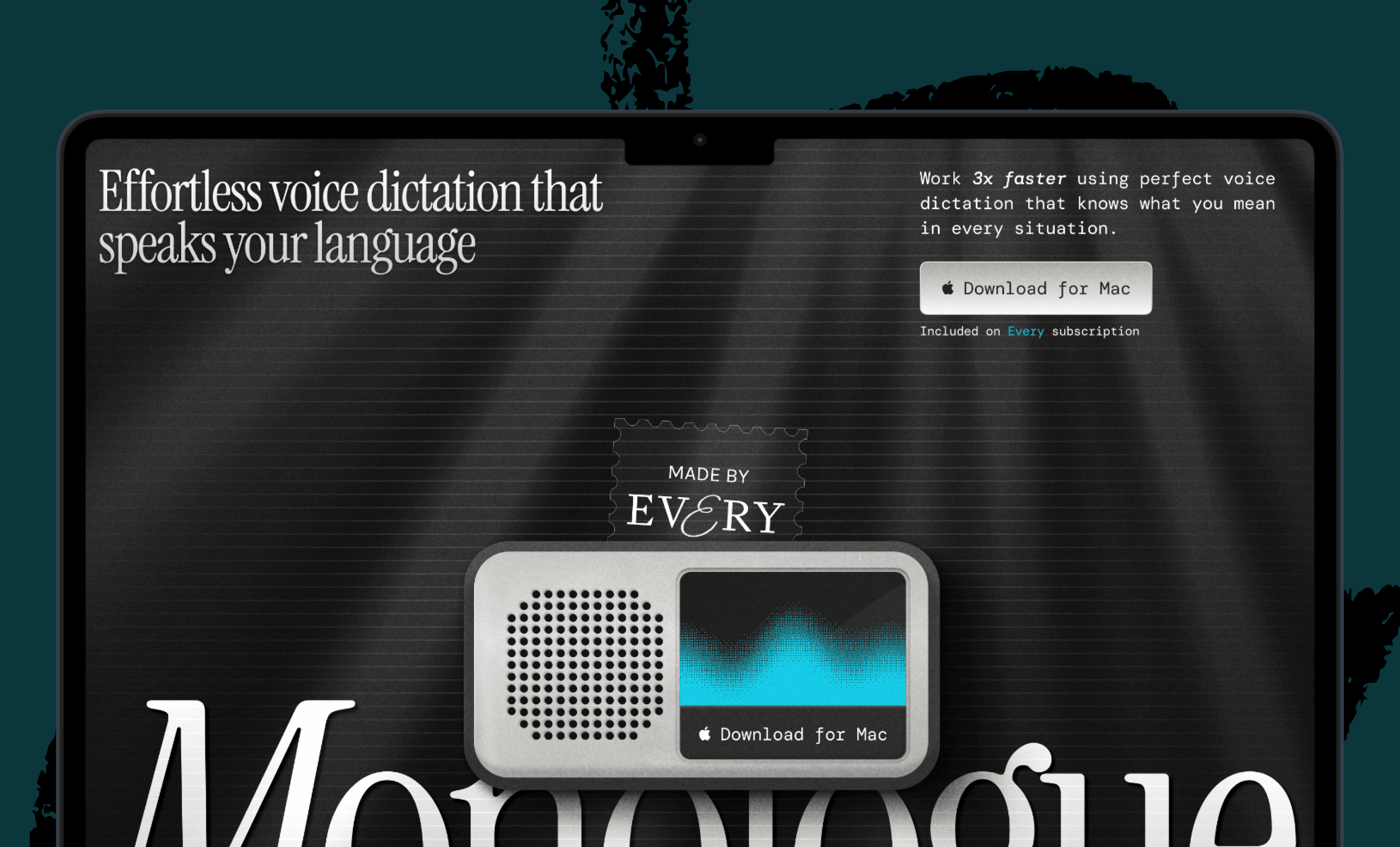
Monologue, Every’s voice dictation app, now keeps your notes on the web and lets you edit them: open any note in a browser at app.monologue.to—from Windows, Android, or your phone, not just the Mac app—to rename it, retag it, regenerate its summary, or name the speakers. You can also wire a webhook so a finished note triggers your other tools.
Alignment
Manual flying. About five years ago, as a young resident doctor on a cardiology ward, I got an almighty bollocking from an attending who savaged the history I had written in a patient’s notes. In my defense, I wrote it on my third night shift, held together by an ungodly amount of caffeine and adrenaline.
At the time, I would have killed for an AI scribe. But Dr. Helen Ouyang, an associate professor of emergency medicine, argued in a recent New York Times essay that writing is an integral part of the clinical reasoning process—it forces you to recall information and synthesize the key points that lead to a decision. The danger of using AI scribes, she argues, is cognitive off-loading: the muscle that allows them to reason through a case and arrive at sound clinical judgment on their own.
Aviation has learned this the hard way. Autopilot is an extraordinary development—it makes flight safer and less exhausting. But when automation handles most of the routine work, pilots can be dangerously reliant on it, their manual flying skills atrophying. The solution was mandated simulation training so pilots stay sharp for the moments when the system fails or hands control back.
Medicine will follow the same arc. First, we’ll automate too much—because it reduces burnout and documentation misery. Then we’ll panic about skill loss. Eventually, I hope, we’ll land somewhere sensible: AI scribes for routine cases, manual reps and simulation mandated for students, young doctors, and anything complex.
I missed the AI scribe era by a few years and have since moved into health tech. But I know exactly what the younger version of me would have done after that bollocking. He would’ve still turned the thing on.—Ashwin Sharma
That’s all for this week! Be sure to follow Every on X at @every and on LinkedIn.
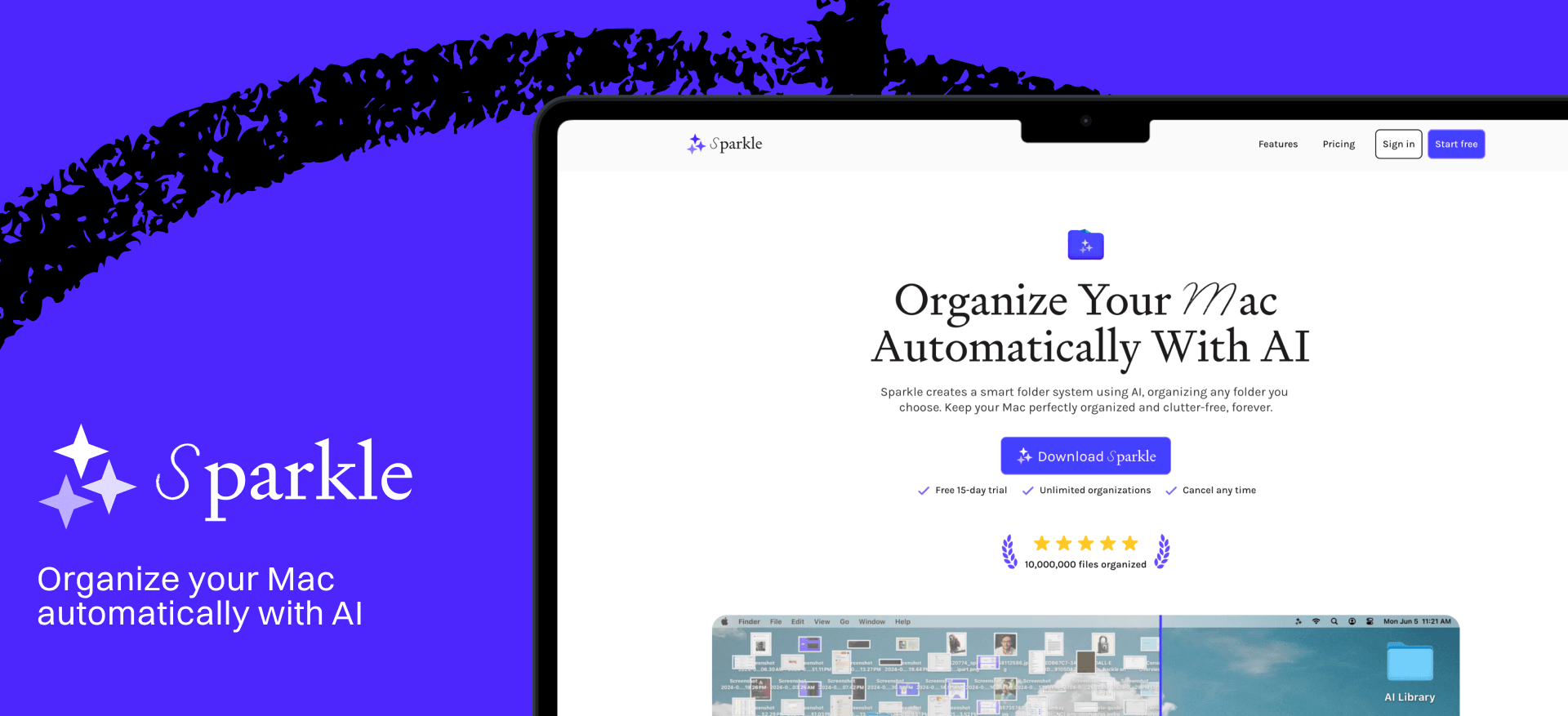
We build AI tools for readers like you. Write brilliantly with Spiral. Organize files automatically with Sparkle. Deliver yourself from email with Cora. Dictate effortlessly with Monologue. Work on documents with AI agents using Proof.
For sponsorship opportunities, reach out to [email protected].
The Only Subscription
You Need to
Stay at the
Edge of AI
The essential toolkit for those shaping the future

"This might be the best value you
can get from an AI subscription."
- Jay S.
 Every Content
 AI&I Podcast
 Monologue
 Every Agent
Join 100,000+ leaders, builders, and innovators

Already have an account? Sign in.
What is included in a subscription?
Daily insights from AI pioneers + early access to powerful AI tools

 Front-row access to the future of AI
 In-depth reviews of new models on release dayPlaybooks and guides for putting AI to workPrompts and use cases for buildersIn-depth reviews of new models on release dayPlaybooks and guides for putting AI to workPrompts and use cases for builders
 Bundle of AI software





 Katie Parrott
 Every Staff
 Kieran Klaassen
Comments